Przkora Rene, Sibille Kimberly, Victor Sandra, Meroney Matthew, Leeuwenburgh Christiaan, Gardner Anna, Vasilopoulos Terrie, Parvataneni Hari K
Department of Anesthesiology, University of Florida College of Medicine, Gainesville, Florida.
Department of Anesthesiology, University of Florida College of Medicine, Gainesville, Florida; Department of Aging and Geriatric Research, University of Florida College of Medicine, Gainesville, Florida.
Eur J Transl Myol. 2021 Apr 7;31(2):9673. doi: 10.4081/ejtm.2021.9673.
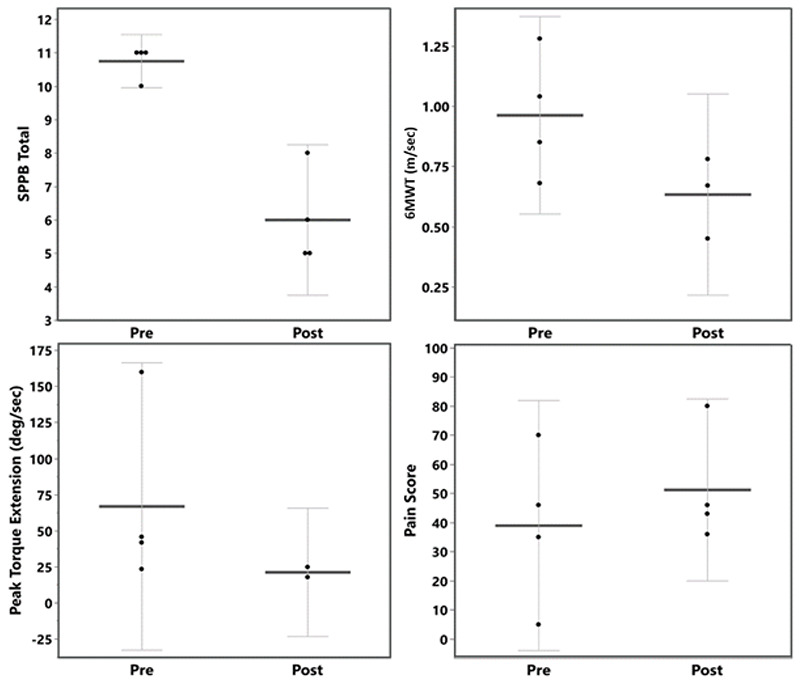
Measurements of physical function after total knee arthroplasty (TKA) are uncertain and require investments for special equipment, space, and staff. Therefore, we evaluated the Short Physical Performance Battery (SPPB) 4 to 6 weeks preoperatively and 2 weeks following TKA as this test battery addresses lower extremity strength, coordination, and balance, without additional special investments. For context, we also employed the Six-Minute Walk test (6MWT) and peak torque knee extension. Our analysis consisted of three women and one man, with average ages of 68.3±3.9 years. Patients showed a decrease in all functional measurements: SPPB (mean change: -4.8±1.9, 44% decrease), 6MWT (-0.37±.21 m/s, 34% decrease), and peak torque (-11.8±8.8°/s, 68% decrease). Our findings suggest the SPPB is feasible and can be integrated easily in daily clinical practice.
全膝关节置换术(TKA)后身体功能的测量结果并不确定,且需要在特殊设备、空间和人员方面进行投入。因此,我们在术前4至6周以及TKA术后2周对简易体能状况量表(SPPB)进行了评估,因为该测试组合涉及下肢力量、协调性和平衡能力,无需额外的特殊投入。为作对比,我们还采用了六分钟步行试验(6MWT)和膝关节伸展峰值扭矩测试。我们的分析涉及三名女性和一名男性,平均年龄为68.3±3.9岁。患者在所有功能测量指标上均出现下降:SPPB(平均变化:-4.8±1.9,下降44%)、6MWT(-0.37±.21米/秒,下降34%)以及峰值扭矩(-11.8±8.8°/秒,下降68%)。我们的研究结果表明,SPPB是可行的,并且可以轻松地融入日常临床实践。