Gonzálvez Carolina, Díaz-Herrero Ángela, Vicent María, Sanmartín Ricardo, Fernández-Sogorb Aitana, Ruiz-Esteban Cecilia
Department of Development Psychology and Teaching, University of Alicante, Alicante, Spain.
Department of Development Psychology and Education, University of Murcia, Murcia, Spain.
Front Psychol. 2021 Mar 25;12:666218. doi: 10.3389/fpsyg.2021.666218. eCollection 2021.
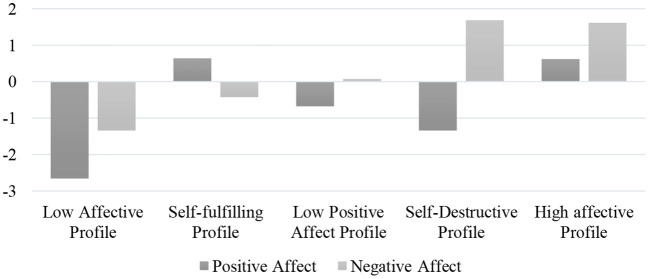
Little has been studied on the relationship between affect and school problems related with attendance. This study aims to identify different affective profiles and to determine whether these profiles differ from each other based on the four functional conditions of school refusal behavior. Participants comprised 1,816 Spanish adolescents aged 15-18 years ( = 16.39; = 1.05). The Positive and Negative Affect Schedule for Children-Short Form and the School Refusal Assessment Scale-Revised for Children (SRAS-R-C) were administered. Latent profile analysis revealed five affective profiles: low affective profile, self-fulfilling profile, low positive affect profile, self-destructive profile, and high affective profile. The self-destructive profile revealed the highest average scores in the first three factors of the SRAS-R-C, whereas the high affective profile reached the highest average score in the fourth factor. On the contrary, the self-fulfilling profile obtained the lowest average scores in the first two factors of the SRAS-R-C, whereas the low affective profile revealed the lowest average scores in the last two factors. Findings suggest the relevance of developing more adaptative affective profiles, such as the self-fulfilling profile, which would contribute to diminishing school attendance problems.
关于情感与与出勤相关的学校问题之间的关系,目前研究较少。本研究旨在识别不同的情感特征,并根据学校拒绝行为的四种功能状况确定这些特征是否彼此不同。参与者包括1816名15 - 18岁的西班牙青少年(平均年龄 = 16.39岁;标准差 = 1.05)。使用了儿童正负情感量表简版和儿童学校拒绝评估量表修订版(SRAS - R - C)。潜在特征分析揭示了五种情感特征:低情感特征、自我实现特征、低积极情感特征、自我毁灭特征和高情感特征。自我毁灭特征在SRAS - R - C的前三个因子中显示出最高平均分,而高情感特征在第四个因子中达到最高平均分。相反,自我实现特征在SRAS - R - C的前两个因子中获得最低平均分,而低情感特征在后两个因子中显示出最低平均分。研究结果表明培养更具适应性的情感特征(如自我实现特征)的重要性,这将有助于减少出勤问题。