Systems Medicine, German Center for Neurodegenerative Diseases (DZNE), Bonn, Germany.
Genomics & Immunoregulation, Life & Medical Sciences (LIMES) Institute, University of Bonn, Bonn, Germany.
Front Immunol. 2021 Mar 25;12:652470. doi: 10.3389/fimmu.2021.652470. eCollection 2021.
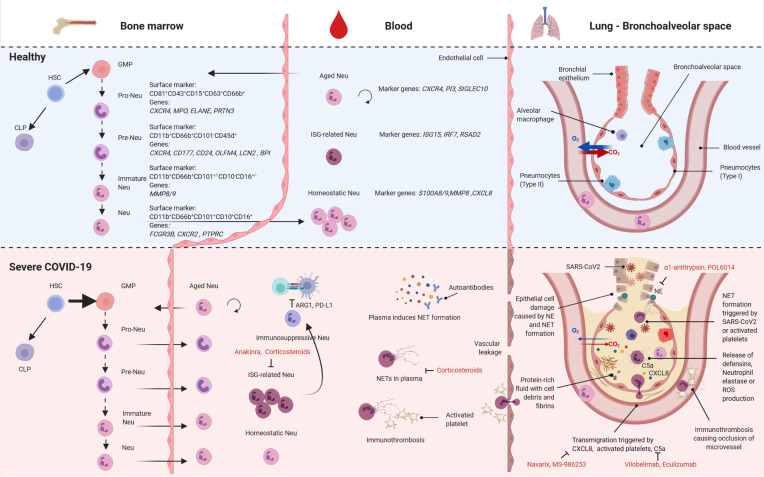
Strong evidence has been accumulated since the beginning of the COVID-19 pandemic that neutrophils play an important role in the pathophysiology, particularly in those with severe disease courses. While originally considered to be a rather homogeneous cell type, recent attention to neutrophils has uncovered their fascinating transcriptional and functional diversity as well as their developmental trajectories. These new findings are important to better understand the many facets of neutrophil involvement not only in COVID-19 but also many other acute or chronic inflammatory diseases, both communicable and non-communicable. Here, we highlight the observed immune deviation of neutrophils in COVID-19 and summarize several promising therapeutic attempts to precisely target neutrophils and their reactivity in patients with COVID-19.
自 COVID-19 大流行开始以来,已经积累了大量证据表明中性粒细胞在病理生理学中发挥着重要作用,特别是在那些病情严重的患者中。虽然最初被认为是一种相当同质的细胞类型,但最近对中性粒细胞的关注揭示了它们令人着迷的转录和功能多样性,以及它们的发育轨迹。这些新发现对于更好地理解中性粒细胞在 COVID-19 以及许多其他急性或慢性炎症性疾病中的参与的多个方面非常重要,这些疾病既有传染性的也有无传染性的。在这里,我们强调了 COVID-19 中观察到的中性粒细胞免疫偏差,并总结了几种有前途的治疗尝试,以精确靶向 COVID-19 患者的中性粒细胞及其反应性。