Telles Rafael, Cunha Ronaldo Alves, Yoshimura André Lima, Pochini Alberto Castro, Ejnisman Benno, Soliaman Renato Rozenblit
Federal University of São Paulo.
Int J Sports Phys Ther. 2021 Apr 1;16(2):496-503. doi: 10.26603/001c.21243.
Throwing athletes present alterations in shoulder rotation range of motion (ROM), but not much is known about the relationship between these alterations and performance measurements in volleyball practitioners.
To compare the passive ranges of motion of internal rotation (IR), external rotation (ER), and total rotation motion (TRM) of the shoulder in dominant and nondominant limbs of young volleyball athletes and to investigate their relationship with ball speed during serves with and without precision (inside and outside court, respectively). The possible association of anthropometrics and competitive practice time with these velocities was also investigated.
Cross-sectional study.
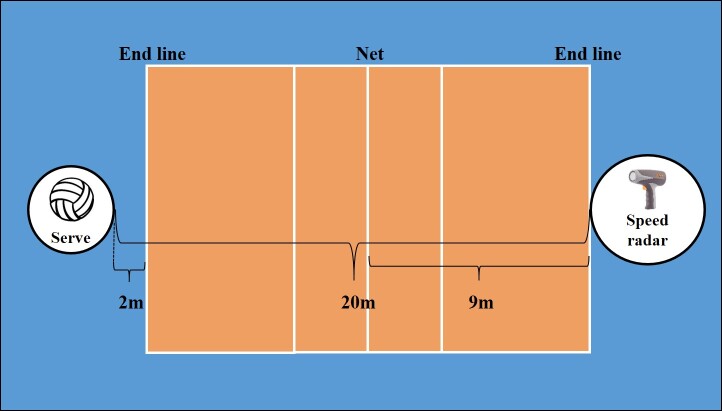
Fifty-seven male volleyball athletes (mean age 17.11 ± 1.88 y; weight 74.68 ± 9.7 kg; height 1.87 ± 0.09 cm) were evaluated for shoulder IR and ER with a bubble goniometer and serve speed inside and outside court was measured with a radar gun. Simple and multiple regression analyses were applied to investigate associations of ROM, anthropometrics, and competitive practice time with serve speed.
Dominant shoulders had diminished IR ROM compared to nondominant shoulders (59.1º ± 16.7º vs 66.4º ± 16.9º; < 0.001) as well as diminished TRM (173.5º ± 31.8º vs 179.1º ± 29.9º; < 0.001). Simple regression showed negative association between dominant ER and serve speed outside the court ( = 0.004). Positive associations existed between age and serve speed in both conditions ( < 0.001), BMI and speed inside ( = 0.009) and outside the court ( = 0.008), and between competitive practice time and speed inside ( = 0.008) and outside court ( = 0.003). However, multiple analysis confirmed only age ( < 0.001) and BMI to be associated with ball velocities (inside court = 0.034; outside court = 0.031).
The results of this study demonstrated that young volleyball athletes presented lower IR and TRM of the shoulder in the dominant upper limb. Age and BMI were directly associated with ball velocities when serving. Passive rotation ROM did not have a relationship with this performance measurement.
3b.
投掷运动员的肩部旋转运动范围(ROM)会出现改变,但对于排球运动员这些改变与运动表现指标之间的关系,人们了解得并不多。
比较年轻排球运动员优势侧和非优势侧肩部的内旋(IR)、外旋(ER)及总旋转运动(TRM)的被动运动范围,并研究其与精准发球(分别为场内和场外)时球速的关系。还研究了人体测量学指标和竞技训练时间与这些球速之间可能存在的关联。
横断面研究。
对57名男性排球运动员(平均年龄17.11±1.88岁;体重74.68±9.7千克;身高1.87±0.09厘米)使用气泡式角度计评估肩部IR和ER,并使用雷达测速仪测量场内和场外的发球速度。应用简单和多元回归分析来研究ROM、人体测量学指标和竞技训练时间与发球速度之间的关联。
与非优势侧肩部相比,优势侧肩部的IR ROM减小(59.1°±16.7°对66.4°±16.9°;P<0.001),TRM也减小(173.5°±31.8°对179.1°±29.9°;P<0.001)。简单回归显示优势侧ER与场外发球速度呈负相关(P = 0.004)。在两种情况下,年龄与发球速度均呈正相关(P<0.001),BMI与场内(P = 0.009)和场外(P = 0.008)发球速度呈正相关,竞技训练时间与场内(P = 0.008)和场外(P = 0.003)发球速度呈正相关。然而,多元分析仅证实年龄(P<0.001)和BMI与球速有关(场内P = 0.034;场外P = 0.031)。
本研究结果表明,年轻排球运动员优势上肢的肩部IR和TRM较低。年龄和BMI与发球时的球速直接相关。被动旋转ROM与该运动表现指标无关。
3b。