Lee An Jun, Lim Joo Weon, Kim Hyeyoung
Department of Food and Nutrition, BK 21 FOUR, College of Human Ecology, Yonsei University, Seoul, Korea.
J Cancer Prev. 2021 Mar 30;26(1):64-70. doi: 10.15430/JCP.2021.26.1.64.
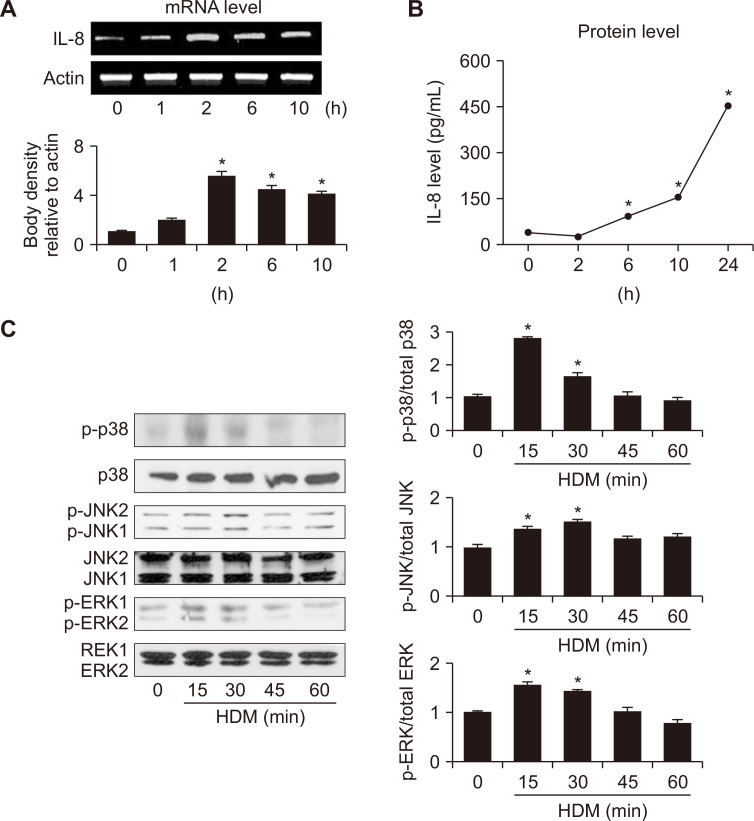
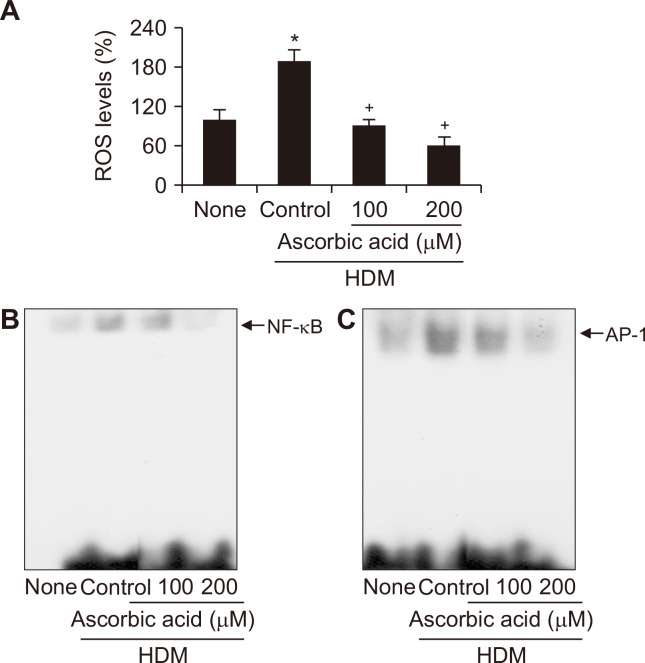
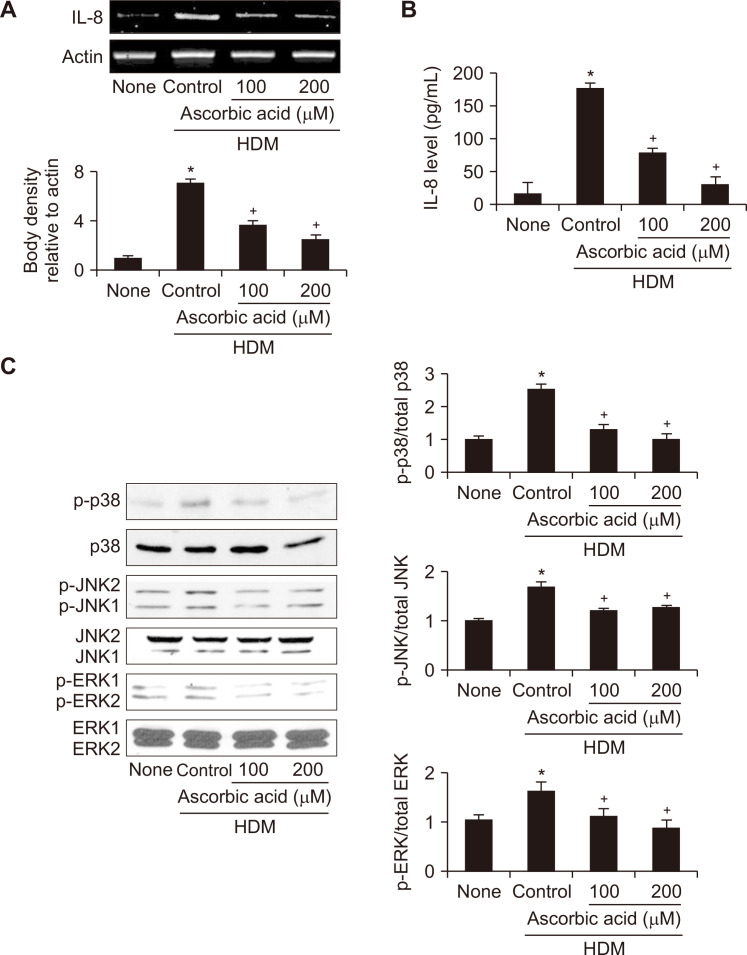
House dust mite (HDM) is one of the significant causes for airway inflammation such as asthma. It induces oxidative stress and an inflammatory response in the lungs through the release of chemokines such as interleukin-8 (IL-8). Reactive oxygen species (ROS) activate inflammatory signaling mediators such as mitogen-activated protein kinases (MAPKs) and redox-sensitive transcription factors including NF-κB and AP-1. Ascorbic acid shows an antioxidant and anti-inflammatory activities in various cells. It ameliorated the symptoms of HDM-induced rhinitis. The present study was aimed to investigate whether HDM could induce IL-8 expression through activation of MAPKs, NF-κB, and AP-1 and whether ascorbic acid could inhibit HDM-stimulated IL-8 expression by reducing ROS and suppressing activation of MAPKs, NF-κB, and AP-1 in respiratory epithelial H292 cells. H292 cells were treated with HDM (5 μg/mL) in the absence or presence of ascorbic acid (100 or 200 μM). HDM treatment increased ROS levels, and activated MAPKs, NF-κB, and AP-1 and thus, induced IL-8 expression in H292 cells. Ascorbic acid reduced ROS levels and inhibited activation of MAPKs, NF-κB and AP-1 and L-8 expression in H292 cells. In conclusion, consumption of ascorbic acid-rich foods may be beneficial for prevention of HDM-mediated respiratory inflammation by suppressing oxidative stress-mediated MAPK signaling pathways and activation of NF-kB and AP-1.
屋尘螨(HDM)是哮喘等气道炎症的重要病因之一。它通过释放白细胞介素-8(IL-8)等趋化因子在肺部诱导氧化应激和炎症反应。活性氧(ROS)激活丝裂原活化蛋白激酶(MAPK)等炎症信号介质以及包括核因子κB(NF-κB)和活化蛋白-1(AP-1)在内的氧化还原敏感转录因子。抗坏血酸在各种细胞中表现出抗氧化和抗炎活性。它改善了HDM诱导的鼻炎症状。本研究旨在探讨HDM是否能通过激活MAPK、NF-κB和AP-1诱导IL-8表达,以及抗坏血酸是否能通过降低ROS并抑制呼吸道上皮H292细胞中MAPK、NF-κB和AP-1的激活来抑制HDM刺激的IL-8表达。在不存在或存在抗坏血酸(100或200μM)的情况下,用HDM(5μg/mL)处理H292细胞。HDM处理增加了ROS水平,激活了MAPK、NF-κB和AP-1,从而在H292细胞中诱导了IL-8表达。抗坏血酸降低了ROS水平,抑制了H292细胞中MAPK、NF-κB和AP-1的激活以及IL-8表达。总之,食用富含抗坏血酸的食物可能通过抑制氧化应激介导的MAPK信号通路以及NF-κB和AP-1的激活,对预防HDM介导的呼吸道炎症有益。