Ren Xuan, Vilhjálmsdóttir Birgitta Lind, Rohde Jeanett Friis, Walker Karen Christina, Runstedt Suzanne Elizabeth, Lauritzen Lotte, Heitmann Berit Lilienthal, Specht Ina Olmer
Research Unit for Dietary Studies at the Parker Institute, Bispebjerg and Frederiksberg Hospital, Copenhagen University Hospital, Copenhagen, Denmark.
Department of Nutrition, Exercise and Sports, Paediatric and International Nutrition, University of Copenhagen, Copenhagen, Denmark.
Front Nutr. 2021 Mar 25;8:625596. doi: 10.3389/fnut.2021.625596. eCollection 2021.
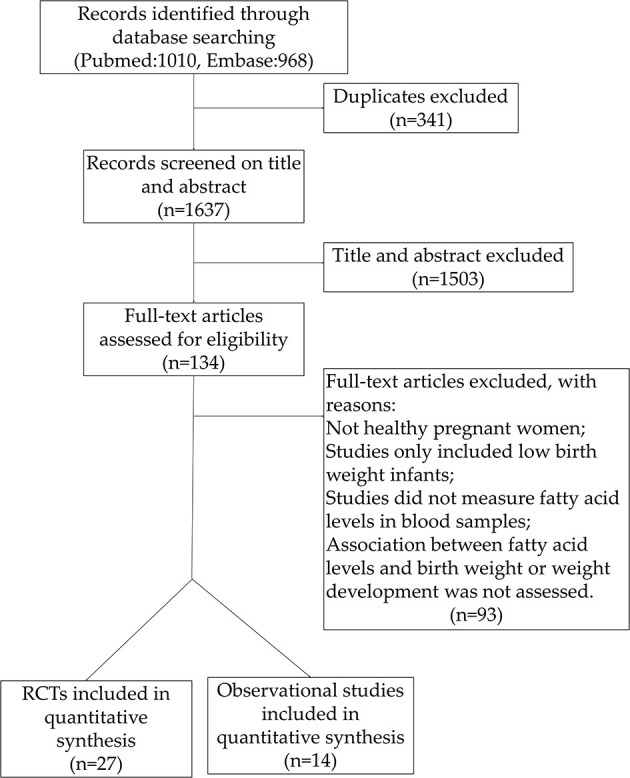
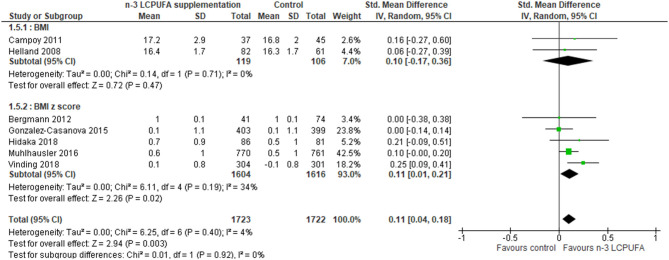
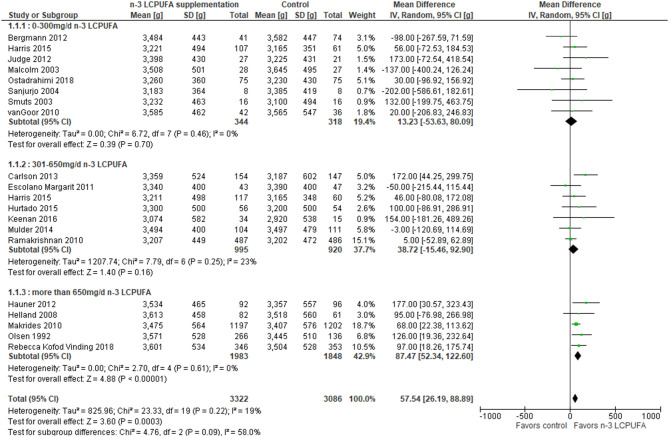
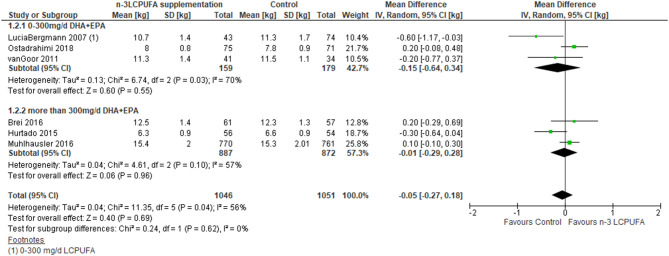
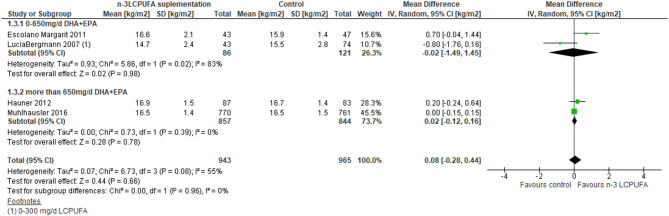
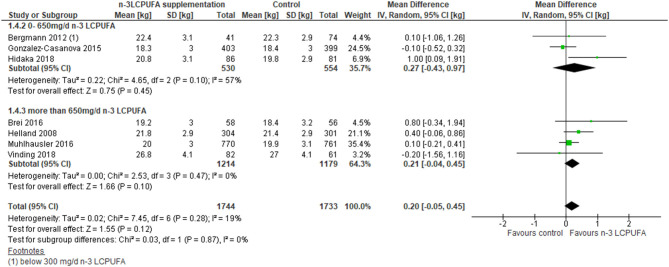
Eicosapentaenoic acid (EPA), docosahexaenoic acid (DHA), and trans fatty acids (TFAs) may have an impact on offspring weight development. We conducted a systematic review and meta-analysis according to PRISMA guidelines to evaluate whether levels of these fatty acids during pregnancy influenced offspring weight development. Randomized controlled trials (RCTs) with DHA and/or EPA supplementation or cohort studies, which examined levels of DHA, EPA, or TFAs in maternal or neonatal blood samples and recorded offspring weight, were included. Overall, 27 RCTs and 14 observational studies were identified. The results showed that DHA and/or EPA supplementation doses >650 mg/day resulted in slightly higher birth weight (MD 87.5 g, 95% CI 52.3-122.6, = 3,831) and combined BMI and BMI score at 5-10 years (SMD 0.11, 95% CI 0.04-0.18, = 3,220). These results were rated as moderate quality. Results from the observational studies were generally inconsistent. High TFA levels during pregnancy seemed to be associated with lower birth weight. Finally, this review and meta-analysis supports a relationship between high maternal or neonatal DHA and/or EPA levels and higher offspring birth weight and weight in childhood. More high-quality long-term studies are still needed.
二十碳五烯酸(EPA)、二十二碳六烯酸(DHA)和反式脂肪酸(TFA)可能会对后代体重发育产生影响。我们根据PRISMA指南进行了一项系统评价和荟萃分析,以评估孕期这些脂肪酸水平是否会影响后代体重发育。纳入了补充DHA和/或EPA的随机对照试验(RCT)或队列研究,这些研究检测了母体或新生儿血样中DHA、EPA或TFA的水平,并记录了后代体重。总体而言,共识别出27项RCT和14项观察性研究。结果显示,每日补充DHA和/或EPA剂量>650 mg会使出生体重略高(MD 87.5 g,95%CI 52.3 - 122.6,n = 3831),且5至10岁时的BMI综合指数和BMI评分也更高(SMD 0.11,95%CI 0.04 - 0.18,n = 3220)。这些结果被评定为中等质量。观察性研究的结果总体上不一致。孕期高TFA水平似乎与较低的出生体重有关。最后,本综述和荟萃分析支持母体或新生儿高DHA和/或EPA水平与后代较高出生体重及儿童期体重之间存在关联。仍需要更多高质量的长期研究。