ADR Monitoring Department, Henan Medical Products Administration & Center for ADR Monitoring of Henan, Zhengzhou, China.
Zhengzhou University Affiliated Cancer Hospital, Zhengzhou, China.
Diabetes Metab J. 2021 Sep;45(5):708-718. doi: 10.4093/dmj.2020.0117. Epub 2021 Apr 13.
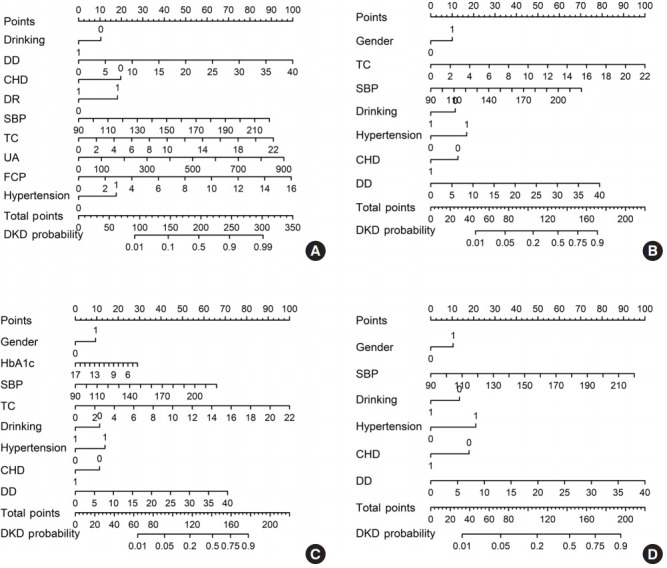
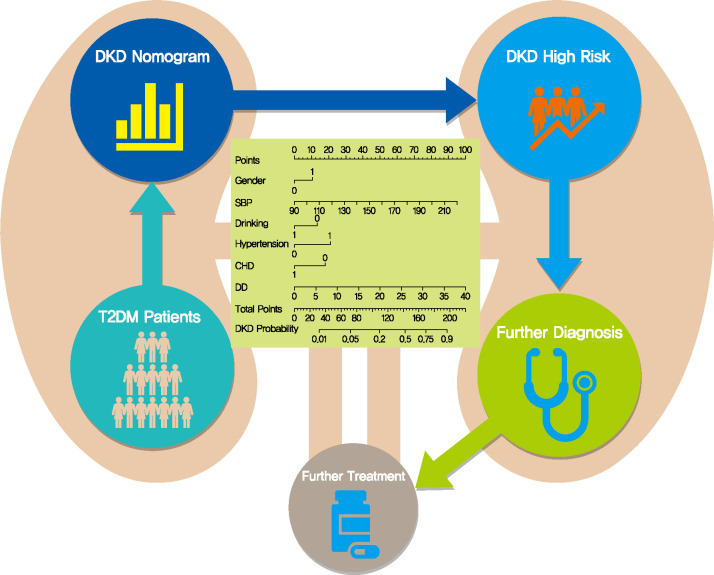
The influencing factors of diabetic kidney disease (DKD) in Chinese patients with type 2 diabetes mellitus (T2DM) were explored to develop and validate a DKD diagnostic tool based on nomogram approach for patients with T2DM.
A total of 2,163 in-hospital patients with diabetes diagnosed from March 2015 to March 2017 were enrolled. Specified logistic regression models were used to screen the factors and establish four different diagnostic tools based on nomogram according to the final included variables. Discrimination and calibration were used to assess the performance of screening tools.
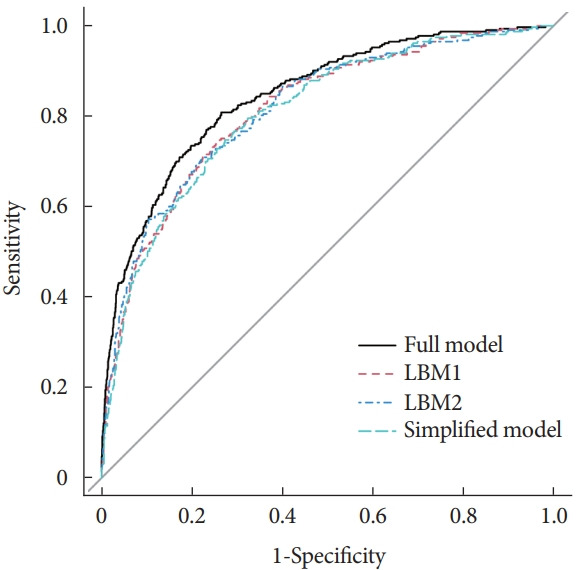
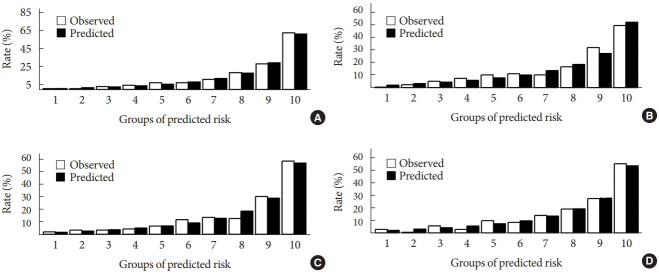
Among the 2,163 participants with diabetes (1,227 men and 949 women), 313 patients (194 men and 120 women) were diagnosed with DKD. Four different screening equations (full model, laboratory-based model 1 [LBM1], laboratory-based model 2 [LBM2], and simplified model) showed good discriminations and calibrations. The C-indexes were 0.8450 (95% confidence interval [CI], 0.8202 to 0.8690) for full model, 0.8149 (95% CI, 0.7892 to 0.8405) for LBM1, 0.8171 (95% CI, 0.7912 to 0.8430) for LBM2, and 0.8083 (95% CI, 0.7824 to 0.8342) for simplified model. According to Hosmer-Lemeshow goodness-of-fit test, good agreement between the predicted and observed DKD events in patients with diabetes was observed for full model (χ2=3.2756, P=0.9159), LBM1 (χ2=7.749, P=0.4584), LBM2 (χ2=10.023, P=0.2634), and simplified model (χ2=12.294, P=0.1387).
LBM1, LBM2, and simplified model exhibited excellent predictive performance and availability and could be recommended for screening DKD cases among Chinese patients with diabetes.
本研究旨在探讨中国 2 型糖尿病(T2DM)患者糖尿病肾病(DKD)的影响因素,为基于列线图的 T2DM 患者 DKD 诊断工具的建立和验证提供依据。
本研究共纳入 2015 年 3 月至 2017 年 3 月期间住院的 2163 例糖尿病患者。采用指定的逻辑回归模型筛选因素,并根据最终纳入的变量建立基于列线图的四种不同的诊断工具。采用判别和校准评估筛选工具的性能。
在 2163 例糖尿病患者中(男性 1227 例,女性 949 例),313 例(男性 194 例,女性 120 例)患者被诊断为 DKD。四个不同的筛选方程(全模型、基于实验室的模型 1[LBM1]、基于实验室的模型 2[LBM2]和简化模型)均显示出良好的判别和校准性能。全模型的 C 指数为 0.8450(95%置信区间[CI]:0.82020.8690),LBM1 的 C 指数为 0.8149(95%CI:0.78920.8405),LBM2 的 C 指数为 0.8171(95%CI:0.79120.8430),简化模型的 C 指数为 0.8083(95%CI:0.78240.8342)。根据 Hosmer-Lemeshow 拟合优度检验,全模型(χ2=3.2756,P=0.9159)、LBM1(χ2=7.749,P=0.4584)、LBM2(χ2=10.023,P=0.2634)和简化模型(χ2=12.294,P=0.1387)的预测和观察到的 DKD 事件之间存在良好的一致性。
LBM1、LBM2 和简化模型具有出色的预测性能和可用性,可用于筛查中国糖尿病患者的 DKD 病例。