Chowdhury Nakib Hayat, Reaz Mamun Bin Ibne, Ali Sawal Hamid Md, Ahmad Shamim, Crespo María Liz, Cicuttin Andrés, Haque Fahmida, Bakar Ahmad Ashrif A, Bhuiyan Mohammad Arif Sobhan
Department of Electrical, Electronic and Systems Engineering, Universiti Kebangsaan Malaysia, Bangi 43600, Malaysia.
Department of Computer Science and Engineering, Bangladesh Army University of Science and Technology, Saidpur Cantonment, Saidpur 5310, Bangladesh.
J Pers Med. 2022 Sep 14;12(9):1507. doi: 10.3390/jpm12091507.
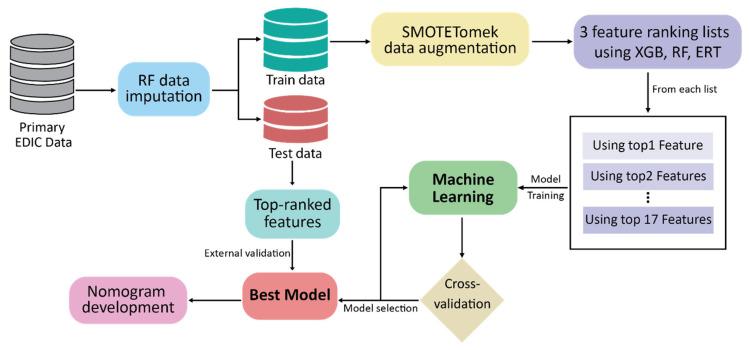
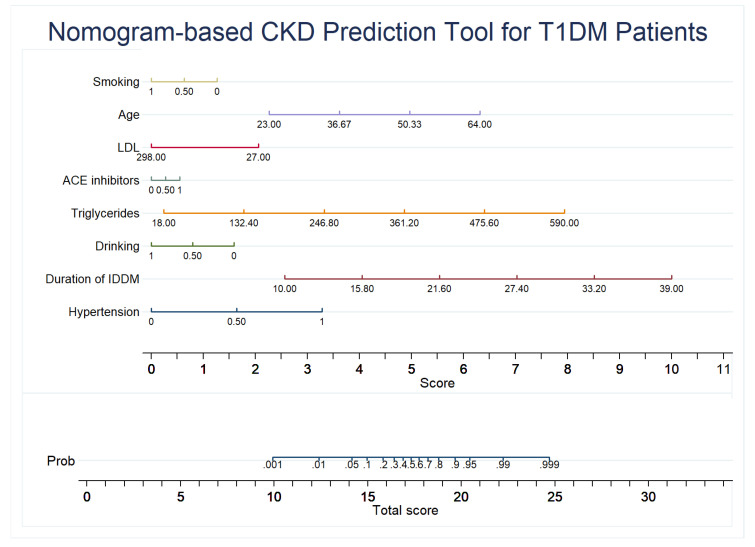
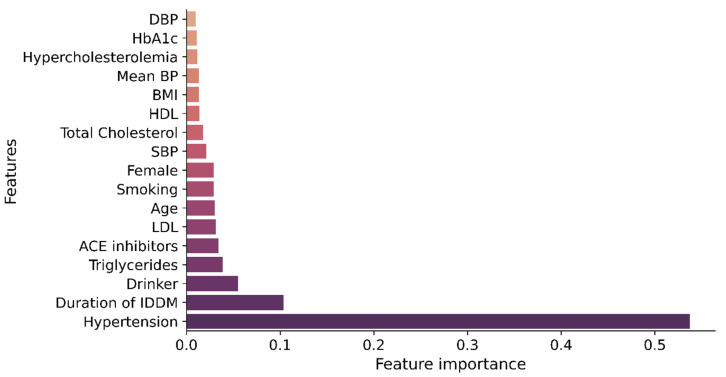
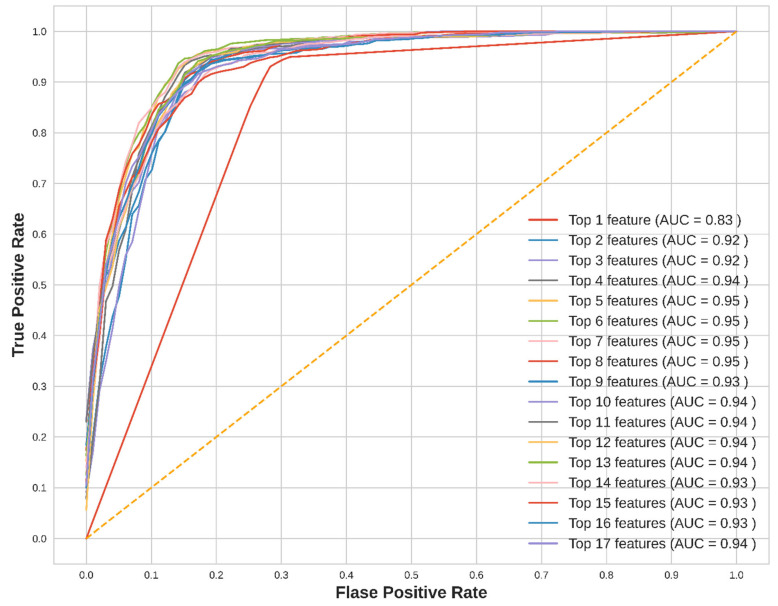
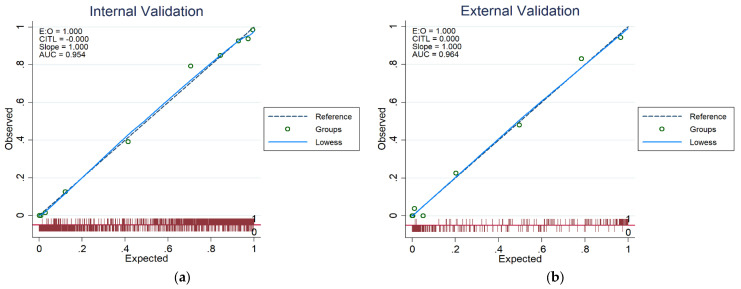
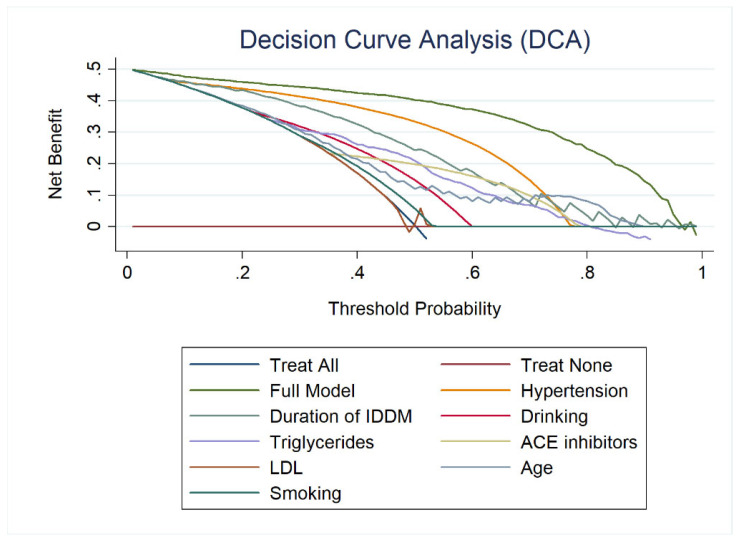
Type 1 diabetes mellitus (T1DM) patients are a significant threat to chronic kidney disease (CKD) development during their life. However, there is always a high chance of delay in CKD detection because CKD can be asymptomatic, and T1DM patients bypass traditional CKD tests during their routine checkups. This study aims to develop and validate a prediction model and nomogram of CKD in T1DM patients using readily available routine checkup data for early CKD detection. This research utilized 1375 T1DM patients' sixteen years of longitudinal data from multi-center Epidemiology of Diabetes Interventions and Complications (EDIC) clinical trials conducted at 28 sites in the USA and Canada and considered 17 routinely available features. Three feature ranking algorithms, extreme gradient boosting (XGB), random forest (RF), and extremely randomized trees classifier (ERT), were applied to create three feature ranking lists, and logistic regression analyses were performed to develop CKD prediction models using these ranked feature lists to identify the best performing top-ranked features combination. Finally, the most significant features were selected to develop a multivariate logistic regression-based CKD prediction model for T1DM patients. This model was evaluated using sensitivity, specificity, accuracy, precision, and F1 score on train and test data. A nomogram of the final model was further generated for easy application in clinical practices. Hypertension, duration of diabetes, drinking habit, triglycerides, ACE inhibitors, low-density lipoprotein (LDL) cholesterol, age, and smoking habit were the top-8 features ranked by the XGB model and identified as the most important features for predicting CKD in T1DM patients. These eight features were selected to develop the final prediction model using multivariate logistic regression, which showed 90.04% and 88.59% accuracy in internal and test data validation. The proposed model showed excellent performance and can be used for CKD identification in T1DM patients during routine checkups.
1型糖尿病(T1DM)患者在其一生中对慢性肾脏病(CKD)的发展构成重大威胁。然而,CKD检测总是很有可能被延误,因为CKD可能没有症状,并且T1DM患者在常规体检时会跳过传统的CKD检测。本研究旨在利用易于获取的常规体检数据开发并验证T1DM患者CKD的预测模型和列线图,以实现CKD的早期检测。本研究使用了来自美国和加拿大28个地点进行的多中心糖尿病干预与并发症流行病学(EDIC)临床试验的1375例T1DM患者的16年纵向数据,并考虑了17个常规可用特征。应用三种特征排序算法,即极端梯度提升(XGB)、随机森林(RF)和极度随机树分类器(ERT),创建三个特征排序列表,并进行逻辑回归分析,以使用这些排序后的特征列表开发CKD预测模型,从而确定表现最佳的顶级特征组合。最后,选择最显著的特征来开发基于多变量逻辑回归的T1DM患者CKD预测模型。使用灵敏度、特异性、准确性、精确性和F1分数对训练数据和测试数据评估该模型。进一步生成最终模型的列线图,以便于在临床实践中应用。高血压、糖尿病病程、饮酒习惯、甘油三酯、血管紧张素转换酶抑制剂、低密度脂蛋白(LDL)胆固醇、年龄和吸烟习惯是XGB模型排名前8的特征,被确定为预测T1DM患者CKD的最重要特征。选择这八个特征使用多变量逻辑回归开发最终预测模型,该模型在内部数据验证和测试数据验证中的准确率分别为90.04%和88.59%。所提出的模型表现出色,可用于T1DM患者在常规体检时的CKD识别。