Department of Advanced Medical and Surgical Sciences, University of Campania "Luigi Vanvitelli", Naples, Italy; Division of Endocrinology and Metabolic Diseases, University of Campania "Luigi Vanvitelli", Naples, Italy.
Unit of Infectious Diseases, Department of Mental Health and Public Medicine, University of Campania "Luigi Vanvitelli", Naples, Italy.
Diabetes Res Clin Pract. 2021 May;175:108797. doi: 10.1016/j.diabres.2021.108797. Epub 2021 Apr 15.
To investigate the rate of antibiotic resistance and its main risk factors in a population of patients with diabetic foot infection (DFI) during the COVID-19 pandemic, in comparison with the population of 2019.
Two hundred and twenty-five patients with DFI were admitted in a tertiary care center from January 2019 to December 2020. Antibiotic resistance was evaluated by microbiological examination of soft tissues' or bone's biopsy.
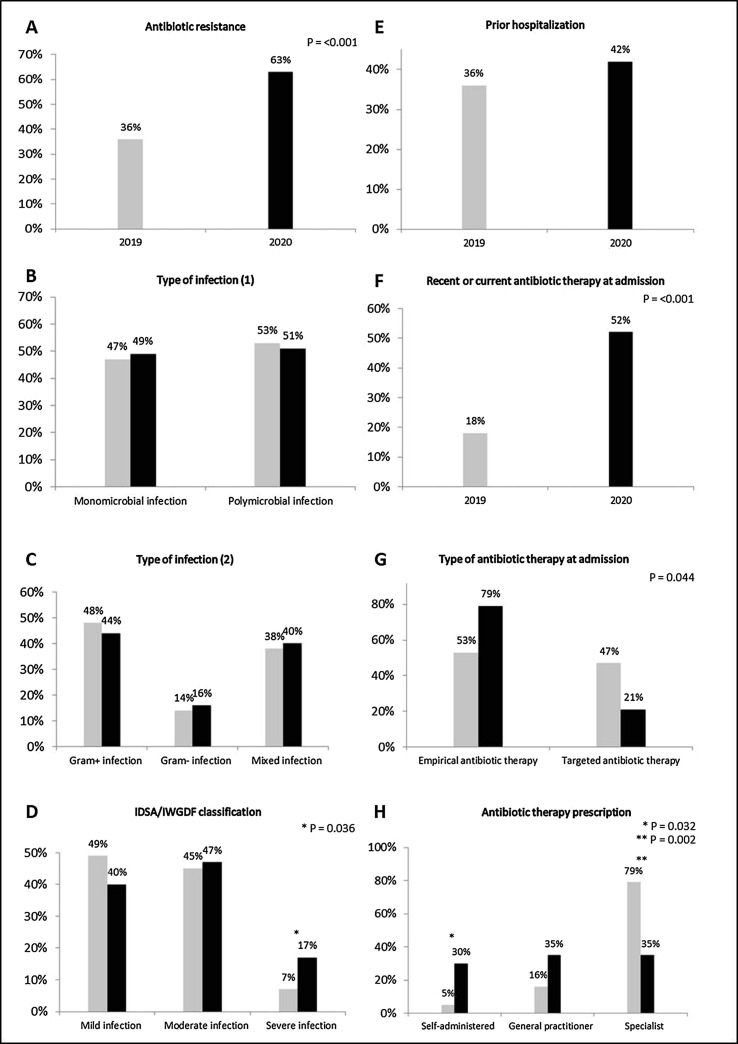
Compared with 2019 group (n = 105), 2020 group (n = 120) had a significantly higher prevalence of antibiotic resistance [2019 vs 2020, 36% vs 63%, P <0.001] and more often was admitted with recent or current antibiotic therapy (18% vs 52%, P <0.001), which was frequently self-administered (5% vs 30%, P = 0.032). The risk of antibiotic resistance was also higher in 2020 group [OR 95% CI, 2.90 (1.68 to 4.99)]. Prior hospitalization, antibiotic self-administration and antibiotic prescription by general practitioners resulted as independent predictors of antibiotic resistance.
In a population of people with DFI admitted in a tertiary care center during the COVID-19 pandemic the prevalence of antibiotic resistance was higher than 2019. Previous hospitalization, antibiotic self-administration /prescription by general practitioners were related to higher risk of antibiotic resistant infections.
在 COVID-19 大流行期间,调查糖尿病足感染(DFI)患者人群中的抗生素耐药率及其主要危险因素,并与 2019 年的人群进行比较。
在一家三级护理中心,从 2019 年 1 月至 2020 年 12 月,共收治了 225 例 DFI 患者。通过软组织或骨活检的微生物学检查来评估抗生素耐药性。
与 2019 年组(n=105)相比,2020 年组(n=120)的抗生素耐药率显著更高[2019 年 vs 2020 年,36% vs 63%,P<0.001],且近期或当前接受抗生素治疗的比例更高[18% vs 52%,P<0.001],且多为自行用药[5% vs 30%,P=0.032]。2020 年组的抗生素耐药风险也更高[OR 95%CI,2.90(1.68 至 4.99)]。既往住院、抗生素自行用药和全科医生处方是抗生素耐药的独立预测因素。
在一家三级护理中心收治的 DFI 患者人群中,COVID-19 大流行期间的抗生素耐药率高于 2019 年。既往住院、抗生素自行用药/全科医生处方与更高的抗生素耐药感染风险相关。