Department Oncology, University of Oxford, Oxford OX3 7DQ, UK.
Department Oncology, University of Oxford, Oxford OX3 7DQ, UK.
Mol Ther. 2021 May 5;29(5):1668-1682. doi: 10.1016/j.ymthe.2021.04.015. Epub 2021 Apr 19.
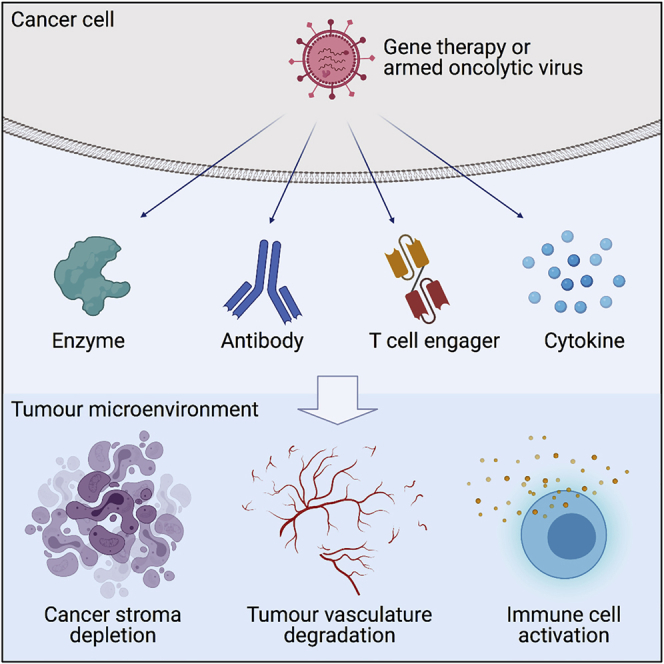
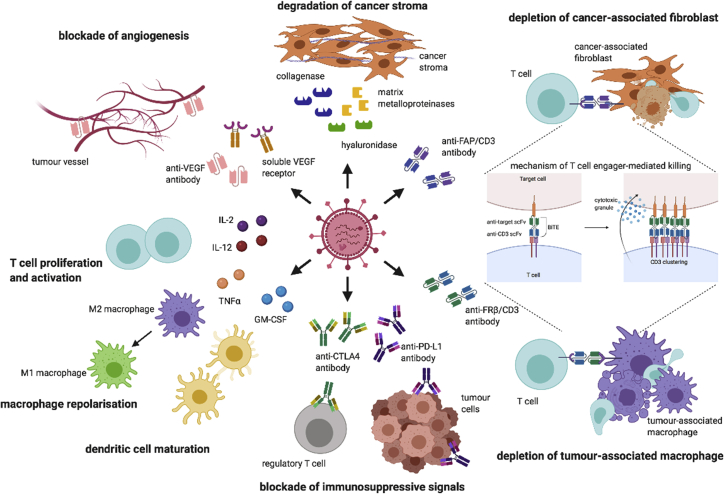
Cancer gene therapies are usually designed either to express wild-type copies of tumor suppressor genes or to exploit tumor-associated phenotypic changes to endow selective cytotoxicity. However, these approaches become less relevant to cancers that contain many independent mutations, and the situation is made more complex by our increased understanding of clonal evolution of tumors, meaning that different metastases and even regions of the same tumor mass have distinct mutational and phenotypic profiles. In contrast, the relatively genetically stable tumor microenvironment (TME) therefore provides an appealing therapeutic target, particularly since it plays an essential role in promoting cancer growth, immune tolerance, and acquired resistance to many therapies. Recently, a variety of different TME-targeted gene therapy and armed oncolytic strategies have been explored, with particular success observed in strategies targeting the cancer stroma, reducing tumor vasculature, and repolarizing the immunosuppressive microenvironment. Herein, we review the progress of these TME-targeting approaches and try to highlight those showing the greatest promise.
癌症基因疗法通常旨在表达肿瘤抑制基因的野生型副本,或利用肿瘤相关的表型变化赋予选择性细胞毒性。然而,这些方法对于包含许多独立突变的癌症变得不那么相关,并且随着我们对肿瘤克隆进化的理解增加,情况变得更加复杂,这意味着不同的转移甚至同一肿瘤块的不同区域具有不同的突变和表型特征。相比之下,相对遗传稳定的肿瘤微环境(TME)因此提供了一个有吸引力的治疗靶标,特别是因为它在促进癌症生长、免疫耐受和对许多治疗方法的获得性耐药方面发挥着至关重要的作用。最近,已经探索了多种不同的 TME 靶向基因治疗和武装溶瘤策略,靶向肿瘤基质、减少肿瘤血管生成和重新极化免疫抑制微环境的策略取得了特别的成功。本文综述了这些 TME 靶向方法的进展,并试图突出那些最有前途的方法。