Department of Neurology, Mental and Neurological Disease Research Center, The Third Affiliated Hospital of Sun Yat-sen University, 600 Tianhe Road, Guangzhou, Guangdong, 510630, People's Republic of China.
Center of Clinical Immunology, Mental and Neurological Disease Research Center, The Third Affiliated Hospital of Sun Yat-sen University, 600 Tianhe Road, Guangzhou, Guangdong, 510630, People's Republic of China.
J Neuroinflammation. 2021 Apr 12;18(1):90. doi: 10.1186/s12974-021-02144-9.
A high-salt diet (HSD) is one of the major risk factors for acute ischemic stroke (AIS). As a potential mechanism, surplus salt intake primes macrophages towards a proinflammatory phenotype. In this study, whether HSD could blunt the efferocytic capability of macrophages after ischemic stroke, thus exacerbating post-stroke neural inflammation, was investigated.
Wild-type male C57BL/6 mice were fed with fodder containing 8% sodium chloride for 4 weeks and subjected to transient middle cerebral occlusion (tMCAO). Disease severity, macrophage polarization as well as efferocytic capability were evaluated. Bone marrow-derived macrophages were cultured in vitro, and the impact of high salinity on their efferocytic activity, as well as their expression of phagocytic molecules, were analyzed. The relationships among sodium concentration, macrophage phenotype, and disease severity in AIS patients were explored.
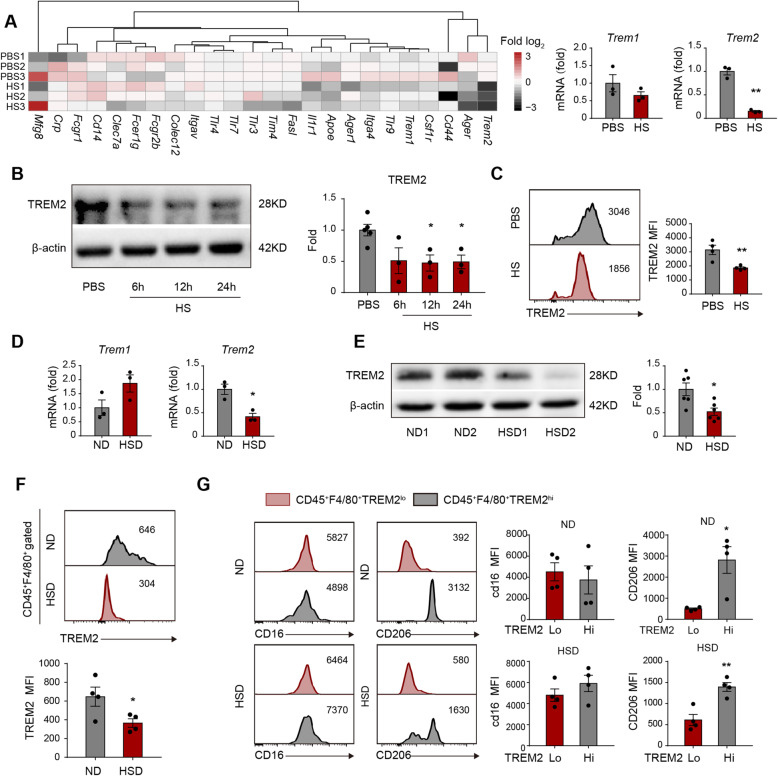
HSD-fed mice displayed increased infarct volume and aggravated neurological deficiency. Mice fed with HSD suffered exacerbated neural inflammation as shown by higher inflammatory mediator expression and immune cell infiltration levels. Infiltrated macrophages within stroke lesions in HSD-fed mice exhibited a shift towards proinflammatory phenotype and impaired efferocytic capability. As assessed with a PCR array, the expression of triggering receptor expressed on myeloid cells 2 (TREM2), a receptor relevant to phagocytosis, was downregulated in high-salt-treated bone marrow-derived macrophages. Enhancement of TREM2 signaling restored the efferocytic capacity and cellular inflammation resolution of macrophages in a high salinity environment in vitro and in vivo. A high concentration of urine sodium in AIS patients was found to be correlated with lower TREM2 expression and detrimental stroke outcomes.
HSD inhibited the efferocytic capacity of macrophages by downregulating TREM2 expression, thus impeding inflammation resolution after ischemic stroke. Enhancing TREM2 signaling in monocytes/macrophages could be a promising therapeutic strategy to enhance efferocytosis and promote post-stroke inflammation resolution.
高盐饮食(HSD)是急性缺血性脑卒中(AIS)的主要危险因素之一。作为潜在机制,过量盐摄入使巨噬细胞向促炎表型极化。在这项研究中,研究了 HSD 是否会削弱缺血性中风后巨噬细胞的吞噬能力,从而加重中风后的神经炎症。
将野生型雄性 C57BL/6 小鼠用含有 8%氯化钠的饲料喂养 4 周,然后进行短暂性大脑中动脉闭塞(tMCAO)。评估疾病严重程度、巨噬细胞极化和吞噬能力。体外培养骨髓来源的巨噬细胞,分析高盐对其吞噬活性以及吞噬分子表达的影响。探讨 AIS 患者体内钠浓度、巨噬细胞表型和疾病严重程度之间的关系。
HSD 喂养的小鼠梗死体积增加,神经功能缺损加重。与 HSD 喂养的小鼠相比,HSD 喂养的小鼠神经炎症加剧,表现为炎症介质表达和免疫细胞浸润水平升高。在 HSD 喂养的小鼠中风病灶内浸润的巨噬细胞向促炎表型转变,吞噬能力受损。通过 PCR 阵列评估,触发受体表达在髓样细胞 2(TREM2)上的表达下调,TREM2 是一种与吞噬作用相关的受体,在高盐处理的骨髓来源的巨噬细胞中。增强 TREM2 信号转导可恢复高盐环境中体外和体内巨噬细胞的吞噬能力和细胞炎症消退。发现 AIS 患者尿液中钠浓度较高与 TREM2 表达降低和不良的中风结局相关。
HSD 通过下调 TREM2 表达抑制巨噬细胞的吞噬能力,从而阻碍缺血性中风后的炎症消退。增强单核细胞/巨噬细胞中的 TREM2 信号可能是增强吞噬作用和促进中风后炎症消退的有前途的治疗策略。