Université de Paris, PARCC, INSERM; Emergency department, Georges-Pompidou European hospital, AP-HP, 75015 Paris, France.
Université de Paris, PARCC, INSERM, 75015 Paris, France.
Arch Cardiovasc Dis. 2021 May;114(5):381-393. doi: 10.1016/j.acvd.2021.02.003. Epub 2021 Mar 9.
Coronavirus disease 2019 (COVID-19) has been associated with coagulation disorders, in particular high concentrations of D-dimer, and increased frequency of venous thromboembolism.
To explore the association between D-dimer at admission and in-hospital mortality in patients hospitalised for COVID-19, with or without symptomatic venous thromboembolism.
From 26 February to 20 April 2020, D-dimer concentration at admission and outcomes (in-hospital mortality and venous thromboembolism) of patients hospitalised for COVID-19 in medical wards were retrospectively analysed in a multicenter study in 24 French hospitals.
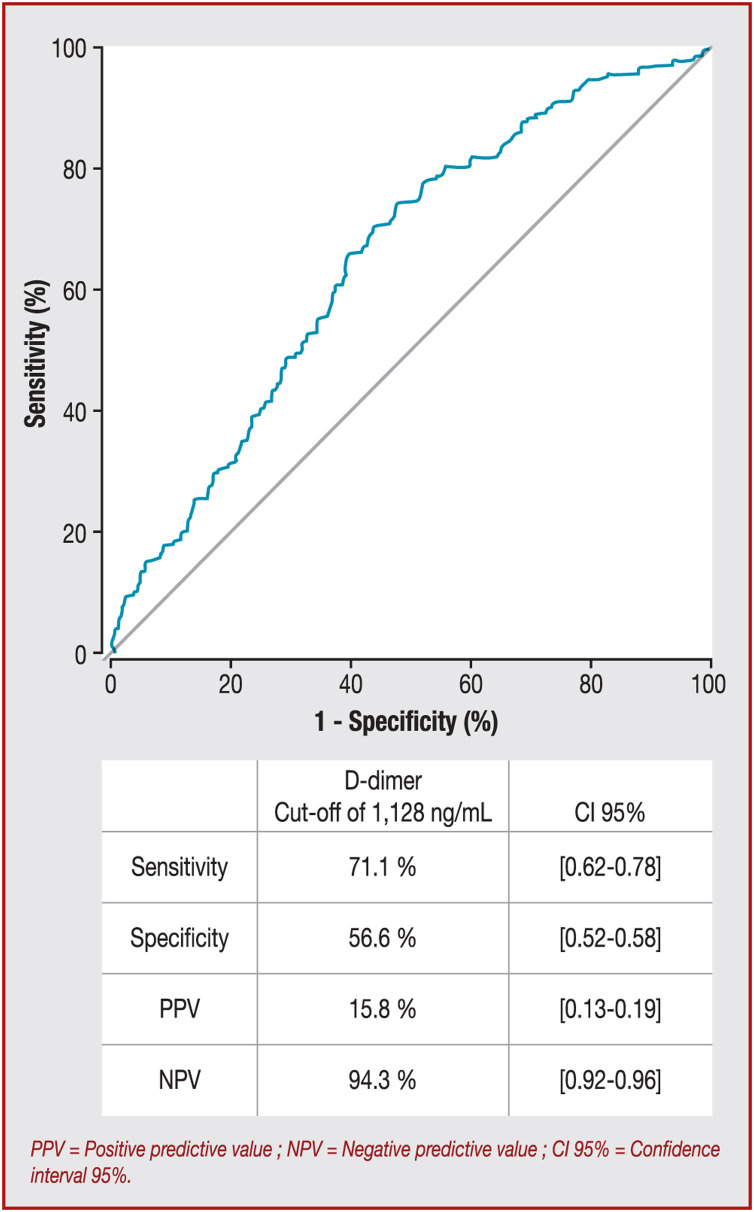
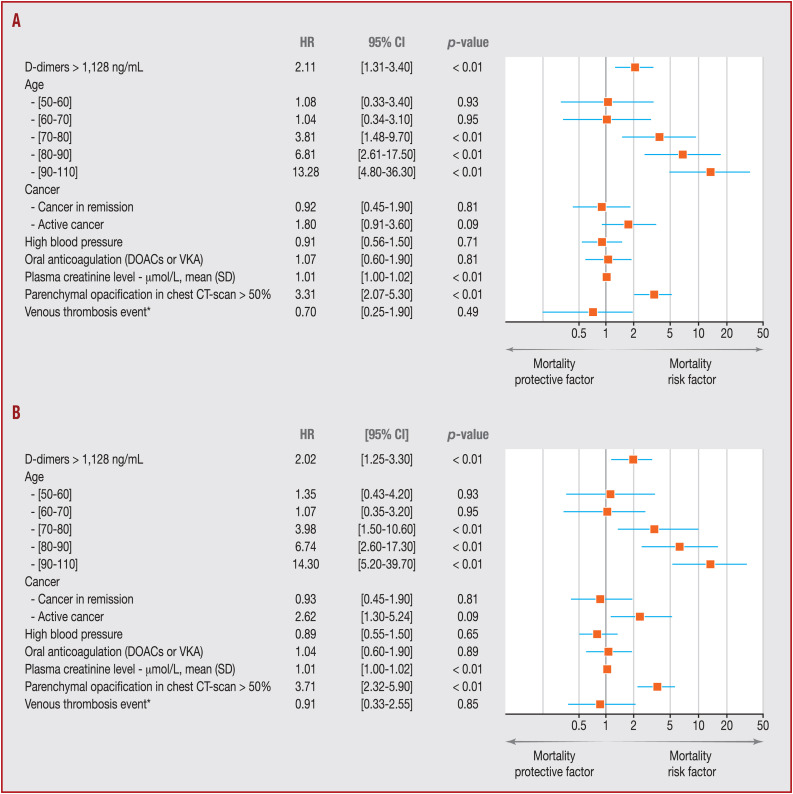
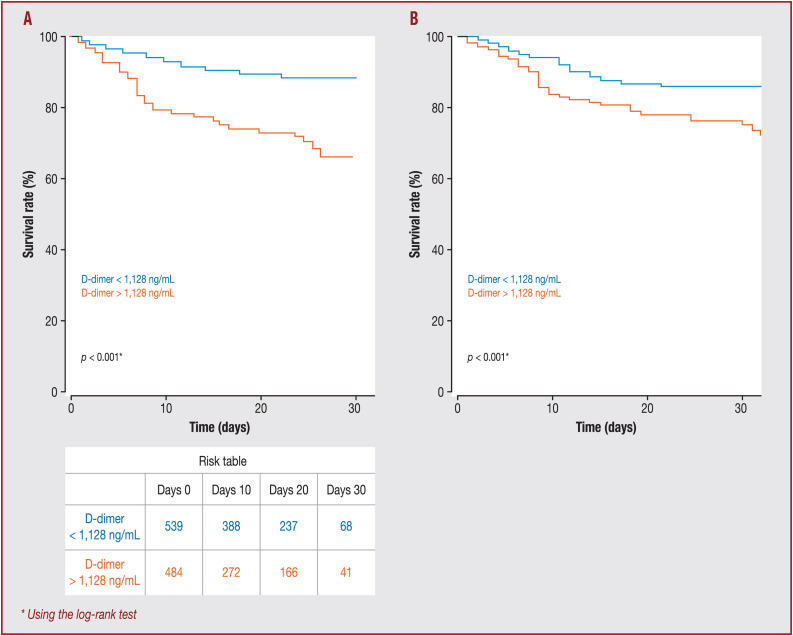
Among 2878 patients enrolled in the study, 1154 (40.1%) patients had D-dimer measurement at admission. Receiver operating characteristic curve analysis identified a D-dimer concentration>1128ng/mL as the best cut-off value for in-hospital mortality (area under the curve 64.9%, 95% confidence interval [CI] 60-69), with a sensitivity of 71.1% (95% CI 62-78) and a specificity of 55.6% (95% CI 52-58), which did not differ in the subgroup of patients with venous thromboembolism during hospitalisation. Among 545 (47.2%) patients with D-dimer concentration>1128ng/mL at admission, 86 (15.8%) deaths occurred during hospitalisation. After adjustment, in Cox proportional hazards and logistic regression models, D-dimer concentration>1128ng/mL at admission was also associated with a worse prognosis, with an odds ratio of 3.07 (95% CI 2.05-4.69; P<0.001) and an adjusted hazard ratio of 2.11 (95% CI 1.31-3.4; P<0.01).
D-dimer concentration>1128ng/mL is a relevant predictive factor for in-hospital mortality in patients hospitalised for COVID-19 in a medical ward, regardless of the occurrence of venous thromboembolism during hospitalisation.
新型冠状病毒病 2019(COVID-19)与凝血功能障碍有关,特别是 D-二聚体浓度升高,静脉血栓栓塞症的发生率增加。
探讨因 COVID-19 住院且有或无症状性静脉血栓栓塞症患者入院时 D-二聚体与住院期间死亡率的相关性。
在 2020 年 2 月 26 日至 4 月 20 日期间,对 24 家法国医院的内科病房中因 COVID-19 住院患者的入院时 D-二聚体浓度和结局(住院期间死亡率和静脉血栓栓塞症)进行了回顾性多中心研究。
在研究纳入的 2878 例患者中,1154 例(40.1%)患者在入院时进行了 D-二聚体测量。受试者工作特征曲线分析发现,D-二聚体浓度>1128ng/mL 是住院期间死亡率的最佳截断值(曲线下面积 64.9%,95%置信区间 60-69),其敏感性为 71.1%(95%置信区间 62-78),特异性为 55.6%(95%置信区间 52-58),在住院期间发生静脉血栓栓塞症的患者亚组中没有差异。在入院时 D-二聚体浓度>1128ng/mL 的 545 例(47.2%)患者中,86 例(15.8%)在住院期间死亡。在 Cox 比例风险和逻辑回归模型校正后,入院时 D-二聚体浓度>1128ng/mL 与预后较差相关,比值比为 3.07(95%置信区间 2.05-4.69;P<0.001),校正危险比为 2.11(95%置信区间 1.31-3.4;P<0.01)。
在因 COVID-19 住院的内科病房患者中,入院时 D-二聚体浓度>1128ng/mL 是住院期间死亡率的一个有意义的预测因素,与住院期间是否发生静脉血栓栓塞症无关。