Education and Research Department, Isokinetic Medical Group, FIFA Medical Centre of Excellence, Bologna, Italy.
Football Research Group, Linköping University, Linköping, Sweden
Br J Sports Med. 2021 Dec;55(23):1350-1356. doi: 10.1136/bjsports-2020-103555. Epub 2021 Apr 12.
Studies on subsequent anterior cruciate ligament (ACL) ruptures and career length in male professional football players after ACL reconstruction (ACLR) are scarce.
To investigate the second ACL injury rate, potential predictors of second ACL injury and the career length after ACLR.
Prospective cohort study.
Men's professional football.
118 players with index ACL injury were tracked longitudinally for subsequent ACL injury and career length over 16.9 years. Multivariable Cox regression analysis with HR was carried out to study potential predictors for subsequent ACL injury.
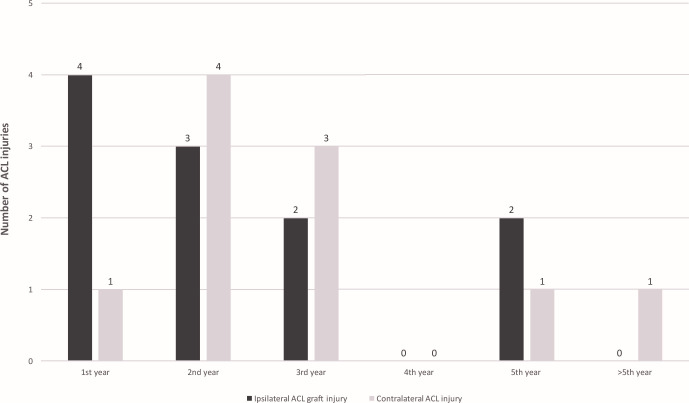
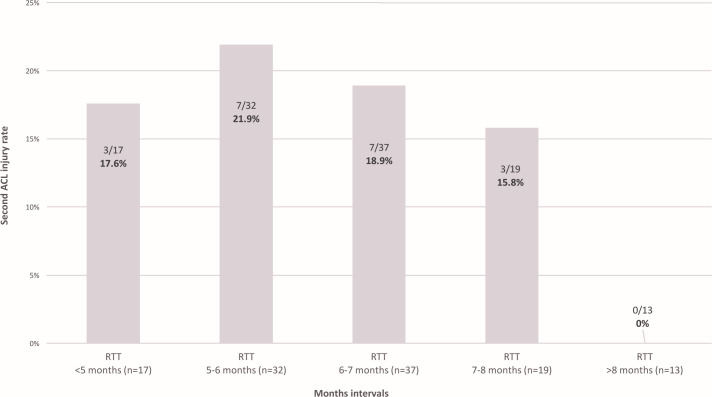
Median follow-up was 4.3 (IQR 4.6) years after ACLR. The second ACL injury rate after return to training (RTT) was 17.8% (n=21), with 9.3% (n=11) to the ipsilateral and 8.5% (n=10) to the contralateral knee. Significant predictors for second ACL injury were a non-contact index ACL injury (HR 7.16, 95% CI 1.63 to 31.22) and an isolated index ACL injury (HR 2.73, 95% CI 1.06 to 7.07). In total, 11 of 26 players (42%) with a non-contact isolated index ACL injury suffered a second ACL injury. RTT time was not an independent predictor of second ACL injury, even though there was a tendency for a risk reduction with longer time to RTT. Median career length after ACLR was 4.1 (IQR 4.0) years and 60% of players were still playing at preinjury level 5 years after ACLR.
Almost one out of five top-level professional male football players sustained a second ACL injury following ACLR and return to football, with a considerably increased risk for players with a non-contact or isolated index injury.
关于男性职业足球运动员前交叉韧带(ACL)重建(ACLR)后再次发生 ACL 破裂和职业生涯长度的研究很少。
调查第二次 ACL 损伤率、第二次 ACL 损伤的潜在预测因素以及 ACLR 后的职业生涯长度。
前瞻性队列研究。
男子职业足球。
对 118 名 ACL 损伤指数患者进行纵向跟踪,以了解 ACLR 后后续 ACL 损伤和职业生涯长度,随访时间超过 16.9 年。采用多变量 Cox 回归分析 HR 来研究第二次 ACL 损伤的潜在预测因素。
ACLR 后中位随访时间为 4.3(IQR 4.6)年。重返训练(RTT)后的第二次 ACL 损伤率为 17.8%(n=21),同侧 9.3%(n=11),对侧 8.5%(n=10)。第二次 ACL 损伤的显著预测因素是非接触性指数 ACL 损伤(HR 7.16,95%CI 1.63 至 31.22)和孤立性指数 ACL 损伤(HR 2.73,95%CI 1.06 至 7.07)。共有 26 名非接触性孤立性指数 ACL 损伤患者中的 11 名(42%)发生了第二次 ACL 损伤。RTT 时间不是第二次 ACL 损伤的独立预测因素,尽管 RTT 时间较长有降低风险的趋势。ACLR 后的中位职业生涯长度为 4.1(IQR 4.0)年,60%的球员在 ACLR 后 5 年内仍处于受伤前的水平。
几乎五分之一的顶级男性职业足球运动员在 ACLR 和重返足球后再次发生 ACL 损伤,具有非接触性或孤立性指数损伤的运动员风险显著增加。