Australian Centre for Disease Preparedness, CSIRO, Geelong, VIC, Australia.
Black Mountain Laboratories, CSIRO, Canberra, ACT, Australia.
Sci Rep. 2021 Apr 12;11(1):7923. doi: 10.1038/s41598-021-87107-z.
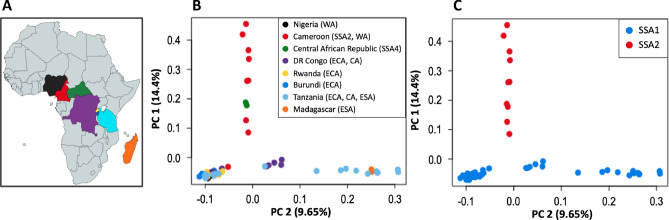
The Bemisia cassava whitefly complex includes species that cause severe crop damage through vectoring cassava viruses in eastern Africa. Currently, this whitefly complex is divided into species and subgroups (SG) based on very limited molecular markers that do not allow clear definition of species and population structure. Based on 14,358 genome-wide SNPs from 62 Bemisia cassava whitefly individuals belonging to sub-Saharan African species (SSA1, SSA2 and SSA4), and using a well-curated mtCOI gene database, we show clear incongruities in previous taxonomic approaches underpinned by effects from pseudogenes. We show that the SSA4 species is nested within SSA2, and that populations of the SSA1 species comprise well-defined south-eastern (Madagascar, Tanzania) and north-western (Nigeria, Democratic Republic of Congo, Burundi) putative sub-species. Signatures of allopatric incipient speciation, and the presence of a 'hybrid zone' separating the two putative sub-species were also detected. These findings provide insights into the evolution and molecular ecology of a highly cryptic hemipteran insect complex in African, and allow the systematic use of genomic data to be incorporated in the development of management strategies for this cassava pest.
烟粉虱复合种包括在东非通过传播木薯病毒而对作物造成严重损害的物种。目前,该粉虱复合种是基于非常有限的分子标记来划分物种和亚群(SG)的,这些标记无法明确界定物种和种群结构。基于来自撒哈拉以南非洲物种(SSA1、SSA2 和 SSA4)的 62 个烟粉虱个体的 14358 个全基因组 SNP,以及使用经过精心整理的 mtCOI 基因数据库,我们发现先前基于假基因效应的分类方法存在明显的不一致性。我们表明,SSA4 物种嵌套在 SSA2 内,而 SSA1 物种的种群则由明确界定的东南(马达加斯加、坦桑尼亚)和西北(尼日利亚、刚果民主共和国、布隆迪)假定亚种组成。还检测到了异域物种形成的初始迹象和分隔两个假定亚种的“杂交区”的存在。这些发现为非洲高度隐生半翅目昆虫复合体的进化和分子生态学提供了新的认识,并允许将基因组数据的系统使用纳入对这种木薯害虫的管理策略的制定中。