Department of Neurosurgery, College of Medicine, Ewha Womans University, Ewha Womans University Seoul Hospital, Seoul, Korea.
Department of Mechanical Engineering and BK21 FOUR ERICA-ACE Center, Hanyang University, 55 Hanyangdaehak-ro, Sangnok-gu, Ansan, 15588, Gyeonggi-do, Korea.
Sci Rep. 2021 Apr 12;11(1):7947. doi: 10.1038/s41598-021-87126-w.
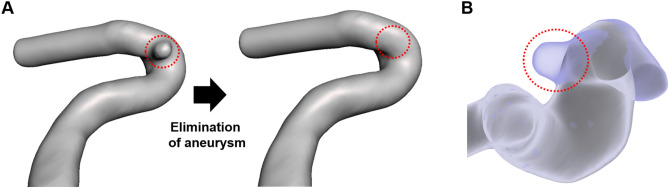
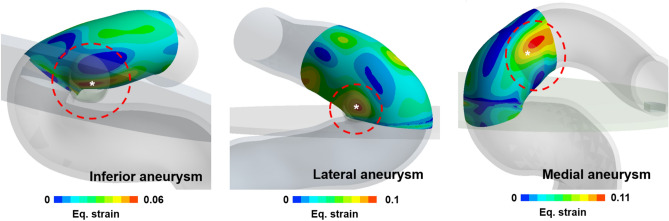
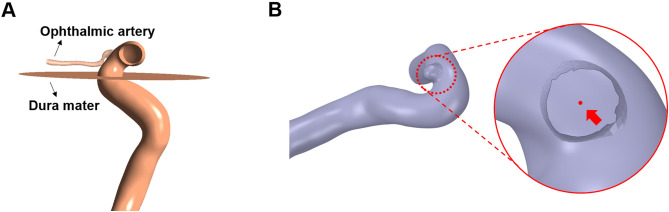
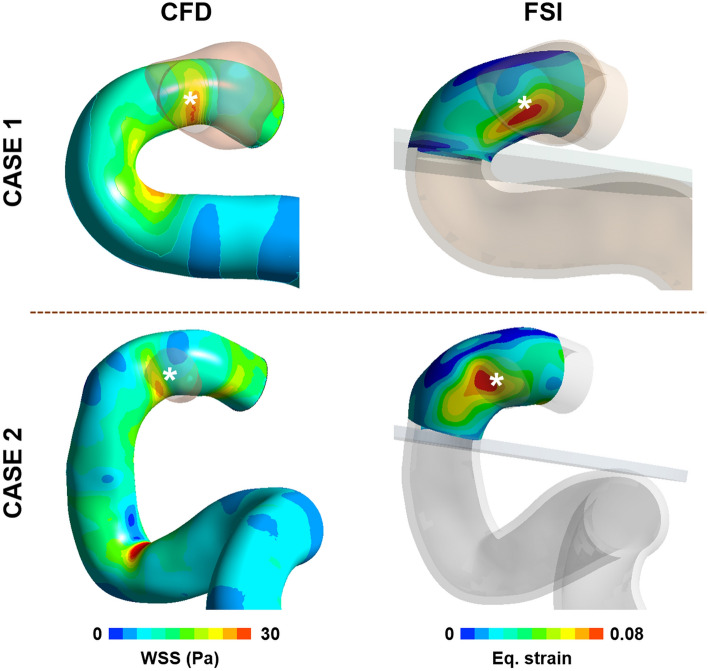
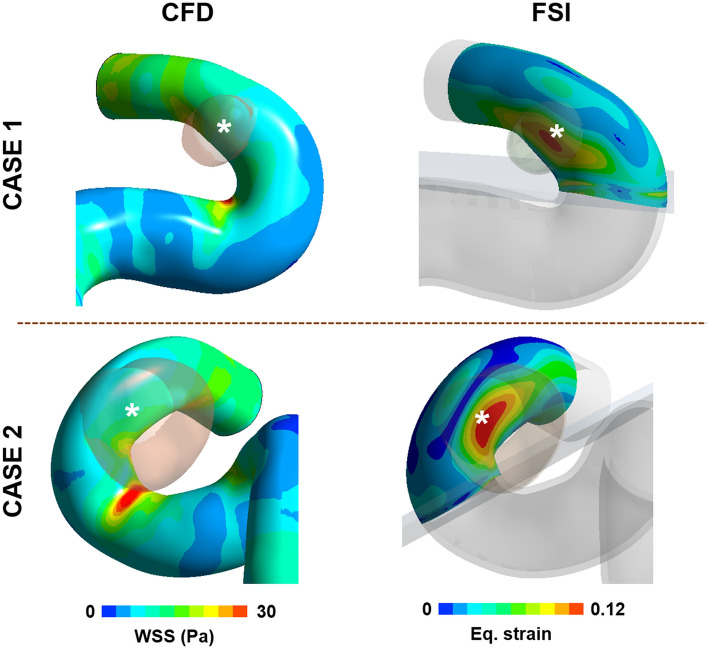
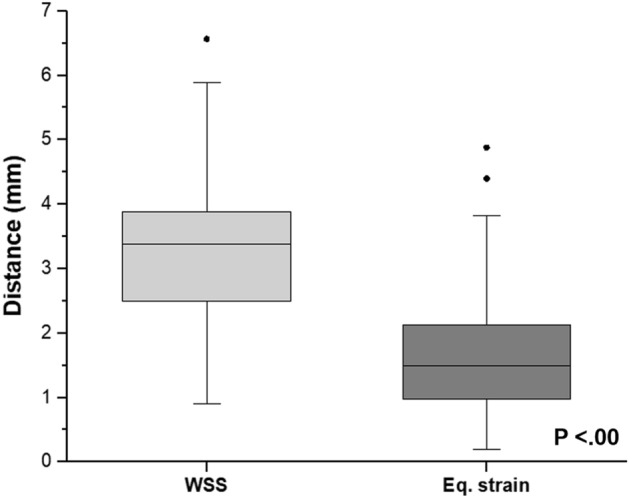
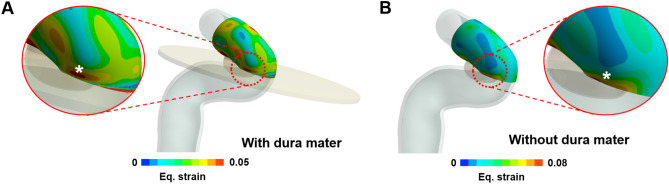
In the hemodynamic study, computational fluid dynamics (CFD) analysis has shown that high wall shear stress (WSS) is an important parameter in cerebral aneurysm formation. However, CFD analysis is not more realistic than fluid-structure interaction (FSI) analysis given its lack of considering the involvement of vascular structures. To investigate the relationship between the hemodynamic parameters and the aneurysm formation, the locations of high WSS and high strain were extracted from the CFD and FSI analyses, respectively. Then the distances between the aneurysm formation site and the locations of high WSS or high strain were calculated. A total of 37 intracranial paraclinoid aneurysms were enrolled for quantitative comparison. Additionally, the dura mater was modeled to facilitate realistic results in FSI analysis. The average distance from the location of the aneurysm formation site to the high strain (1.74 mm [Formula: see text] 1.04 mm) was smaller than the average distance to the high WSS (3.33 mm [Formula: see text] 1.18 mm). The presence of dura mater also influenced the findings in the aneurysm formation site. High strain extracted by FSI analysis is an important hemodynamic factor related to the formation of cerebral aneurysms. Strain parameter could help to predict the formation of aneurysms and elucidate the appropriate treatment.
在血流动力学研究中,计算流体动力学(CFD)分析表明,高壁切应力(WSS)是脑动脉瘤形成的一个重要参数。然而,由于缺乏对血管结构参与的考虑,CFD 分析不如流固耦合(FSI)分析更现实。为了研究血流动力学参数与动脉瘤形成之间的关系,分别从 CFD 和 FSI 分析中提取了高壁切应力和高应变的位置。然后计算了动脉瘤形成部位与高壁切应力或高应变位置之间的距离。共纳入 37 例颅内翼状旁动脉瘤进行定量比较。此外,还对硬脑膜进行建模,以促进 FSI 分析中的实际结果。从动脉瘤形成部位到高应变位置的平均距离(1.74±1.04mm)小于到高壁切应力位置的平均距离(3.33±1.18mm)。硬脑膜的存在也影响了动脉瘤形成部位的发现。FSI 分析提取的高应变是与脑动脉瘤形成相关的重要血流动力学因素。应变参数有助于预测动脉瘤的形成,并阐明适当的治疗方法。