Cho Kwang-Chun
Department of Neurosurgery, Yongin Severance Hospital, Yongin, Korea.
Neurointervention. 2023 Jun;18(2):107-113. doi: 10.5469/neuroint.2023.00164. Epub 2023 Jun 20.
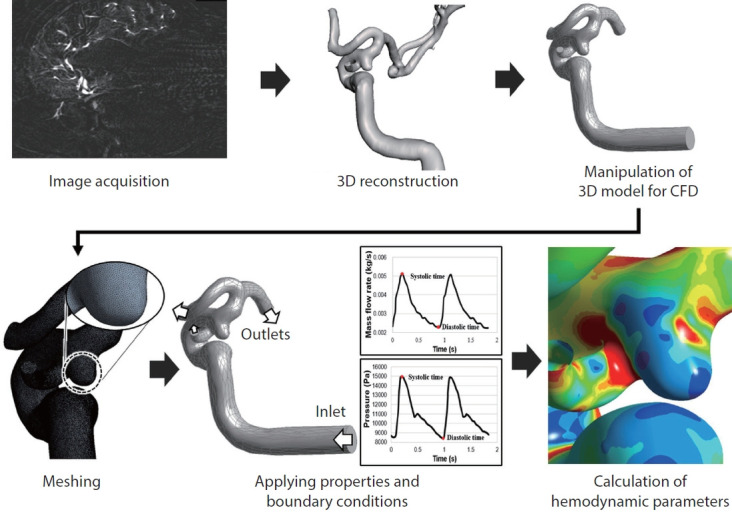
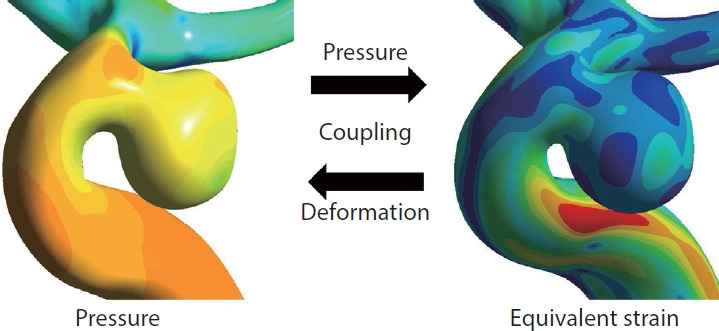
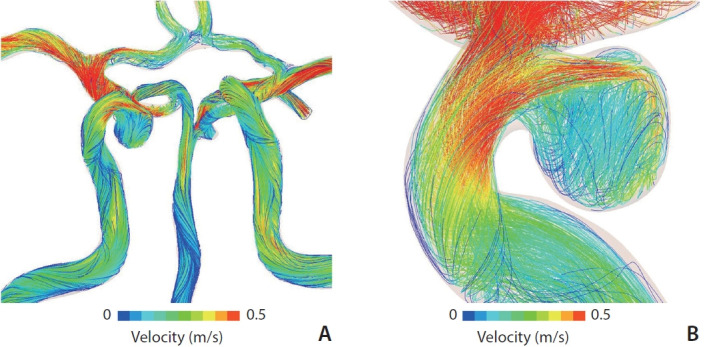
Among the various perspectives on cerebrovascular diseases, hemodynamic analysis-which has recently garnered interest-is of great help in understanding cerebrovascular diseases. Computational fluid dynamics (CFD) analysis has been the primary hemodynamic analysis method, and studies on cerebral aneurysms have been actively conducted. However, owing to the intrinsic limitations of the analysis method, the role of wall shear stress (WSS), the most representative parameter, remains controversial. High WSS affects the formation of cerebral aneurysms; however, no consensus has been reached on the role of WSS in the growth and rupture of cerebral aneurysms. Therefore, this review aimed to briefly introduce the up-to-date results and limitations made through CFD analysis and to inform the need for a new hemodynamic analysis method.
在关于脑血管疾病的各种观点中,血流动力学分析——最近受到了关注——对理解脑血管疾病有很大帮助。计算流体动力学(CFD)分析一直是主要的血流动力学分析方法,并且对脑动脉瘤的研究一直在积极开展。然而,由于该分析方法固有的局限性,最具代表性的参数壁面剪应力(WSS)的作用仍存在争议。高WSS会影响脑动脉瘤的形成;然而,关于WSS在脑动脉瘤生长和破裂中的作用尚未达成共识。因此,本综述旨在简要介绍通过CFD分析取得的最新结果和局限性,并说明需要一种新的血流动力学分析方法。