Sorbonne Université, Institut National de la Santé et de la Recherche Médicale, Centre National de la Recherche Scientifique, Institut de la Vision, Paris, France.
Centre Hospitalier National d'Ophtalmologie des Quinze-Vingts, INSERM-DGOS CIC1423, Paris, France.
Hum Mutat. 2021 Jun;42(6):641-666. doi: 10.1002/humu.24205. Epub 2021 May 16.
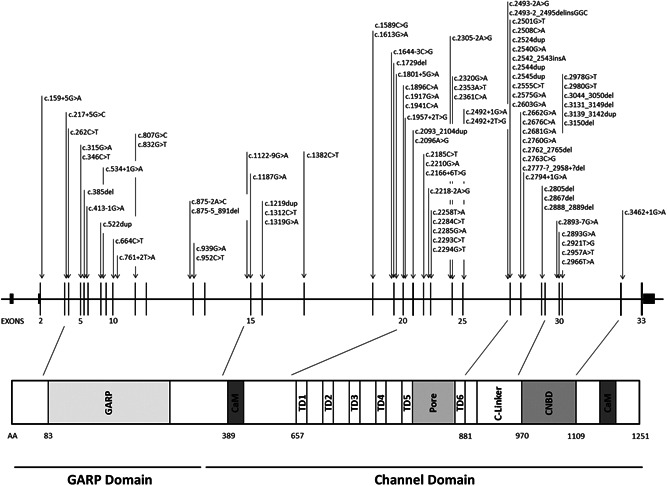
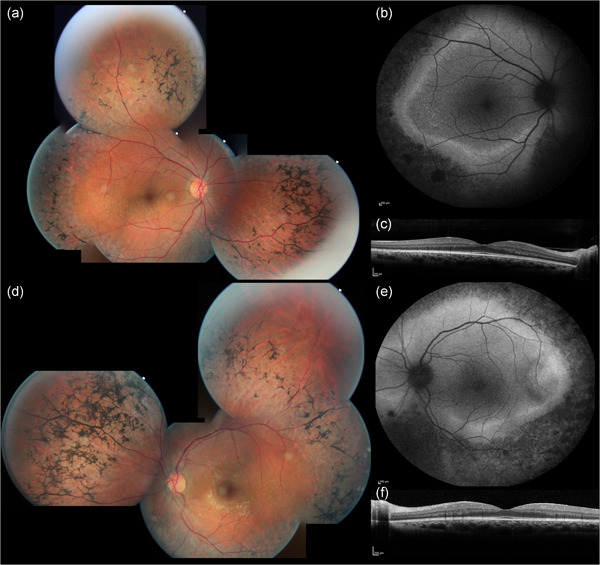
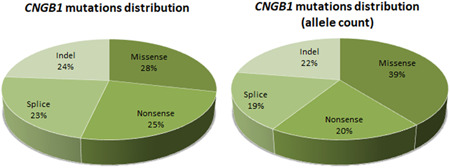
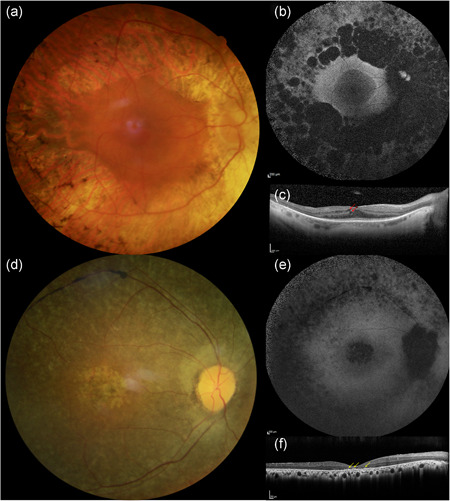
Cyclic nucleotide-gated channel β1 (CNGB1) encodes the 240-kDa β subunit of the rod photoreceptor cyclic nucleotide-gated ion channel. Disease-causing sequence variants in CNGB1 lead to autosomal recessive rod-cone dystrophy/retinitis pigmentosa (RP). We herein present a comprehensive review and analysis of all previously reported CNGB1 sequence variants, and add 22 novel variants, thereby enlarging the spectrum to 84 variants in total, including 24 missense variants (two of which may also affect splicing), 21 nonsense, 19 splicing defects (7 at noncanonical positions), 10 small deletions, 1 small insertion, 1 small insertion-deletion, 7 small duplications, and 1 gross deletion. According to the American College of Medical Genetics and Genomics classification criteria, 59 variants were considered pathogenic or likely pathogenic and 25 were variants of uncertain significance. In addition, we provide further phenotypic data from 34 CNGB1-related RP cases, which, overall, are in line with previous findings suggesting that this form of RP has long-term retention of useful central vision despite the early onset of night blindness, which is valuable for patient counseling, but also has implications for it being considered a priority target for gene therapy trials.
环核苷酸门控通道 β1(CNGB1)编码视杆细胞环核苷酸门控离子通道的 240kDaβ亚基。CNGB1 中的致病序列变异导致常染色体隐性遗传性视杆-圆锥营养不良/色素性视网膜炎(RP)。本文对所有先前报道的 CNGB1 序列变异进行了全面的回顾和分析,并增加了 22 个新的变异体,从而将该谱扩大到总共 84 个变异体,包括 24 个错义变异体(其中两个可能也影响剪接)、21 个无义变异体、19 个剪接缺陷(7 个位于非规范位置)、10 个小缺失、1 个小插入、1 个小插入-缺失、7 个小重复和 1 个大片段缺失。根据美国医学遗传学与基因组学学院的分类标准,59 个变异体被认为是致病性或可能致病性的,25 个是意义不明的变异体。此外,我们还提供了 34 个与 CNGB1 相关的 RP 病例的进一步表型数据,这些数据总体上与之前的发现一致,即这种形式的 RP 在夜间视力出现早期丧失的情况下,仍能长期保持有用的中心视力,这对患者咨询有价值,但也意味着它被认为是基因治疗试验的优先目标。