Department of Orthopaedic and Traumatology, Marmara University Pendik Training and Research Hospital, İstanbul, Turkey.
Acta Orthop Traumatol Turc. 2021 Mar;55(2):154-158. doi: 10.5152/j.aott.2021.20115.
This study aimed to investigate amputation-related factors after limb-salvage surgery (LSS) in patients with extremity-located bone and soft-tissue sarcomas and determine the relationship between these factors and patient survival.
In this retrospective study at our institution, patients in whom LSS was first performed because of an extremity-located musculoskeletal sarcoma, and subsequently amputation was carried out for various indications were included. Patient and tumor characteristics, details of surgical procedures, indications of amputation, number of operations, presence of metastasis before amputation, and post-amputation patient survival rates were analyzed.
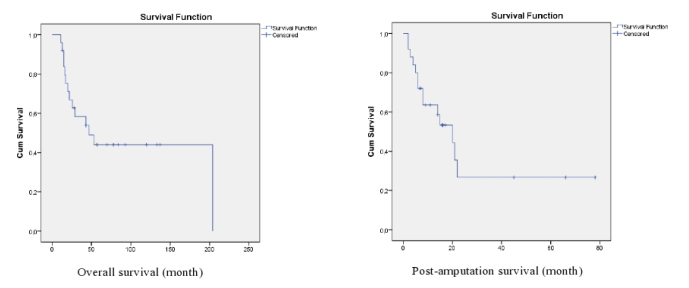
A total of 25 patients (10 men, 15 women; mean age=41.96±21.88 years), in whom amputation was performed after LSS as initial resection of an extremity sarcoma or re-resection(s) of a local recurrence, were included in the study. The leading oncological indication for amputation was local recurrence that occurred in 18 (72%) patients. Non-oncological indications included prosthetic infection in 5 (20%), mechanical failure in 1 (4%), and skin necrosis in 1 (4%) patient. The patients underwent a median of 2 (range, 1-4) limb-salvage procedures before amputation. Distant organ metastasis was detected in 22 (88%) patients during follow-up; in 13 (52%) of these patients, metastasis was present before amputation. A total of 11 (44%) patients were alive at the time of study with no evidence of the disease (n=3) or with disease (n=8), and 14 (56%) patients died of disease. The mean overall and post-amputation survival were 47±20.519 (range, 11-204) months and 22±4.303 (range, 2-78) months, respectively. The median follow-up was 27 (range, 6-125) months.
The most common causes of amputation after LSS were local recurrence and prosthetic infection. Patients who underwent amputation after LSS developed a high rate of distant organ metastasis during follow-up and had reduced survival.
Level IV, Therapeutic Study.
本研究旨在探讨保肢手术后(LSS)截肢相关因素,并确定这些因素与患者生存之间的关系。
本研究为回顾性研究,纳入在我院首次因肢体骨骼肌肉肉瘤行 LSS 治疗,后因各种原因行截肢术的患者。分析患者和肿瘤特征、手术细节、截肢指征、手术次数、截肢前转移情况以及截肢后患者生存率。
本研究共纳入 25 例患者(10 例男性,15 例女性;平均年龄 41.96±21.88 岁),这些患者因肢体肉瘤初始切除或局部复发病灶再次切除后行 LSS 治疗,最终行截肢术。截肢的主要肿瘤学指征是 18 例(72%)患者发生的局部复发。非肿瘤学指征包括 5 例(20%)患者的假体感染、1 例(4%)患者的机械故障和 1 例(4%)患者的皮肤坏死。患者在截肢前平均接受了 2(范围,1-4)次保肢手术。在随访期间,22 例(88%)患者发现远处器官转移,其中 13 例(52%)患者在截肢前已有转移。研究时,共有 11 例(44%)患者存活且无疾病证据(n=3)或有疾病证据(n=8),14 例(56%)患者死于疾病。总的和截肢后的总生存率分别为 47±20.519 个月(范围,11-204 个月)和 22±4.303 个月(范围,2-78 个月)。中位随访时间为 27(范围,6-125)个月。
LSS 后截肢最常见的原因是局部复发和假体感染。LSS 后行截肢术的患者在随访期间远处器官转移发生率较高,生存时间缩短。
IV 级,治疗性研究。