Asan Institute for Life Sciences, Seoul, Korea.
Department of Neurological Surgery, Asan Medical Center, University of Ulsan College of Medicine, Seoul, Korea.
Endocrinol Metab (Seoul). 2021 Apr;36(2):455-465. doi: 10.3803/EnM.2020.942. Epub 2021 Apr 14.
The C-C motif chemokine ligand 11 (CCL11) has been receiving attention as a potential pro-aging factor. Accordingly, it may be involved in muscle metabolism and sarcopenia, a key component of aging phenotypes. To clarify this potential, we investigated the effects of CCL11 on in vitro muscle biology and its clinical relevance for sarcopenia parameters in older adults.
Myogenesis was induced in mouse C2C12 myoblasts with 2% horse serum. Human blood samples were collected from 79 participants who underwent a functional assessment. Thereafter, CCL11 level was measured using a quantikine ELISA kit. Sarcopenia was defined using the Asian-specific guideline.
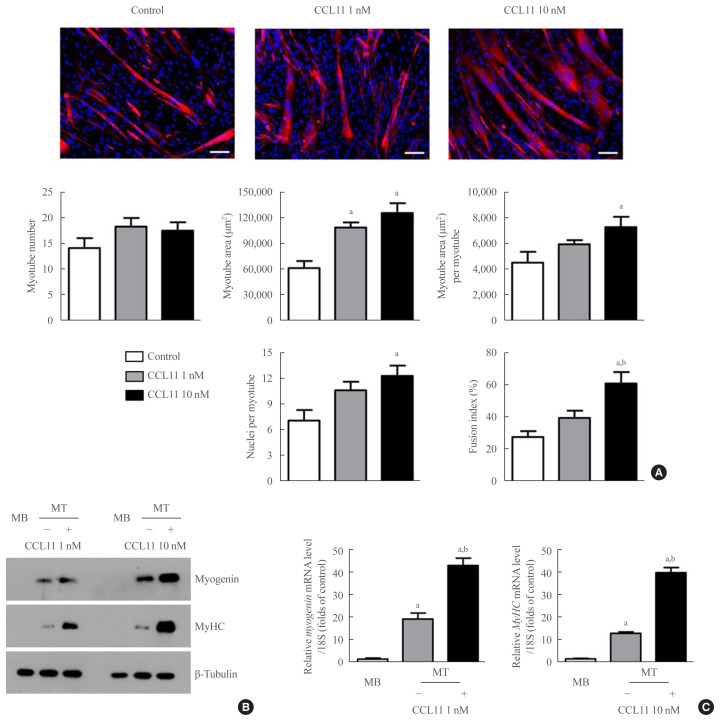
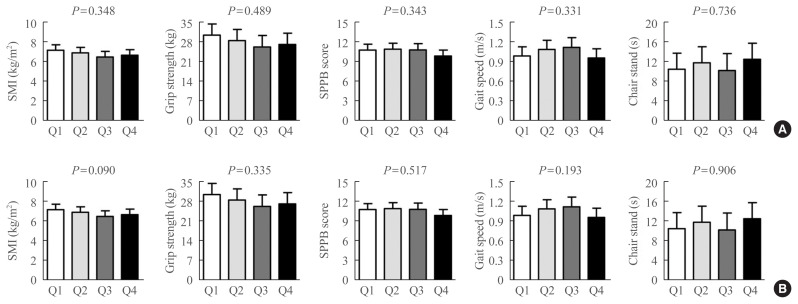
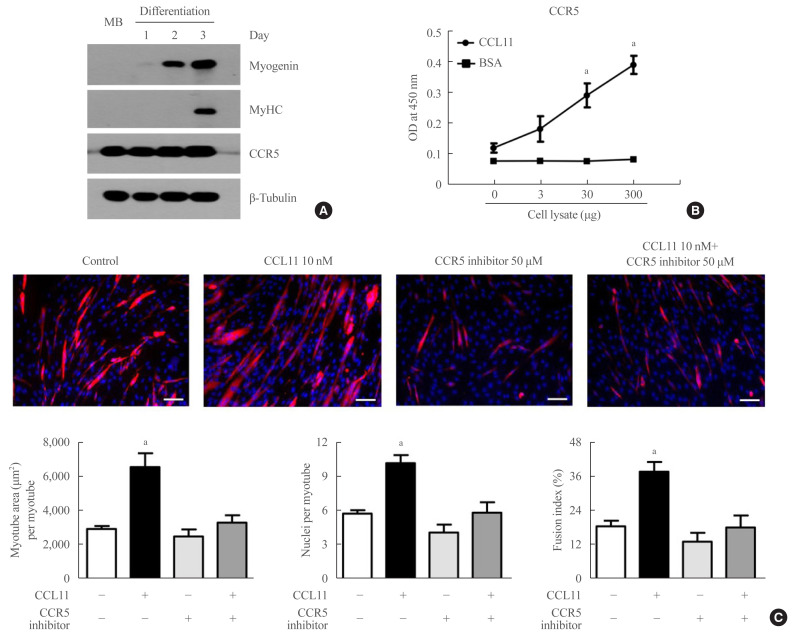
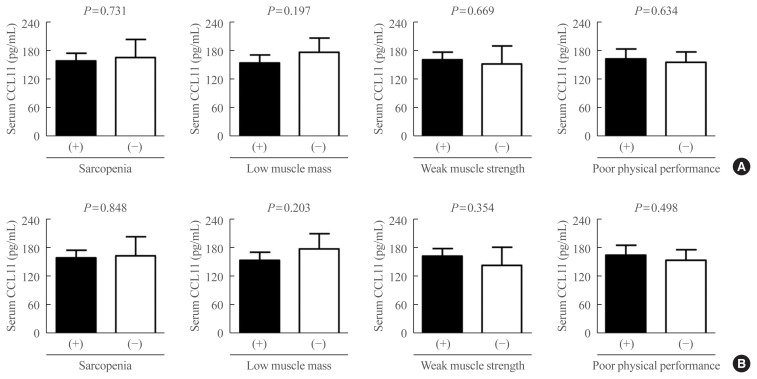
Recombinant CCL11 treatment significantly stimulated myogenesis in a dose-dependent manner, and consistently increased the expression of myogenic differentiation markers. Among the C-C chemokine receptors (CCRs), CCR5, not CCR2 and CCR3, was predominantly expressed in muscle cells. Further, the CCR5 inhibitor blocked recombinant CCL11-stimulated myogenesis. In a clinical study, serum CCL11 level was not significantly different according to the status of sarcopenia, low muscle mass, weak muscle strength, and poor physical performance, and was not associated with skeletal muscle index, grip strength, short physical performance battery score, gait speed, and time to complete 5 chair stands, after adjusting for sex, age, and body mass index.
Contrary to expectations, CCL11 exerted beneficial effects on muscle metabolism at least in vitro system. However, its impact on human muscle health was not evident, suggesting that circulating CCL11 may not be a useful biomarker for sarcopenia risk assessment in older adults.
C-C 基序趋化因子配体 11(CCL11)作为一种潜在的促衰老因子受到关注。因此,它可能参与肌肉代谢和肌肉减少症,这是衰老表型的一个关键组成部分。为了阐明这种潜在的作用,我们研究了 CCL11 对体外肌肉生物学的影响及其与老年人肌肉减少症参数的临床相关性。
用 2%马血清诱导小鼠 C2C12 成肌细胞的肌发生。从接受功能评估的 79 名参与者中采集人血样本。然后,使用定量酶联免疫吸附测定试剂盒测量 CCL11 水平。使用亚洲特定的指南定义肌肉减少症。
重组 CCL11 以剂量依赖性方式显著刺激肌发生,并且一致增加肌生成分化标志物的表达。在 C-C 趋化因子受体(CCR)中,CCR5 而不是 CCR2 和 CCR3,主要在肌肉细胞中表达。此外,CCR5 抑制剂阻断了重组 CCL11 刺激的肌发生。在一项临床研究中,血清 CCL11 水平根据肌肉减少症、低肌肉量、弱肌肉力量和身体机能差的状态没有显著差异,并且与骨骼肌指数、握力、短体适能电池评分、步态速度和完成 5 次椅子站立的时间无关,在校正性别、年龄和体重指数后。
与预期相反,CCL11 至少在体外系统中对肌肉代谢产生有益的影响。然而,它对人体肌肉健康的影响并不明显,这表明循环 CCL11 可能不是评估老年人肌肉减少症风险的有用生物标志物。