Department of Molecular and Cell Biology, Faculty of Science, University of Cape Town, Cape Town, South Africa.
Institute of Infectious Disease & Molecular Medicine, University of Cape Town, Cape Town, South Africa.
BMC Infect Dis. 2021 Apr 13;21(1):348. doi: 10.1186/s12879-021-06044-4.
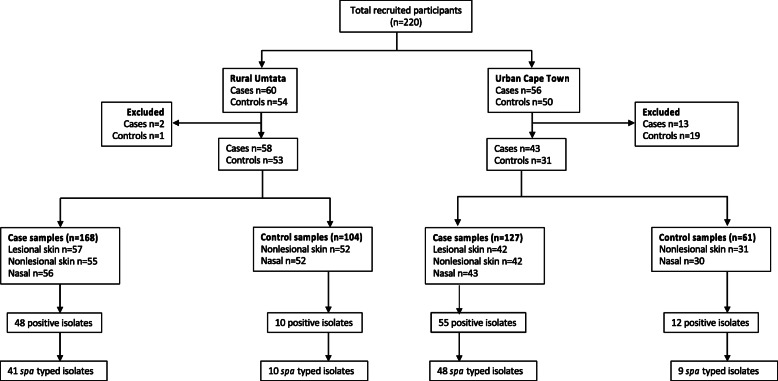
Staphylococcus aureus has been associated with the exacerbation and severity of atopic dermatitis (AD). Studies have not investigated the colonisation dynamics of S. aureus lineages in African toddlers with AD. We determined the prevalence and population structure of S. aureus in toddlers with and without AD from rural and urban South African settings.
We conducted a study of AD-affected and non-atopic AmaXhosa toddlers from rural Umtata and urban Cape Town, South Africa. S. aureus was screened from skin and nasal specimens using established microbiological methods and clonal lineages were determined by spa typing. Logistic regression analyses were employed to assess risk factors associated with S. aureus colonisation.
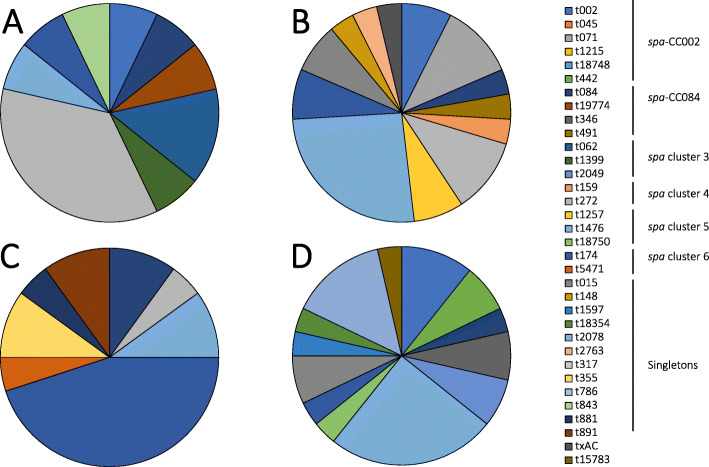
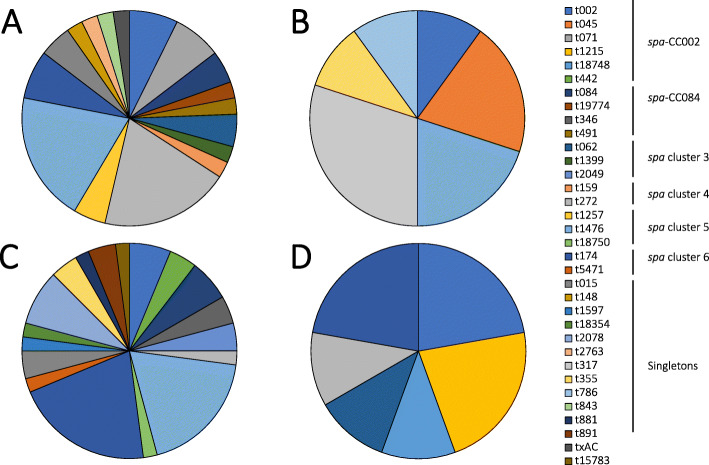
S. aureus colonisation was higher in cases compared to controls independent of geographic location (54% vs. 13%, p < 0.001 and 70% vs. 35%, p = 0.005 in Umtata [rural] and Cape Town [urban], respectively). Severe AD was associated with higher colonisation compared with moderate AD (86% vs. 52%, p = 0.015) among urban cases. Having AD was associated with colonisation in both rural (odds ratio [OR] 7.54, 95% CI 2.92-19.47) and urban (OR 4.2, 95% CI 1.57-11.2) toddlers. In rural toddlers, living in an electrified house that uses gas (OR 4.08, 95% CI 1.59-10.44) or utilises kerosene and paraffin (OR 2.88, 95% CI 1.22-6.77) for heating and cooking were associated with increased S. aureus colonisation. However, exposure to farm animals (OR 0.3, 95% CI 0.11-0.83) as well as living in a house that uses wood and coal (OR 0.14, 95% CI 0.04-0.49) or outdoor fire (OR 0.31, 95% CI 0.13-0.73) were protective. Spa types t174 and t1476, and t272 and t1476 were dominant among urban and rural cases, respectively, but no main spa type was observed among controls, independent of geographic location. In urban cases, spa type t002 and t442 isolates were only identified in severe AD, t174 was more frequent in moderate AD, and t1476 in severe AD.
The strain genotype of S. aureus differed by AD phenotypes and rural-urban settings. Continued surveillance of colonising S. aureus lineages is key in understanding alterations in skin microbial composition associated with AD pathogenesis and exacerbation.
金黄色葡萄球菌与特应性皮炎(AD)的恶化和严重程度有关。研究尚未调查 AD 非洲幼儿中金黄色葡萄球菌谱系的定植动力学。我们确定了来自南非农村和城市的 AD 受影响和非特应性 AmaXhosa 幼儿中金黄色葡萄球菌的患病率和种群结构。
我们对来自南非农村乌姆塔塔和城市开普敦的 AD 受影响和非特应性 AmaXhosa 幼儿进行了一项研究。使用既定的微生物学方法从皮肤和鼻腔标本中筛选金黄色葡萄球菌,并通过 spa 分型确定克隆谱系。采用逻辑回归分析评估与金黄色葡萄球菌定植相关的危险因素。
金黄色葡萄球菌定植在病例中高于对照组,与地理位置无关(乌姆塔塔[农村]和开普敦[城市]分别为 54%对 13%,p<0.001 和 70%对 35%,p=0.005)。与中度 AD 相比,重度 AD 与更高的定植相关(城市病例中为 86%对 52%,p=0.015)。在农村幼儿中,患有 AD 与定植相关(农村的比值比 [OR] 7.54,95%CI 2.92-19.47)和城市(OR 4.2,95%CI 1.57-11.2)。在农村幼儿中,居住在使用气体(OR 4.08,95%CI 1.59-10.44)或使用煤油和石蜡(OR 2.88,95%CI 1.22-6.77)加热和烹饪的通电房屋中,或使用木柴和煤炭(OR 0.14,95%CI 0.04-0.49)或户外火(OR 0.31,95%CI 0.13-0.73)的房屋中,金黄色葡萄球菌定植增加。然而,接触农场动物(OR 0.3,95%CI 0.11-0.83)以及居住在使用木材和煤炭(OR 0.14,95%CI 0.04-0.49)或户外火(OR 0.31,95%CI 0.13-0.73)的房屋中具有保护作用。spa 型 t174 和 t1476,以及 t272 和 t1476 在城市和农村病例中分别占优势,但在地理位置独立的情况下,在对照组中未观察到主要 spa 型。在城市病例中,spa 型 t002 和 t442 分离株仅在重度 AD 中鉴定出,t174 在中度 AD 中更频繁,t1476 在重度 AD 中更频繁。
金黄色葡萄球菌的菌株基因型因 AD 表型和城乡环境而异。持续监测定植金黄色葡萄球菌谱系是理解与 AD 发病机制和恶化相关的皮肤微生物组成变化的关键。