Department of Rehabilitation, Lentis Psychiatric Institute, Lagerhout E35, 9741 KE, Zuidlaren, The Netherlands.
Department of Clinical and Developmental Neuropsychology, University of Groningen, Grote Kruisstraat 2/1, 9712 TS, Groningen, The Netherlands.
Trials. 2021 Apr 13;22(1):275. doi: 10.1186/s13063-021-05230-8.
A fundamental challenge for many people with severe mental illness (SMI) is how to deal with cognitive impairments. Cognitive impairments are common in this population and limit daily functioning. Moreover, neural plasticity in people with SMI appears to be reduced, a factor that might hinder newly learned cognitive skills to sustain. The objective of this pilot trial is to investigate the effects of cognitive remediation (CR) on cognitive and daily functioning in people dependent on residential settings. In addition, transcranial direct current stimulation (tDCS) is used to promote neural plasticity. It is expected that the addition of tDCS can enhance learning and will result in longer-lasting improvements in cognitive and daily functioning.
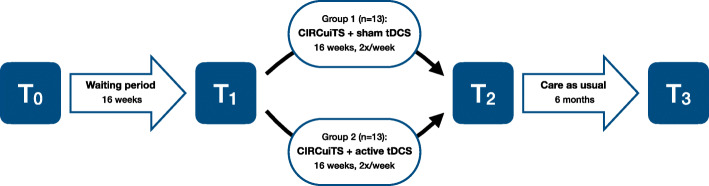
This is a pragmatic, triple-blinded, randomized, sham-controlled, pilot trial following a non-concurrent multiple baseline design with the participants serving as their own control. We will compare (1) CR to treatment as usual, (2) active/sham tDCS+CR to treatment as usual, and (3) active tDCS+CR to sham tDCS+CR. Clinical relevance, feasibility, and acceptability of the use of CR and tDCS will be evaluated. We will recruit 26 service users aged 18 years or older, with a SMI and dependent on residential facilities. After a 16-week waiting period (treatment as usual), which will serve as a within-subject control condition, participants will be randomized to 16 weeks of twice weekly CR combined with active (N = 13) or sham tDCS (N = 13). Cognitive, functional, and clinical outcome assessments will be performed at baseline, after the control (waiting) period, directly after treatment, and 6-months post-treatment.
The addition of cognitive interventions to treatment as usual may lead to long-lasting improvements in the cognitive and daily functioning of service users dependent on residential facilities. This pilot trial will evaluate whether CR on its own or in combination with tDCS can be a clinically relevant addition to further enhance recovery. In case the results indicate that cognitive performance can be improved with CR, and whether or not tDCS will lead to additional improvement, this pilot trial will be extended to a large randomized multicenter study.
Dutch Trial Registry NL7954 . Prospectively registered on August 12, 2019.
许多患有严重精神疾病 (SMI) 的人面临的一个基本挑战是如何应对认知障碍。该人群中认知障碍很常见,限制了日常功能。此外,SMI 患者的神经可塑性似乎降低,这一因素可能阻碍新习得的认知技能的维持。本试验旨在研究认知矫正 (CR) 对依赖居住环境的人群认知和日常功能的影响。此外,还使用经颅直流电刺激 (tDCS) 来促进神经可塑性。预计 tDCS 的加入可以增强学习能力,并导致认知和日常功能的改善更持久。
这是一项实用的、三盲的、随机的、假对照的试验,采用非同期多项基线设计,参与者作为自己的对照。我们将比较 (1) CR 与常规治疗,(2) 主动/假 tDCS+CR 与常规治疗,以及 (3) 主动 tDCS+CR 与假 tDCS+CR。将评估使用 CR 和 tDCS 的临床相关性、可行性和可接受性。我们将招募 26 名年龄在 18 岁或以上、患有 SMI 并依赖居住设施的服务使用者。在 16 周的等待期(常规治疗)后,将作为一个自身对照条件,参与者将被随机分为 16 周每周两次的 CR 联合主动(N=13)或假 tDCS(N=13)。在基线、等待期后、治疗后直接和治疗后 6 个月进行认知、功能和临床结果评估。
将认知干预措施添加到常规治疗中可能会导致依赖居住设施的服务使用者的认知和日常功能得到持久改善。本试验将评估 CR 本身或与 tDCS 联合使用是否可以作为进一步增强康复的临床相关补充。如果结果表明 CR 可以提高认知表现,以及 tDCS 是否会带来额外的改善,那么本试验将扩展到一个大型的随机多中心研究。
荷兰试验注册 NL7954。2019 年 8 月 12 日前瞻性注册。