Garrity Kevin F, Choudhary Kamal
Materials Science and Engineering Division, National Institute of Standards and Technology, Gaithersburg, Maryland, 20899, USA.
Theiss Research, La Jolla, CA, 92037, USA.
Sci Data. 2021 Apr 13;8(1):106. doi: 10.1038/s41597-021-00885-z.
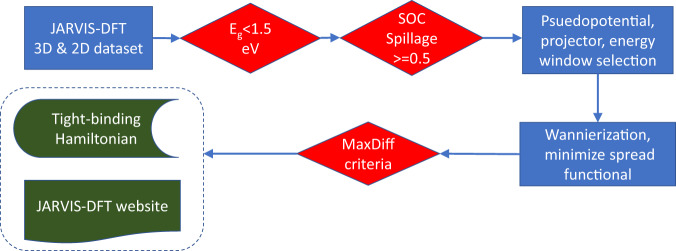
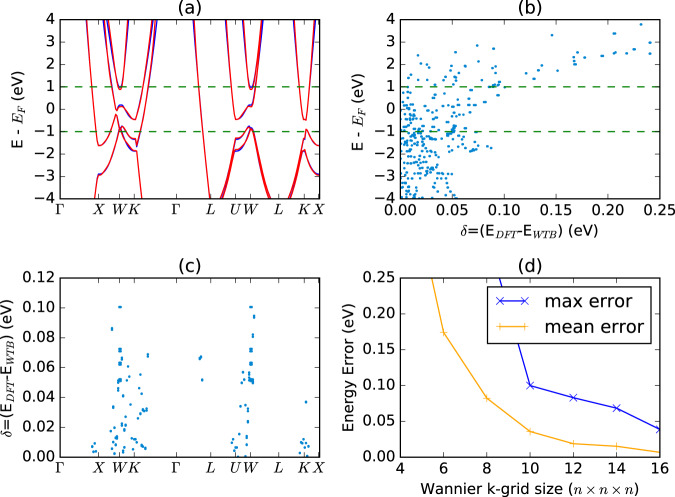
Wannier tight-binding Hamiltonians (WTBH) provide a computationally efficient way to predict electronic properties of materials. In this work, we develop a computational workflow for high-throughput Wannierization of density functional theory (DFT) based electronic band structure calculations. We apply this workflow to 1771 materials (1406 3D and 365 2D), and we create a database with the resulting WTBHs. We evaluate the accuracy of the WTBHs by comparing the Wannier band structures to directly calculated spin-orbit coupling DFT band structures. Our testing includes k-points outside the grid used in the Wannierization, providing an out-of-sample test of accuracy. We illustrate the use of WTBHs with a few example applications. We also develop a web-app that can be used to predict electronic properties on-the-fly using WTBH from our database. The tools to generate the Hamiltonian and the database of the WTB parameters are made publicly available through the websites https://github.com/usnistgov/jarvis and https://jarvis.nist.gov/jarviswtb .
万尼尔紧束缚哈密顿量(WTBH)为预测材料的电子性质提供了一种计算效率高的方法。在这项工作中,我们开发了一种计算工作流程,用于基于密度泛函理论(DFT)的电子能带结构计算的高通量万尼尔化。我们将此工作流程应用于1771种材料(1406种三维材料和365种二维材料),并创建了一个包含所得WTBH的数据库。我们通过将万尼尔能带结构与直接计算的自旋轨道耦合DFT能带结构进行比较来评估WTBH的准确性。我们的测试包括万尼尔化中使用的网格之外的k点,从而提供了对准确性的样本外测试。我们通过几个示例应用来说明WTBH的使用。我们还开发了一个网络应用程序,可用于使用我们数据库中的WTBH即时预测电子性质。生成哈密顿量和万尼尔参数数据库的工具可通过网站https://github.com/usnistgov/jarvis和https://jarvis.nist.gov/jarviswtb公开获取。