Fiester Peter, Rao Dinesh, Soule Erik, Orallo Peaches, Rahmathulla Gazanfar
Department of Neuroradiology, University of Florida Health, Jacksonville, FL, USA.
Department of Anesthesia, University of Florida Health, Jacksonville, FL, USA.
J Craniovertebr Junction Spine. 2021 Jan-Mar;12(1):4-9. doi: 10.4103/jcvjs.JCVJS_209_20. Epub 2021 Mar 4.
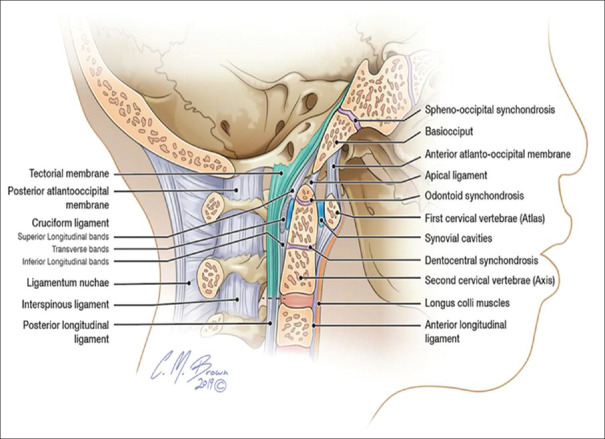
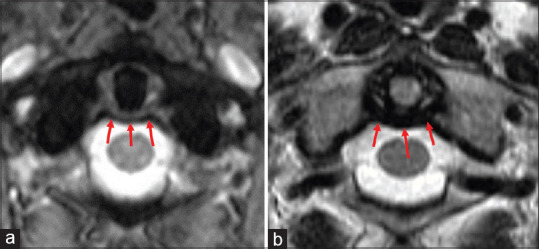
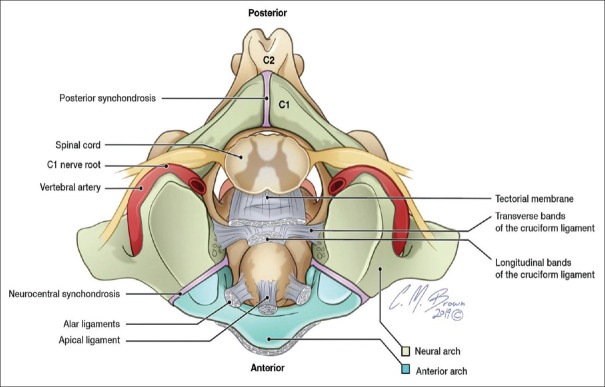
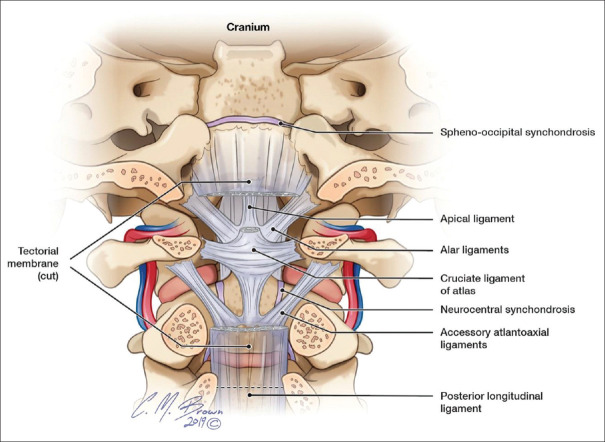
The craniocervical junction (CCJ) is a complex and unique osteoligamentous structure that balances maximum stability and protection of vital neurovascular anatomy with ample mobility and range of motion. With the increasing utilization and improved resolution of cervical magnetic resonance imaging, craniocervical injury is being more accurately defined as a spectrum of injury that ranges in severity from overt craniocervical disassociation to isolated injuries of one more of the craniocervical ligaments, which may also lead to craniocervical instability. Thus, it is vital for the radiologist and neurosurgeon to have a thorough understanding of the imaging anatomy and function of the CCJ.
颅颈交界区(CCJ)是一个复杂而独特的骨韧带结构,它在最大程度的稳定性和对重要神经血管解剖结构的保护与充足的活动度和活动范围之间取得平衡。随着颈椎磁共振成像的使用增加和分辨率提高,颅颈损伤正被更准确地定义为一系列损伤,其严重程度从明显的颅颈分离到颅颈韧带中一个或多个的孤立损伤,这也可能导致颅颈不稳定。因此,放射科医生和神经外科医生全面了解CCJ的影像解剖结构和功能至关重要。