
肌肉浸润性膀胱癌患者中衰弱与治疗方式选择的关系(FRART-BC研究)
Relationship of frailty with treatment modality selection in patients with muscle-invasive bladder cancer (FRART-BC study).
作者信息
Iwamura Hiromichi, Hatakeyama Shingo, Momota Masaki, Kojima Yuta, Narita Takuma, Okamoto Teppei, Fujita Naoki, Hamano Itsuto, Togashi Kyou, Hamaya Tomoko, Yoneyama Tohru, Yamamoto Hayato, Yoneyama Takahiro, Hashimoto Yasuhiro, Ohyama Chikara
机构信息
Department of Urology, Hirosaki University, Graduate School of Medicine, Hirosaki, Japan.
Department of Advanced Blood Purification Therapy, Hirosaki University, Graduate School of Medicine, Hirosaki, Japan.
出版信息
Transl Androl Urol. 2021 Mar;10(3):1143-1151. doi: 10.21037/tau-20-1351.
BACKGROUND
We aimed to investigate the association of frailty with treatment selection in patients with muscle-invasive bladder cancer (MIBC) as frailty is one of the key factors for modality selection.
METHODS
We retrospectively evaluated frailty in 169 patients with MIBC from January 2014 to September 2020 using the Fried phenotype, modified frailty index, and frailty discriminant score. The primary purpose was comparing the frailty between the patients who underwent radical cystectomy (RC) with those who had trimodal therapy (TMT) for bladder preservation. Secondary purposes were comparing the frailty between the groups and the effect of TMT on overall survival adjusting the frailty by multivariate Cox proportional hazards analysis using inverse probability of treatment weighting (IPTW)-adjusted model.
RESULTS
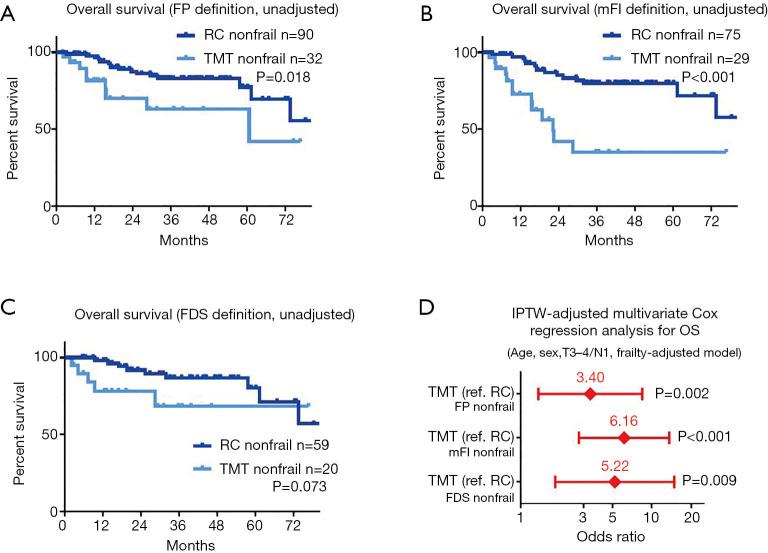
Of 169 patients, 96 and 73 were classified into the RC and the TMT groups, respectively. The median age of the TMT group was significantly higher than that of the RC group (80 . 69 years). Frailty levels and prevalence in the Fried phenotype, modified frailty index, and frailty discriminant score were significantly higher in the TMT group than those in the RC group. Logistic regression analysis showed that frailty was significantly associated with the TMT selection. Overall survival was significantly shorter in the TMT group by the IPTW-adjusted Cox regression analysis (hazard ratio 2.48, P=0.043).
CONCLUSIONS
Frailty was significantly different between the RC and TMT in patients with MIBC and might be one of the key factors for treatment selection.
背景
我们旨在研究肌肉浸润性膀胱癌(MIBC)患者的虚弱与治疗选择之间的关联,因为虚弱是治疗方式选择的关键因素之一。
方法
我们回顾性评估了2014年1月至2020年9月期间169例MIBC患者的虚弱情况,采用Fried表型、改良虚弱指数和虚弱判别评分。主要目的是比较接受根治性膀胱切除术(RC)的患者与接受三联疗法(TMT)以保留膀胱的患者之间的虚弱情况。次要目的是比较两组之间的虚弱情况,以及通过使用治疗权重逆概率(IPTW)调整模型的多变量Cox比例风险分析来调整虚弱后TMT对总生存的影响。
结果
169例患者中,分别有96例和73例被纳入RC组和TMT组。TMT组的中位年龄显著高于RC组(80.69岁)。TMT组的Fried表型、改良虚弱指数和虚弱判别评分中的虚弱水平及患病率均显著高于RC组。逻辑回归分析显示,虚弱与TMT选择显著相关。通过IPTW调整的Cox回归分析,TMT组的总生存显著缩短(风险比2.48,P = 0.043)。
结论
MIBC患者中,RC组和TMT组之间的虚弱情况存在显著差异,虚弱可能是治疗选择的关键因素之一。


 Zotero 插件