Blizard Institute, Barts and The London School of Medicine and Dentistry, Queen Mary University of London, 4 Newark Street, London, E1 2AT, UK.
Institute of Laboratory Medicine, University Hospital, LMU Munich, Munich, Germany.
Eur Child Adolesc Psychiatry. 2022 Aug;31(8):1-12. doi: 10.1007/s00787-021-01757-y. Epub 2021 Apr 13.
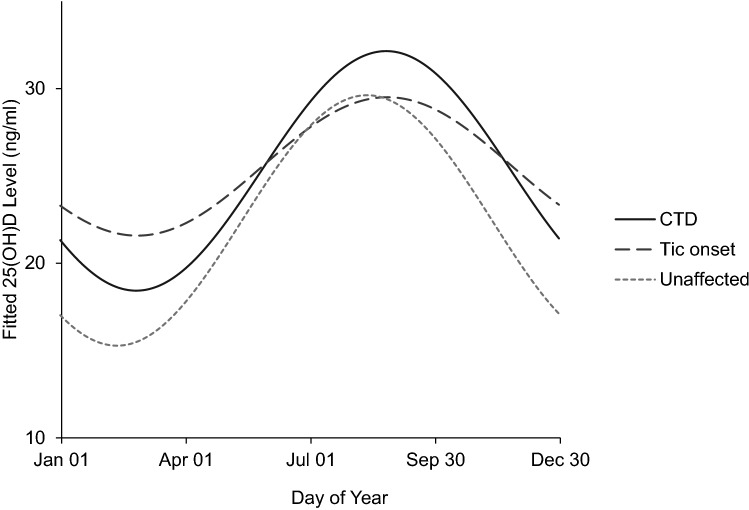
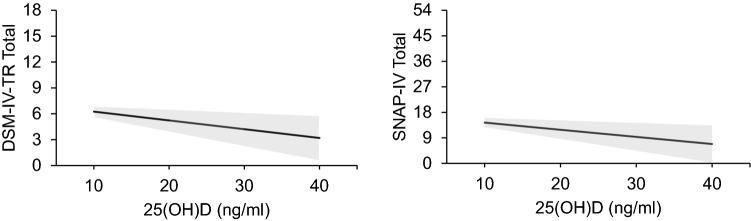
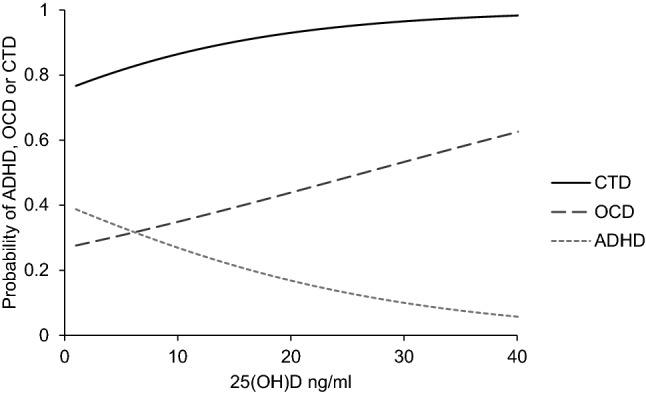
This study investigated whether vitamin D is associated with the presence or severity of chronic tic disorders and their psychiatric comorbidities. This cross-sectional study compared serum 25-hydroxyvitamin D [25(OH)D] (ng/ml) levels among three groups: children and adolescents (3-16 years) with CTD (n = 327); first-degree relatives (3-10 years) of individuals with CTD who were assessed for a period of up to 7 years for possible onset of tics and developed tics within this period (n = 31); and first-degree relatives who did not develop tics and were ≥ 10 years old at their last assessment (n = 93). The relationship between 25(OH)D and the presence and severity of tics, as well as comorbid obsessive-compulsive disorder (OCD) and attention-deficit/hyperactivity disorder (ADHD), were analysed controlling for age, sex, season, centre, latitude, family relatedness, and comorbidities. When comparing the CTD cohort to the unaffected cohort, the observed result was contrary to the one expected: a 10 ng/ml increase in 25(OH)D was associated with higher odds of having CTD (OR 2.08, 95% CI 1.27-3.42, p < 0.01). There was no association between 25(OH)D and tic severity. However, a 10 ng/ml increase in 25(OH)D was associated with lower odds of having comorbid ADHD within the CTD cohort (OR 0.55, 95% CI 0.36-0.84, p = 0.01) and was inversely associated with ADHD symptom severity (β = - 2.52, 95% CI - 4.16-0.88, p < 0.01). In conclusion, lower vitamin D levels were not associated with a higher presence or severity of tics but were associated with the presence and severity of comorbid ADHD in children and adolescents with CTD.
这项研究旨在探讨维生素 D 是否与慢性抽动障碍及其精神共病的存在或严重程度有关。本横断面研究比较了三组血清 25-羟维生素 D [25(OH)D](ng/ml)水平:患有 CTD(n=327)的儿童和青少年(3-16 岁);CTD 患者的一级亲属(3-10 岁),他们在长达 7 年的时间内接受了可能发生抽动的评估,并在此期间出现了抽动(n=31);一级亲属在最后一次评估时未出现抽动且年龄≥10 岁(n=93)。在控制年龄、性别、季节、中心、纬度、家族关系和合并症的情况下,分析了 25(OH)D 与抽动的存在和严重程度以及合并的强迫症(OCD)和注意缺陷多动障碍(ADHD)之间的关系。将 CTD 队列与未受影响的队列进行比较时,观察到的结果与预期的结果相反:25(OH)D 增加 10ng/ml 与 CTD 的发生几率更高相关(OR 2.08,95%CI 1.27-3.42,p<0.01)。25(OH)D 与抽动严重程度之间没有关联。然而,在 CTD 队列中,25(OH)D 增加 10ng/ml 与 ADHD 合并症的发生几率降低相关(OR 0.55,95%CI 0.36-0.84,p=0.01),并且与 ADHD 症状严重程度呈负相关(β=-2.52,95%CI -4.16-0.88,p<0.01)。总之,较低的维生素 D 水平与更高的抽动存在或严重程度无关,但与患有 CTD 的儿童和青少年中 ADHD 的存在和严重程度有关。