Instituto de Biotecnología, Universidad Nacional Autónoma de México, Cuernavaca, Morelos, México.
Unidad de Investigación en Medicina Experimental, Facultad de Medicina, Universidad Nacional Autónoma de México, Ciudad de México, México.
PLoS One. 2021 Apr 14;16(4):e0240958. doi: 10.1371/journal.pone.0240958. eCollection 2021.
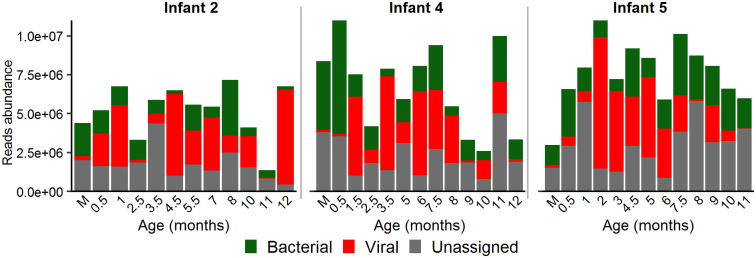
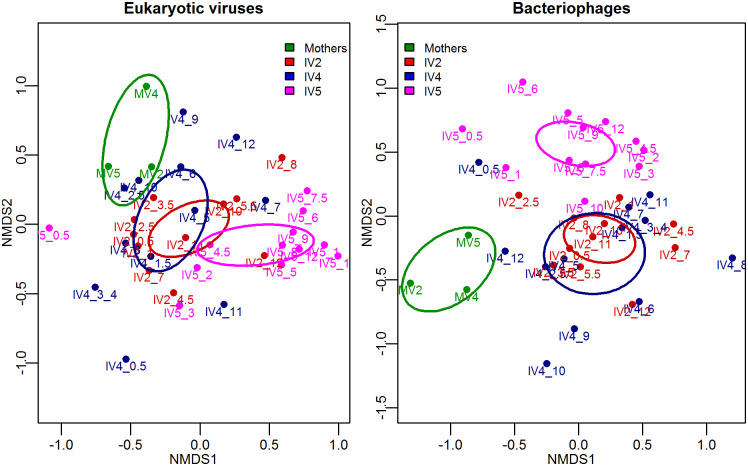
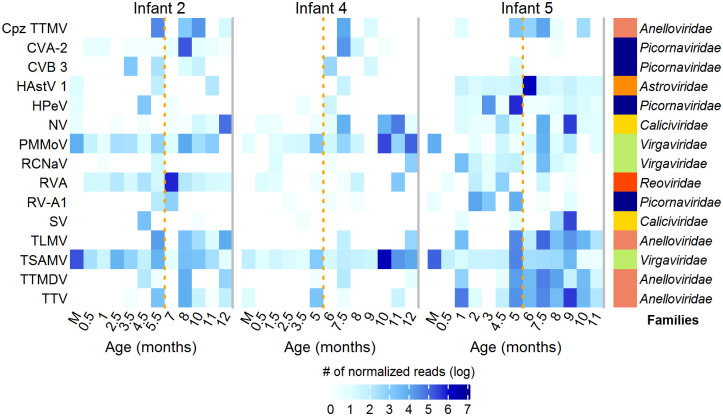
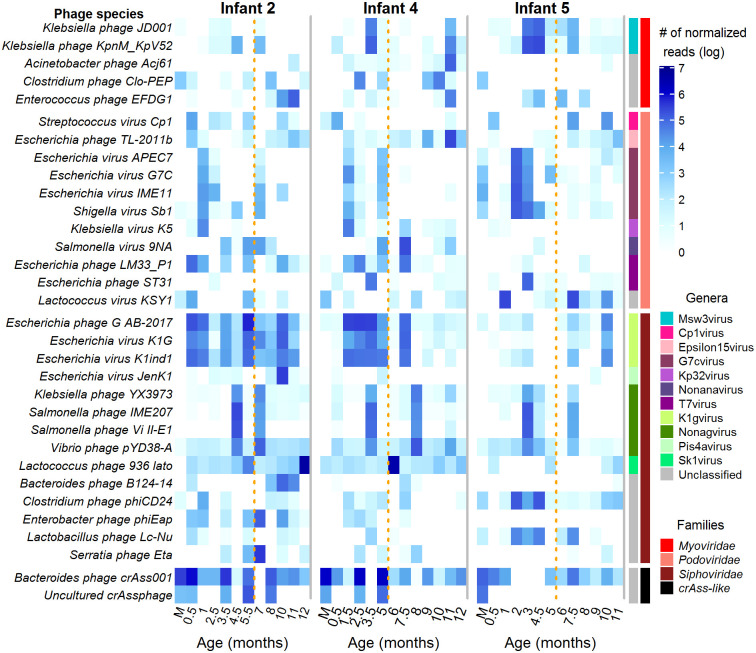
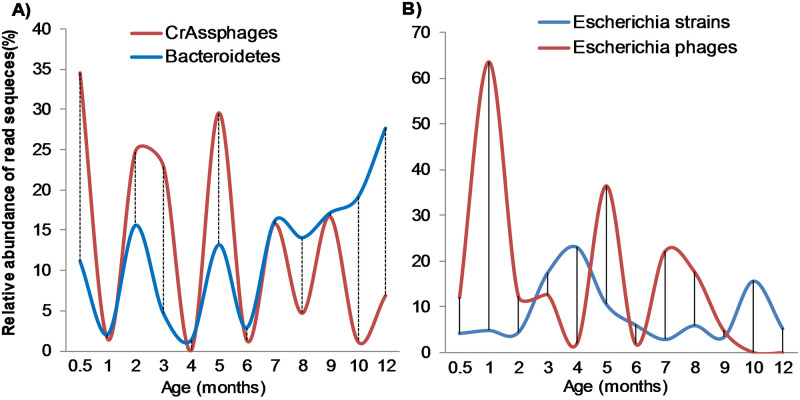
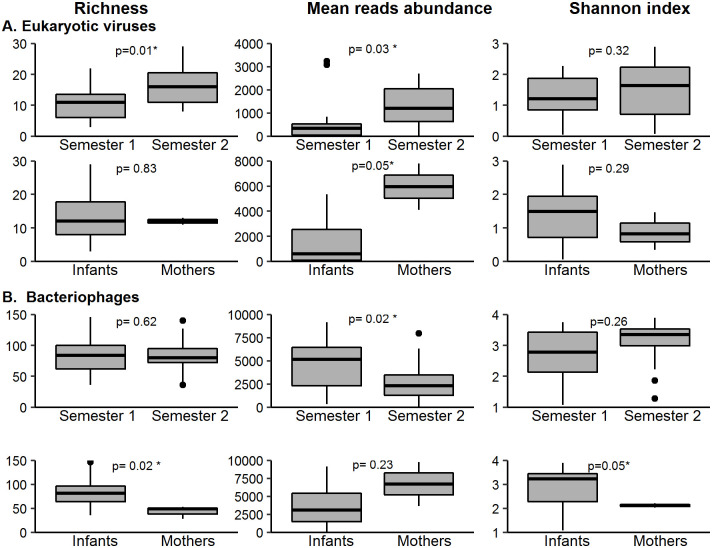
In this work, we determined the diversity and dynamics of the gut virome of infants during the first year of life. Fecal samples were collected monthly, from birth to one year of age, from three healthy children living in a semi-rural village in Mexico. Most of the viral reads were classified into six families of bacteriophages including five dsDNA virus families of the order Caudovirales, with Siphoviridae and Podoviridae being the most abundant. Eukaryotic viruses were detected as early as two weeks after birth and remained present all along the first year of life. Thirty-four different eukaryotic virus families were found, where eight of these families accounted for 98% of all eukaryotic viral reads: Anelloviridae, Astroviridae, Caliciviridae, Genomoviridae, Parvoviridae, Picornaviridae, Reoviridae and the plant-infecting viruses of the Virgaviridae family. Some viruses in these families are known human pathogens, and it is surprising that they were found during the first year of life in infants without gastrointestinal symptoms. The eukaryotic virus species richness found in this work was higher than that observed in previous studies; on average between 7 and 24 virus species were identified per sample. The richness and abundance of the eukaryotic virome significantly increased during the second semester of life, probably because of an increased environmental exposure of infants with age. Our findings suggest an early and permanent contact of infants with a diverse array of bacteriophages and eukaryotic viruses, whose composition changes over time. The bacteriophages and eukaryotic viruses found in these children could represent a metastable virome, whose potential influence on the development of the infant's immune system or on the health of the infants later in life, remains to be investigated.
在这项工作中,我们确定了婴儿在生命的第一年肠道病毒组的多样性和动态。从出生到一岁,每月从生活在墨西哥一个半农村村庄的三个健康儿童中收集粪便样本。大多数病毒读数被分类为六种噬菌体科,包括六个噬菌体科,其中五个是尾噬菌体目噬菌体科,其中 Siphoviridae 和 Podoviridae 最为丰富。真核病毒早在出生后两周就被检测到,并在整个第一年的生命中一直存在。发现了 34 种不同的真核病毒科,其中 8 种病毒科占所有真核病毒读数的 98%:细小病毒科、星状病毒科、杯状病毒科、基因组病毒科、细小病毒科、小核糖核酸病毒科、呼肠孤病毒科和植物感染病毒科。这些科中的一些病毒是已知的人类病原体,令人惊讶的是,它们在没有胃肠道症状的婴儿生命的第一年就被发现了。本研究中发现的真核病毒种丰富度高于以往研究观察到的结果;平均每个样本中鉴定出 7 到 24 种病毒。真核病毒组的丰富度和丰度在生命的第二个学期显著增加,可能是因为随着年龄的增长,婴儿的环境暴露增加。我们的研究结果表明,婴儿与各种噬菌体和真核病毒的早期和永久性接触,其组成随时间而变化。这些儿童中发现的噬菌体和真核病毒可能代表一个亚稳定的病毒组,其对婴儿免疫系统发育或婴儿日后健康的潜在影响仍有待研究。