Department of Social Pediatrics, Faculty of Medicine, Eskisehir Osmangazi University, Eskisehir 26040, Turkey.
Genomics and Health Area, Foundation for the Promotion of Sanitary and Biomedical Research of Valencia Region (FISABIO-Public Health), 46020 Valencia, Spain.
Nutrients. 2021 May 23;13(6):1779. doi: 10.3390/nu13061779.
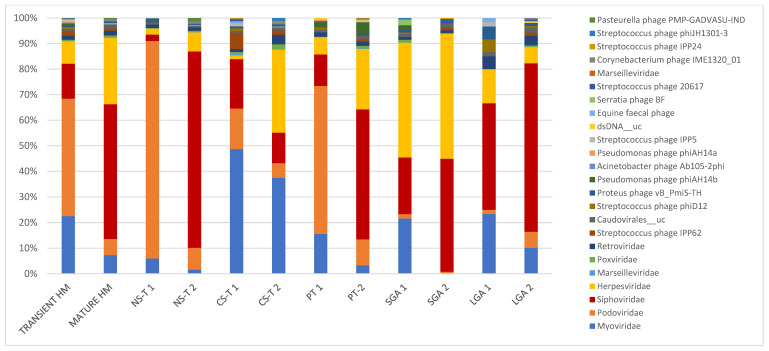
The human milk (HM) microbiota is a significant source of microbes that colonize the infant gut early in life. The aim of this study was to compare transient and mature HM virome compositions, and also possible changes related to the mode of delivery, gestational age, and weight for gestational age. Overall, in the 81 samples analyzed in this study, reads matching bacteriophages accounted for 79.5% (mainly ) of the reads, far more abundant than those classified as eukaryotic viruses (20.5%, mainly ). In the whole study group of transient human milk, the most abundant families were and . In mature human milk, decreased, and became the most abundant family. Bacteriophages were predominant in transient HM samples (98.4% in the normal spontaneous vaginal delivery group, 92.1% in the premature group, 89.9% in the C-section group, and 68.3% in the large for gestational age group), except in the small for gestational age group (only ~45% bacteriophages in transient HM samples). Bacteriophages were also predominant in mature HM; however, they were lower in mature HM than in transient HM (71.7% in the normal spontaneous vaginal delivery group, 60.8% in the C-section group, 56% in the premature group, and 80.6% in the large for gestational age group). Bacteriophages still represented 45% of mature HM in the small for gestational age group. In the transient HM of the normal spontaneous vaginal delivery group, the most abundant family was ; however, in mature HM, became less prominent than . was predominant in both transient and mature HM in the premature group (all C-section), and was predominant in transient HM, while and were predominant in mature HM. In the small for gestational age group, the most abundant taxa in transient HM were the family and a species of the genus . Bacteriophages constituted the major component of the HM virome, and we showed changes regarding the lactation period, preterm birth, delivery mode, and birth weight. Early in life, the HM virome may influence the composition of an infant's gut microbiome, which could have short- and long-term health implications. Further longitudinal mother-newborn pair studies are required to understand the effects of these variations on the composition of the HM and the infant gut virome.
人乳(HM)微生物群是定植于婴儿肠道的微生物的重要来源。本研究旨在比较短暂和成熟 HM 病毒组的组成,以及与分娩方式、胎龄和体重与胎龄比相关的可能变化。总的来说,在本研究分析的 81 个样本中,匹配噬菌体的读数占读数的 79.5%(主要是),远远多于归类为真核病毒的读数(20.5%,主要是)。在整个短暂人乳研究组中,最丰富的科是科和科。在成熟的人乳中,科和科减少,科成为最丰富的科。噬菌体在短暂 HM 样本中占优势(正常自然分娩组为 98.4%,早产组为 92.1%,剖宫产组为 89.9%,大于胎龄组为 68.3%),除了小于胎龄组(短暂 HM 样本中仅约 45%的噬菌体)。在成熟的 HM 中噬菌体也占主导地位;然而,它们在成熟的 HM 中低于在短暂的 HM 中(正常自然分娩组为 71.7%,剖宫产组为 60.8%,早产组为 56%,大于胎龄组为 80.6%)。在小于胎龄组中,成熟的 HM 中仍有 45%的噬菌体。在正常自然分娩组的短暂 HM 中,最丰富的科是科;然而,在成熟的 HM 中,科的丰度不如科。在早产组(所有剖宫产)中,噬菌体在短暂和成熟的 HM 中都占主导地位,而在短暂的 HM 中,科和科占主导地位,而在成熟的 HM 中,科和科占主导地位。在小于胎龄组中,短暂 HM 中最丰富的分类群是科和属的一个种。噬菌体构成了 HM 病毒组的主要成分,我们还发现了与哺乳期、早产、分娩方式和出生体重相关的变化。在生命早期,HM 病毒组可能会影响婴儿肠道微生物组的组成,这可能会对短期和长期健康产生影响。需要进一步进行纵向母婴对研究,以了解这些变化对 HM 和婴儿肠道病毒组组成的影响。