Boehringer Ingelheim Animal Health, Saint-Priest, France.
Boehringer Ingelheim Animal Health, Saint-Vulbas, France.
J Clin Microbiol. 2021 Jun 18;59(7):e0300620. doi: 10.1128/JCM.03006-20.
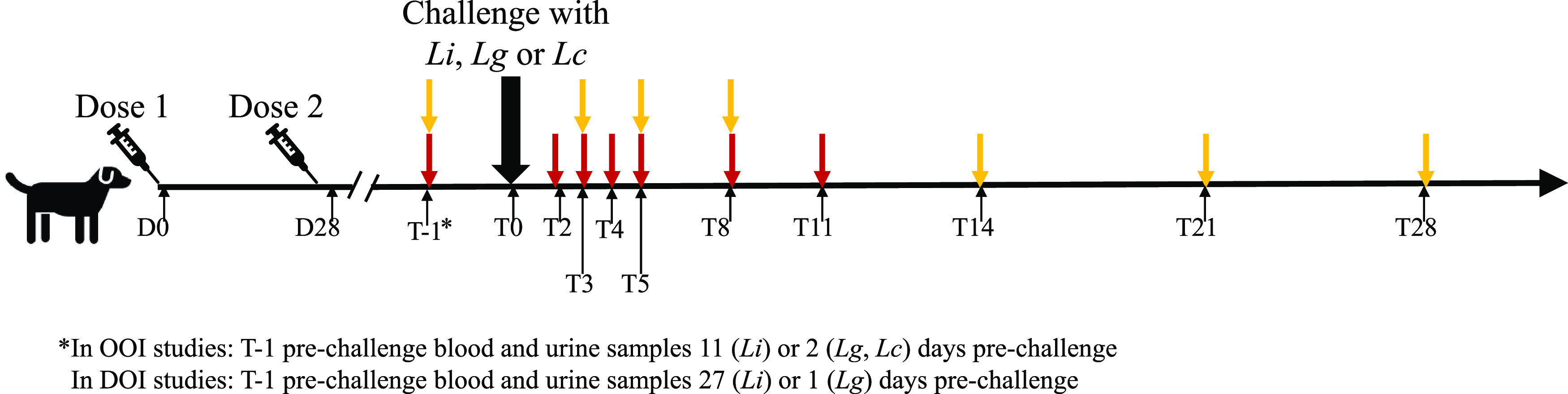
Leptospirosis is a vaccine-preventable bacterial zoonotic disease caused by pathogenic Leptospira species. The efficacy of canine vaccines is assessed by challenging vaccinated and control dogs with virulent serovars of , followed by detection of in blood and urine. We assessed the consistency between results obtained for urine and blood samples from clinical studies with species-specific real-time quantitative PCR (qPCR) targeting the gene and those obtained with the reference culture method. The specificity of the qPCR assay was confirmed by negative results for nonpathogenic and for several canine viruses, bacteria, and parasites. The results from the two methods were compared using McNemar's test, kappa coefficient (κ), and percentage of agreement analyses. The results for numbers of positive and negative dogs were similar, with no false-negative results with the qPCR assay. For both blood and urine, there was strong agreement between the culture method and qPCR results (κ = 0.68 [95% confidence interval (CI), 0.62 to 0.74] and κ = 0.65 [95% CI, 0.59 to 0.71], respectively). However, there was a statistically significant difference between blood samples ( < 0.001) and urine samples ( = 0.028). The negative percentage agreements were 97% and 84% and the positive percentage agreements were 68% and 83% for blood and urine samples, respectively. Although the cell culture method is the recommended gold standard, our results show that qPCR assay is a valid alternative method for the rapid and specific detection of pathogenic spp. in urine and blood samples during vaccine efficacy studies, without loss of sensitivity.
钩端螺旋体病是一种由致病性钩端螺旋体引起的可预防的细菌性人畜共患病。犬用疫苗的功效是通过用强毒血清型挑战接种疫苗和对照犬,然后检测血液和尿液中的 来评估的。我们评估了针对 基因的物种特异性实时定量 PCR(qPCR)与参考培养方法从临床研究中获得的尿液和血液样本结果之间的一致性。qPCR 检测方法的特异性通过对非致病性 以及几种犬病毒、细菌和寄生虫的阴性结果得到证实。使用 McNemar 检验、kappa 系数(κ)和一致性百分比分析比较了两种方法的结果。阳性和阴性犬的结果相似,qPCR 检测方法没有假阴性结果。对于血液和尿液,培养方法和 qPCR 结果之间具有很强的一致性(κ=0.68[95%置信区间(CI),0.62 至 0.74]和 κ=0.65[95%CI,0.59 至 0.71])。然而,血液样本之间存在统计学上的显著差异(<0.001),而尿液样本之间无差异(=0.028)。血液和尿液样本的阴性百分比一致性分别为 97%和 84%,阳性百分比一致性分别为 68%和 83%。尽管细胞培养法是推荐的金标准,但我们的结果表明 qPCR 检测方法是一种有效的替代方法,可用于在疫苗功效研究中快速、特异性地检测尿液和血液样本中的致病性 spp.,而不会降低敏感性。