National Infection Service, Public Health England, London, UK; Lao-Oxford-Mahosot Hospital-Wellcome Trust Research Unit, Microbiology Laboratory, Mahosot Hospital, Vientiane, Laos.
Lao-Oxford-Mahosot Hospital-Wellcome Trust Research Unit, Microbiology Laboratory, Mahosot Hospital, Vientiane, Laos; Bart's Health Division of Infection, Pathology and Pharmacy Department, Royal London Hospital, London, UK.
Clin Microbiol Infect. 2018 Sep;24(9):1017.e1-1017.e7. doi: 10.1016/j.cmi.2017.10.017. Epub 2017 Oct 26.
To compare two molecular assays (rrs quantitative PCR (qPCR) versus a combined 16SrRNA and LipL32 qPCR) on different sample types for diagnosing leptospirosis in febrile patients presenting to Mahosot Hospital, Vientiane, Laos.
Serum, buffy coat and urine samples were collected on admission, and follow-up serum ∼10 days later. Leptospira spp. culture and microscopic agglutination tests (MAT) were performed as reference standards. Bayesian latent class modelling was performed to estimate sensitivity and specificity of each diagnostic test.
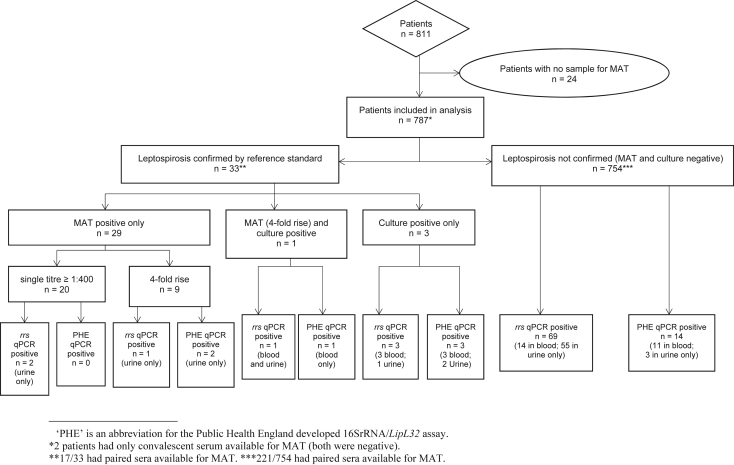
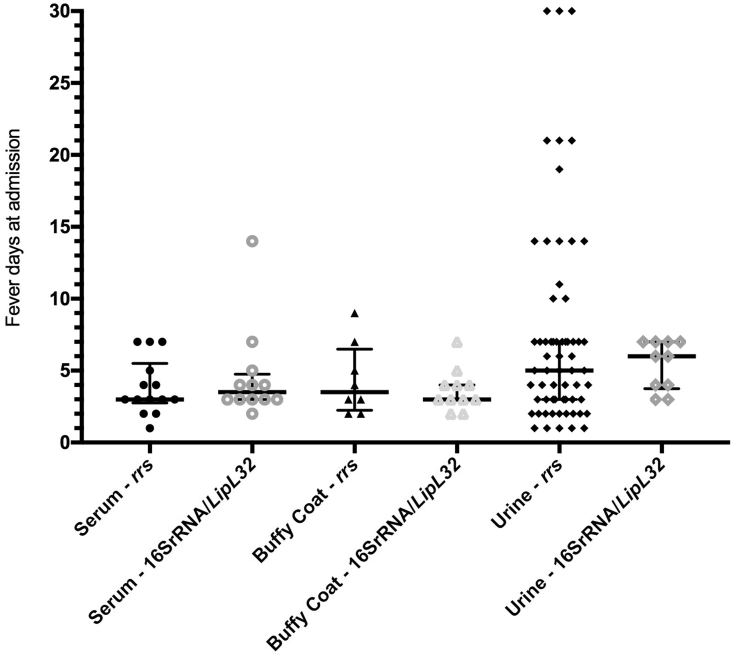
In all, 787 patients were included in the analysis: 4/787 (0.5%) were Leptospira culture positive, 30/787 (3.8%) were MAT positive, 76/787 (9.7%) were rrs qPCR positive and 20/787 (2.5%) were 16SrRNA/LipL32 qPCR positive for pathogenic Leptospira spp. in at least one sample. Estimated sensitivity and specificity (with 95% CI) of 16SrRNA/LipL32 qPCR on serum (53.9% (33.3%-81.8%); 99.6% (99.2%-100%)), buffy coat (58.8% (34.4%-90.9%); 99.9% (99.6%-100%)) and urine samples (45.0% (27.0%-66.7%); 99.6% (99.3%-100%)) were comparable with those of rrs qPCR, except specificity of 16SrRNA/LipL32 qPCR on urine samples was significantly higher (99.6% (99.3%-100%) vs. 92.5% (92.3%-92.8%), p <0.001). Sensitivities of MAT (16% (95% CI 6.3%-29.4%)) and culture (25% (95% CI 13.3%-44.4%)) were low. Mean positive Cq values showed that buffy coat samples were more frequently inhibitory to qPCR than either serum or urine (p <0.001).
Serum and urine are better samples for qPCR than buffy coat, and 16SrRNA/LipL32 qPCR performs better than rrs qPCR on urine. Quantitative PCR on admission is a reliable rapid diagnostic tool, performing better than MAT or culture, with significant implications for clinical and epidemiological investigations of this global neglected disease.
比较两种分子检测方法(rrqPCR 与 16SrRNA 和 LipL32 qPCR 联合检测)在不同样本类型下对老挝万象玛霍索医院发热患者进行钩端螺旋体病诊断的效果。
入院时采集血清、血涂片和尿液样本,约 10 天后采集后续血清样本。以钩端螺旋体培养和显微镜凝集试验(MAT)为参考标准。采用贝叶斯潜在类别建模来估计每种诊断试验的敏感性和特异性。
共纳入 787 例患者进行分析:787 例患者中,有 4 例(0.5%)钩端螺旋体培养阳性,30 例(3.8%)MAT 阳性,76 例(9.7%)rrqPCR 阳性,20 例(2.5%)16SrRNA/LipL32 qPCR 阳性,至少在一个样本中检测到致病性钩端螺旋体 spp.。血清(53.9%(33.3%-81.8%);99.6%(99.2%-100%))、血涂片(58.8%(34.4%-90.9%);99.9%(99.6%-100%))和尿液样本(45.0%(27.0%-66.7%);99.6%(99.3%-100%))中 16SrRNA/LipL32 qPCR 的估计敏感性和特异性(95%CI)与 rrqPCR 相似,除了尿液样本中 16SrRNA/LipL32 qPCR 的特异性显著更高(99.6%(99.3%-100%)vs. 92.5%(92.3%-92.8%),p<0.001)。MAT(16%(95%CI 6.3%-29.4%))和培养(25%(95%CI 13.3%-44.4%))的敏感性较低。阳性 Cq 值平均值表明,与血清或尿液相比,血涂片样本对 qPCR 的抑制作用更频繁(p<0.001)。
血清和尿液样本比血涂片样本更适合 qPCR,16SrRNA/LipL32 qPCR 对尿液样本的检测效果优于 rrqPCR。入院时进行 qPCR 是一种可靠的快速诊断工具,其性能优于 MAT 或培养,对该全球性被忽视疾病的临床和流行病学研究具有重要意义。