Department of Human Genetics, University of California, Los Angeles, CA 90095.
Department of Biology, Stanford University, Stanford, CA 94305.
Proc Natl Acad Sci U S A. 2021 Apr 20;118(16). doi: 10.1073/pnas.2019116118.
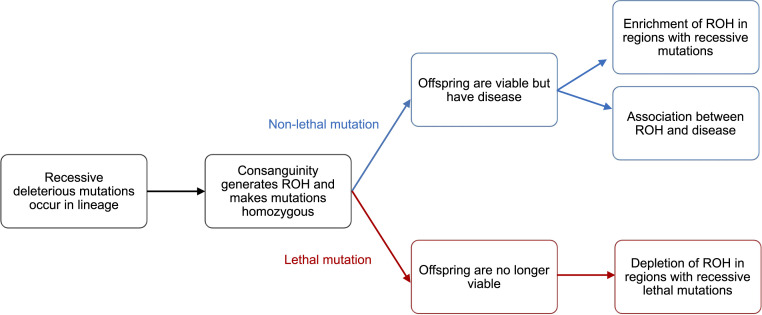
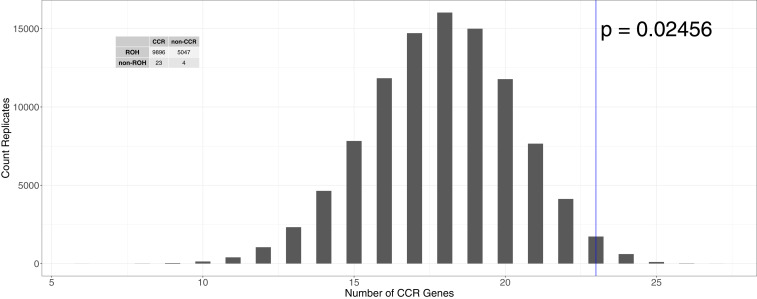
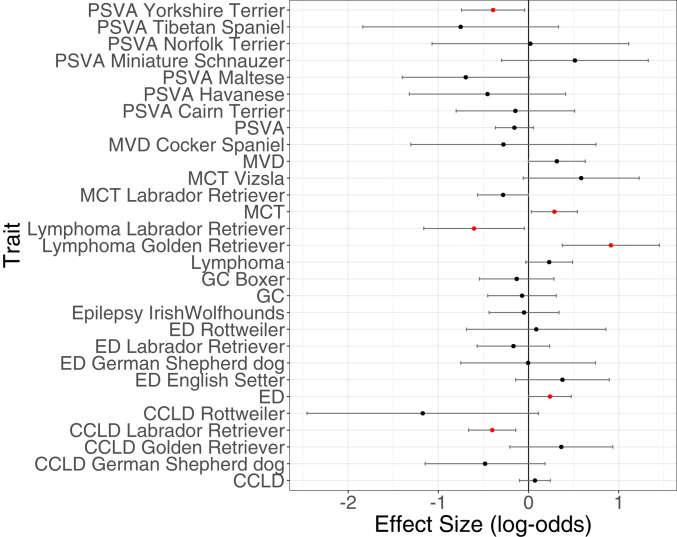
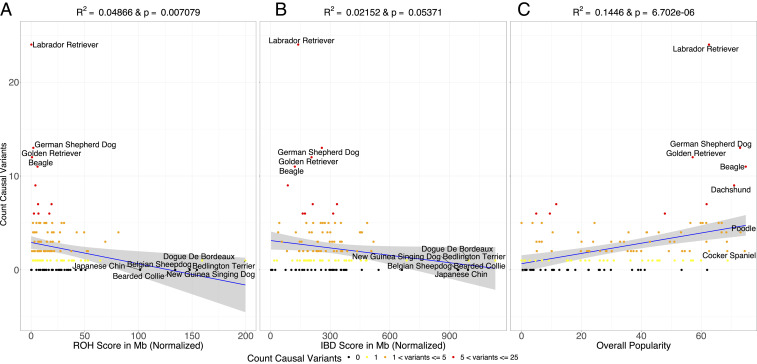
Domestic dogs have experienced population bottlenecks, recent inbreeding, and strong artificial selection. These processes have simplified the genetic architecture of complex traits, allowed deleterious variation to persist, and increased both identity-by-descent (IBD) segments and runs of homozygosity (ROH). As such, dogs provide an excellent model for examining how these evolutionary processes influence disease. We assembled a dataset containing 4,414 breed dogs, 327 village dogs, and 380 wolves genotyped at 117,288 markers and data for clinical and morphological phenotypes. Breed dogs have an enrichment of IBD and ROH, relative to both village dogs and wolves, and we use these patterns to show that breed dogs have experienced differing severities of bottlenecks in their recent past. We then found that ROH burden is associated with phenotypes in breed dogs, such as lymphoma. We next test the prediction that breeds with greater ROH have more disease alleles reported in the Online Mendelian Inheritance in Animals (OMIA). Surprisingly, the number of causal variants identified correlates with the popularity of that breed rather than the ROH or IBD burden, suggesting an ascertainment bias in OMIA. Lastly, we use the distribution of ROH across the genome to identify genes with depletions of ROH as potential hotspots for inbreeding depression and find multiple exons where ROH are never observed. Our results suggest that inbreeding has played a large role in shaping genetic and phenotypic variation in dogs and that future work on understudied breeds may reveal new disease-causing variation.
家犬经历了种群瓶颈、近期近亲繁殖和强烈的人工选择。这些过程简化了复杂性状的遗传结构,允许有害变异持续存在,并增加了同系相续(IBD)片段和纯合子区域(ROH)。因此,狗为研究这些进化过程如何影响疾病提供了一个极好的模型。我们组装了一个数据集,其中包含 4414 只品种犬、327 只乡村犬和 380 只狼,这些犬种在 117288 个标记处进行了基因分型,并提供了临床和形态表型的数据。与乡村犬和狼相比,品种犬的 IBD 和 ROH 富集程度更高,我们利用这些模式表明,品种犬在其最近的历史中经历了不同严重程度的瓶颈。然后,我们发现 ROH 负担与品种犬的表型(如淋巴瘤)有关。接下来,我们测试了这样一种预测,即 ROH 负担较大的品种在在线孟德尔遗传动物(OMIA)中报告的疾病等位基因更多。令人惊讶的是,鉴定出的因果变异数量与该品种的流行程度相关,而与 ROH 或 IBD 负担无关,这表明 OMIA 存在选择偏差。最后,我们利用 ROH 在基因组上的分布,确定 ROH 缺失的基因作为近交衰退的潜在热点,并找到了多个从未观察到 ROH 的外显子。我们的研究结果表明,近交在塑造犬类遗传和表型变异方面发挥了重要作用,未来对研究较少的品种进行研究可能会揭示新的致病变异。