Iyer Amrita A, Groves Andrew K
Department of Molecular and Human Genetics, Baylor College of Medicine, Houston, TX, United States.
Program in Genetics & Genomics, Houston, TX, United States.
Front Cell Neurosci. 2021 Mar 29;15:660748. doi: 10.3389/fncel.2021.660748. eCollection 2021.
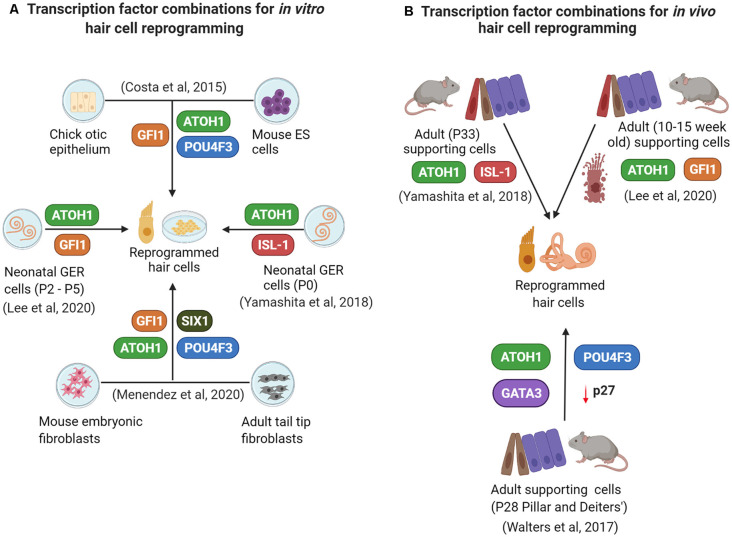
Non-mammalian vertebrates can restore their auditory and vestibular hair cells naturally by triggering the regeneration of adjacent supporting cells. The transcription factor ATOH1 is a key regulator of hair cell development and regeneration in the inner ear. Following the death of hair cells, supporting cells upregulate ATOH1 and give rise to new hair cells. However, in the mature mammalian cochlea, such natural regeneration of hair cells is largely absent. Transcription factor reprogramming has been used in many tissues to convert one cell type into another, with the long-term hope of achieving tissue regeneration. Reprogramming transcription factors work by altering the transcriptomic and epigenetic landscapes in a target cell, resulting in a fate change to the desired cell type. Several studies have shown that ATOH1 is capable of reprogramming cochlear non-sensory tissue into cells resembling hair cells in young animals. However, the reprogramming ability of ATOH1 is lost with age, implying that the potency of individual hair cell-specific transcription factors may be reduced or lost over time by mechanisms that are still not clear. To circumvent this, combinations of key hair cell transcription factors have been used to promote hair cell regeneration in older animals. In this review, we summarize recent findings that have identified and studied these reprogramming factor combinations for hair cell regeneration. Finally, we discuss the important questions that emerge from these findings, particularly the feasibility of therapeutic strategies using reprogramming factors to restore human hearing in the future.
非哺乳类脊椎动物可以通过触发相邻支持细胞的再生来自然恢复其听觉和前庭毛细胞。转录因子ATOH1是内耳毛细胞发育和再生的关键调节因子。毛细胞死亡后,支持细胞上调ATOH1并产生新的毛细胞。然而,在成熟的哺乳动物耳蜗中,毛细胞的这种自然再生在很大程度上并不存在。转录因子重编程已在许多组织中用于将一种细胞类型转化为另一种细胞类型,长期目标是实现组织再生。重编程转录因子通过改变靶细胞中的转录组和表观遗传景观来发挥作用,从而导致细胞命运转变为所需的细胞类型。多项研究表明,ATOH1能够将幼年动物的耳蜗非感觉组织重编程为类似毛细胞的细胞。然而,ATOH1的重编程能力会随着年龄的增长而丧失,这意味着单个毛细胞特异性转录因子的效力可能会随着时间的推移因尚不清楚的机制而降低或丧失。为了规避这一问题,关键毛细胞转录因子的组合已被用于促进老年动物的毛细胞再生。在这篇综述中,我们总结了最近的研究发现,这些发现确定并研究了用于毛细胞再生的重编程因子组合。最后,我们讨论了这些发现中出现的重要问题,特别是未来使用重编程因子恢复人类听力的治疗策略的可行性。