Epigenetics and Cell Fates Laboratory, Programme in Stem Cell, Regenerative Medicine and Aging, Institute of Molecular and Cell Biology, A*STAR, Singapore 138673, Singapore.
School of Biological Sciences, Nanyang Technological University, Singapore 637551, Singapore.
Sci Adv. 2020 Sep 11;6(37). doi: 10.1126/sciadv.aba1190. Print 2020 Sep.
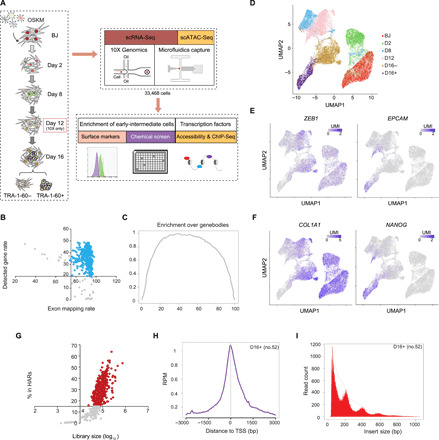
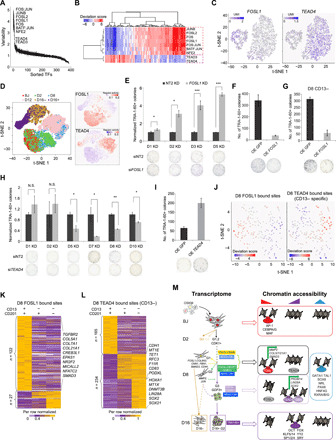
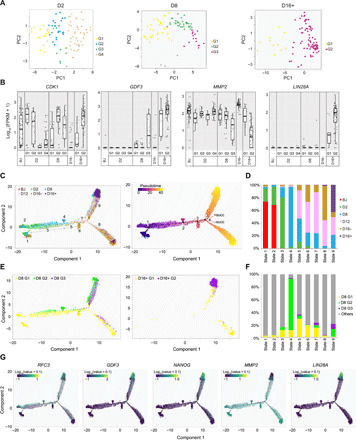
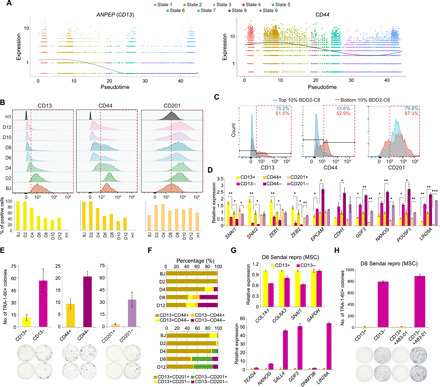
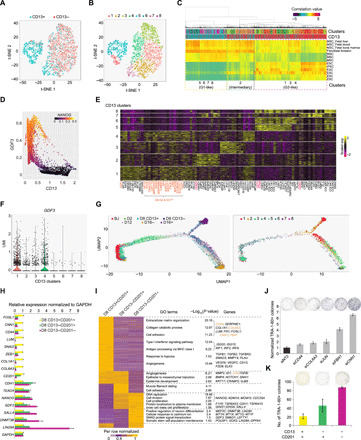
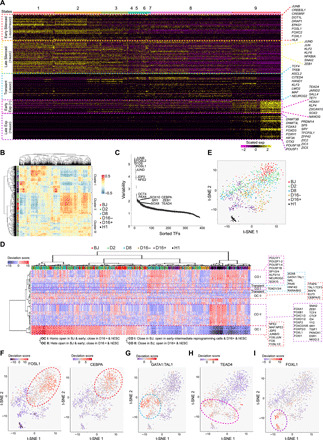
Cellular reprogramming suffers from low efficiency especially for the human cells. To deconstruct the heterogeneity and unravel the mechanisms for successful reprogramming, we adopted single-cell RNA sequencing (scRNA-Seq) and single-cell assay for transposase-accessible chromatin (scATAC-Seq) to profile reprogramming cells across various time points. Our analysis revealed that reprogramming cells proceed in an asynchronous trajectory and diversify into heterogeneous subpopulations. We identified fluorescent probes and surface markers to enrich for the early reprogrammed human cells. Furthermore, combinatory usage of the surface markers enabled the fine segregation of the early-intermediate cells with diverse reprogramming propensities. scATAC-Seq analysis further uncovered the genomic partitions and transcription factors responsible for the regulatory phasing of reprogramming process. Binary choice between a FOSL1 and a TEAD4-centric regulatory network determines the outcome of a successful reprogramming. Together, our study illuminates the multitude of diverse routes transversed by individual reprogramming cells and presents an integrative roadmap for identifying the mechanistic part list of the reprogramming machinery.
细胞重编程的效率尤其低,特别是对人类细胞而言。为了解构异质性并揭示成功重编程的机制,我们采用单细胞 RNA 测序 (scRNA-Seq) 和转座酶可及染色质的单细胞分析 (scATAC-Seq) 来描绘不同时间点的重编程细胞。我们的分析表明,重编程细胞沿着一条异步轨迹前进,并分化为异质的亚群。我们确定了荧光探针和表面标记物,以富集早期重编程的人类细胞。此外,表面标记物的组合使用可以精细地分离具有不同重编程倾向的早期-中期细胞。scATAC-Seq 分析进一步揭示了负责重编程过程调控分相的基因组分区和转录因子。FOSL1 和 TEAD4 为中心的调控网络之间的二元选择决定了成功重编程的结果。总之,我们的研究阐明了单个重编程细胞所经历的多种不同途径,并为鉴定重编程机制的机械部件提供了一个综合的路线图。