Celiac Disease Research Center, Faculty of Medicine and Health Technology, Tampere University, Tampere, Finland.
Department of Dermatology, Tampere University Hospital, Tampere, Finland.
Front Immunol. 2021 Mar 29;12:657280. doi: 10.3389/fimmu.2021.657280. eCollection 2021.
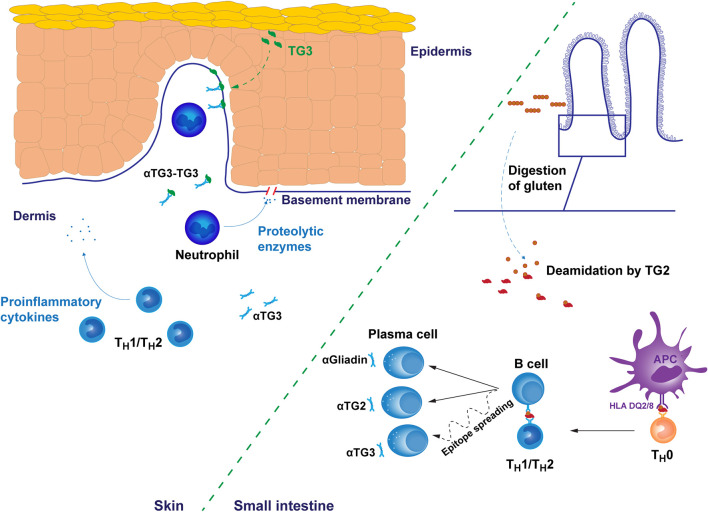
Dermatitis herpetiformis is a cutaneous form of celiac disease manifesting as an itching rash typically on the elbows, knees and buttocks. It is driven by the ingestion of gluten-containing cereals and characterized by granular deposits of immunoglobulin A in the papillary dermis. These antibodies target transglutaminase (TG) 3 and in the majority of patients they are also found in circulation. The circulating antibodies disappear and skin symptoms resolve as a result of gluten-free diet but the cutaneous anti-TG3 IgA deposits may persist for several years. In dermatitis herpetiformis, plasma cells secreting antibodies against TG3 are located in the intestinal mucosa similarly to those producing TG2 antibodies characteristic for celiac disease. In fact, both TG2- and TG3-specific plasma cells and gluten responsive T cells are found in dermatitis herpetiformis patients but the interplay between these cell populations is unknown. The small bowel mucosal damage in celiac disease is believed to be mediated by co-operation of cytotoxic intraepithelial T cells and the inflammatory milieu contributed by gluten-reactive CD4+ T cells, whereas the skin lesions in dermatitis herpetiformis appear to be devoid of gluten reactive T cells. Thus, how celiac disease-type intestinal T and B cell responses develop into an autoimmune condition affecting the skin is still incompletely understood. Finally, the skin and small bowel lesions may reappear upon reintroduction of gluten in patients treated with gluten-free diet but virtually nothing is known about the long-lived B cell and memory T cell populations activating in response to dietary gluten in dermatitis herpetiformis.
疱疹样皮炎是一种皮肤形式的乳糜泻,表现为典型的瘙痒皮疹,通常出现在肘部、膝盖和臀部。它是由含麸质的谷物摄入引起的,其特征是在乳头真皮中有免疫球蛋白 A 的颗粒沉积。这些抗体针对转谷氨酰胺酶 (TG) 3,并且在大多数患者中也存在于循环中。由于无麸质饮食,循环抗体消失,皮肤症状得到缓解,但皮肤抗 TG3 IgA 沉积可能持续数年。在疱疹样皮炎中,分泌针对 TG3 的抗体的浆细胞位于肠黏膜中,类似于产生 TG2 抗体的浆细胞,这些抗体是乳糜泻的特征。事实上,在疱疹样皮炎患者中既发现了 TG2-和 TG3-特异性浆细胞,也发现了对麸质有反应的 T 细胞,但这些细胞群体之间的相互作用尚不清楚。据信,乳糜泻中的小肠黏膜损伤是由细胞毒性上皮内 T 细胞和由麸质反应性 CD4+T 细胞贡献的炎症环境共同介导的,而疱疹样皮炎中的皮肤损伤似乎缺乏麸质反应性 T 细胞。因此,乳糜泻型肠道 T 和 B 细胞反应如何发展成影响皮肤的自身免疫性疾病仍不完全清楚。最后,在接受无麸质饮食治疗的患者中重新引入麸质时,皮肤和小肠病变可能会再次出现,但对于在疱疹样皮炎中对饮食麸质激活的长寿 B 细胞和记忆 T 细胞群体几乎一无所知。