Celiac Disease Research Center, Faculty of Medicine and Health Technology, Tampere University, FI-33520 Tampere, Finland.
Department of Dermatology, Tampere University Hospital, FI-33520 Tampere, Finland.
Int J Mol Sci. 2022 Mar 8;23(6):2910. doi: 10.3390/ijms23062910.
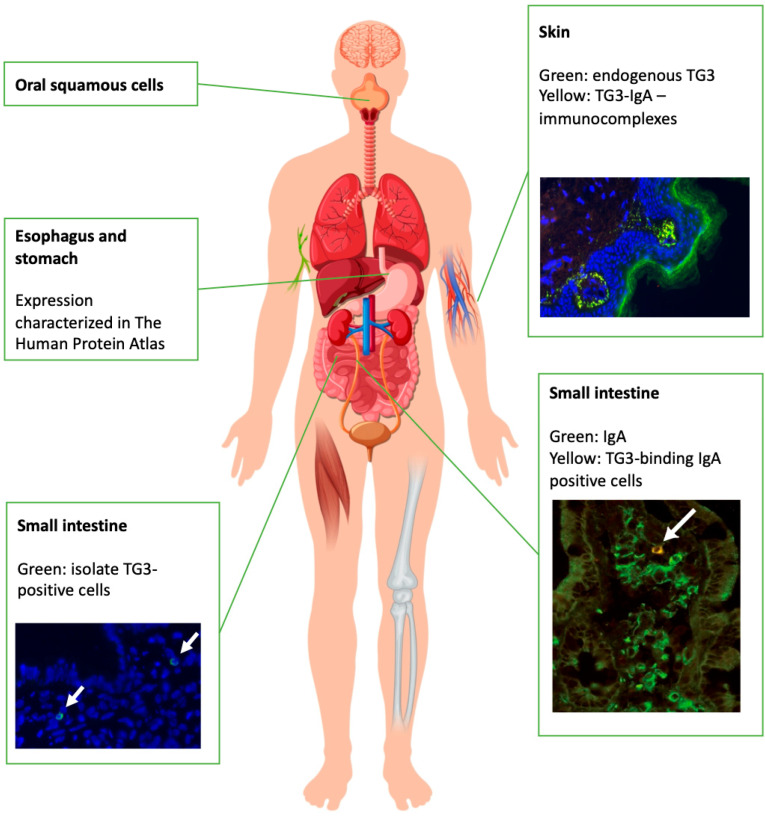
Dermatitis herpetiformis (DH) is the skin manifestation of celiac disease, presenting with a blistering rash typically on the knees, elbows, buttocks and scalp. In both DH and celiac disease, exposure to dietary gluten triggers a cascade of events resulting in the production of autoantibodies against the transglutaminase (TG) enzyme, mainly TG2 but often also TG3. The latter is considered to be the primary autoantigen in DH. The dynamics of the development of the TG2-targeted autoimmune response have been studied in depth in celiac disease, but the immunological process underlying DH pathophysiology is incompletely understood. Part of this process is the occurrence of granular deposits of IgA and TG3 in the perilesional skin. While this serves as the primary diagnostic finding in DH, the role of these immunocomplexes in the pathogenesis is unknown. Intriguingly, even though gluten-intolerance likely develops initially in a similar manner in both DH and celiac disease, after the onset of the disease, its manifestations differ widely.
疱疹样皮炎(DH)是乳糜泻的皮肤表现,表现为水疱性皮疹,通常见于膝盖、肘部、臀部和头皮。在 DH 和乳糜泻中,暴露于膳食麸质会引发一系列事件,导致针对转谷氨酰胺酶(TG)酶的自身抗体的产生,主要是 TG2,但通常也有 TG3。后者被认为是 DH 的主要自身抗原。在乳糜泻中,已经深入研究了 TG2 靶向自身免疫反应的发展动态,但 DH 病理生理学的免疫学过程尚不完全清楚。该过程的一部分是在病变皮肤周围出现 IgA 和 TG3 的颗粒状沉积物。虽然这是 DH 的主要诊断发现,但这些免疫复合物在发病机制中的作用尚不清楚。有趣的是,尽管麸质不耐受可能最初以类似的方式在 DH 和乳糜泻中发展,但在疾病发作后,其表现差异很大。