Gavriliuc Stefan, Stothart Mason R, Henry Astrid, Poissant Jocelyn
Faculty of Veterinary Medicine, University of Calgary, Calgary, AB, Canada.
PeerJ. 2021 Mar 9;9:e10837. doi: 10.7717/peerj.10837. eCollection 2021.
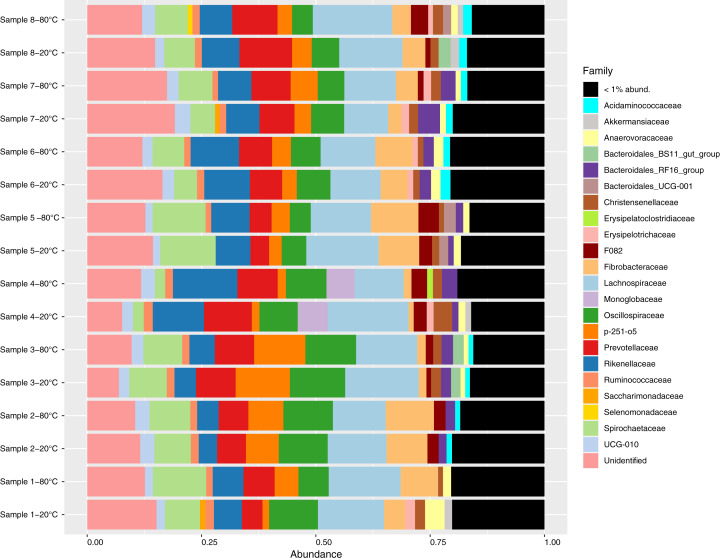
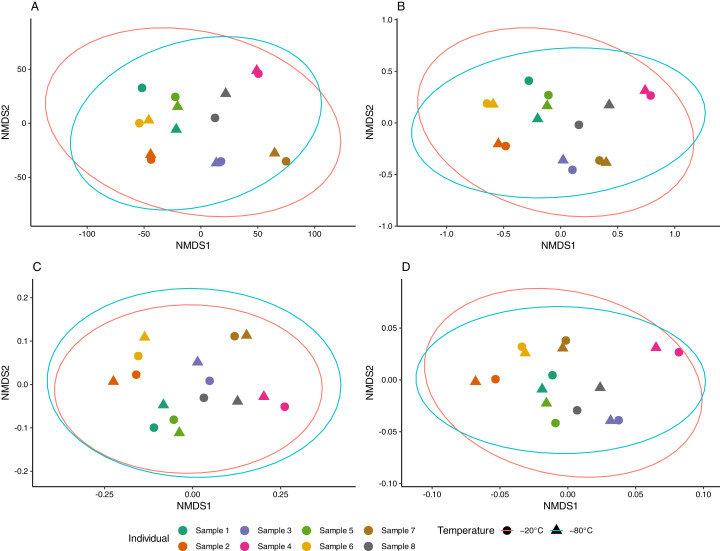
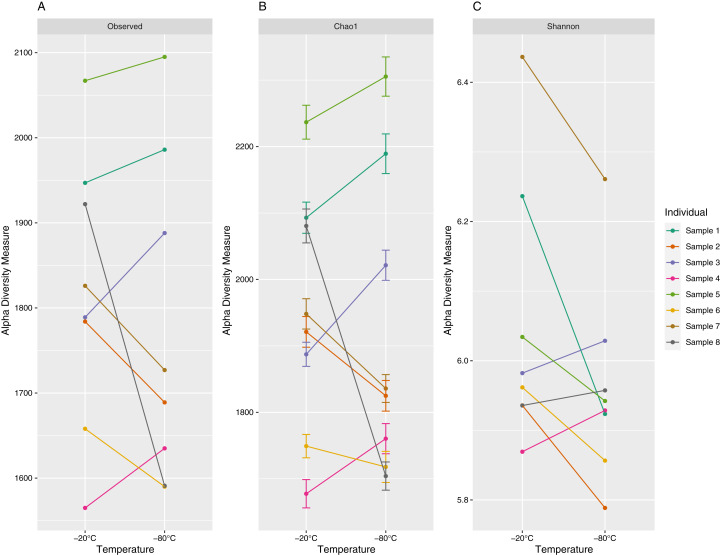
The development of next-generation sequencing technologies has spurred a surge of research on bacterial microbiome diversity and function. But despite the rapid growth of the field, many uncertainties remain regarding the impact of differing methodologies on downstream results. Sample storage temperature is conventionally thought to be among the most important factors for ensuring reproducibility across marker gene studies, but to date much of the research on this topic has focused on short-term storage in the context of clinical applications. Consequently, it has remained unclear if storage at -80 °C, widely viewed as the gold standard for long-term archival of feces, is truly required for maintaining sample integrity in amplicon-based studies. A better understanding of the impacts of long-term storage conditions is important given the substantial cost and limited availability of ultra-low temperature freezers. To this end, we compared bacterial microbiome profiles inferred from 16S V3-V4 amplicon sequencing for paired fecal samples obtained from a feral horse population from Sable Island, Nova Scotia, Canada, stored at either -80 °C or -20 °C for 4 years. We found that storage temperature did not significantly affect alpha diversity measures, including amplicon sequence variant (ASV) richness and evenness, and abundance of rare sequence variants, nor presence/absence, relative abundances and phylogenetic diversity weighted measures of beta diversity. These results indicate that storage of equine feces at -20 °C for periods ranging from a few months to a few years is equivalent to storage at -80 °C for amplicon-based microbiome studies, adding to accumulating evidence indicating that standard domestic freezers are both economical and effective for microbiome research.
下一代测序技术的发展推动了对细菌微生物组多样性和功能的大量研究。尽管该领域发展迅速,但关于不同方法对下游结果的影响仍存在许多不确定性。样本储存温度通常被认为是确保跨标记基因研究可重复性的最重要因素之一,但迄今为止,关于这一主题的许多研究都集中在临床应用背景下的短期储存。因此,对于基于扩增子的研究而言,将粪便长期存档的黄金标准——-80°C储存,是否真的是维持样本完整性所必需的,仍不清楚。鉴于超低温冰箱成本高昂且可用性有限,更好地了解长期储存条件的影响很重要。为此,我们比较了从加拿大新斯科舍省塞布尔岛的野马种群采集的配对粪便样本的细菌微生物组概况,这些样本分别在-80°C或-20°C下储存了4年,并通过16S V3-V4扩增子测序进行推断。我们发现,储存温度对α多样性指标没有显著影响,包括扩增子序列变体(ASV)的丰富度和均匀度、稀有序列变体的丰度,以及β多样性的有无、相对丰度和系统发育多样性加权指标。这些结果表明,对于基于扩增子的微生物组研究,将马粪便在-20°C下储存几个月至几年的效果与在-80°C下储存相当,越来越多的证据表明,标准家用冰箱对微生物组研究既经济又有效。