Universitätsklinikum Erlangen, Friedrich-Alexander Universität (FAU) Erlangen-Nürnberg, Medizinische Klinik 1, Erlangen, Germany.
Universitätsklinikum Regensburg, Regensburg, Germany.
Eur Radiol. 2021 Oct;31(10):7614-7625. doi: 10.1007/s00330-021-07872-3. Epub 2021 Apr 15.
Hepatocellular carcinoma (HCC) can be diagnosed non-invasively with contrast-enhanced ultrasound (CEUS) in cirrhosis if the characteristic pattern of arterial phase hyperenhancement followed by hypoenhancement is present. Recent studies suggest that diagnosis based on this "hyper-hypo" pattern needs further refinement. This study compares the diagnostic accuracies of standardized CEUS for HCC according to the current guideline definition and following the newly developed CEUS algorithms (CEUS LI-RADS®, ESCULAP) in a prospective multicenter real-life setting.
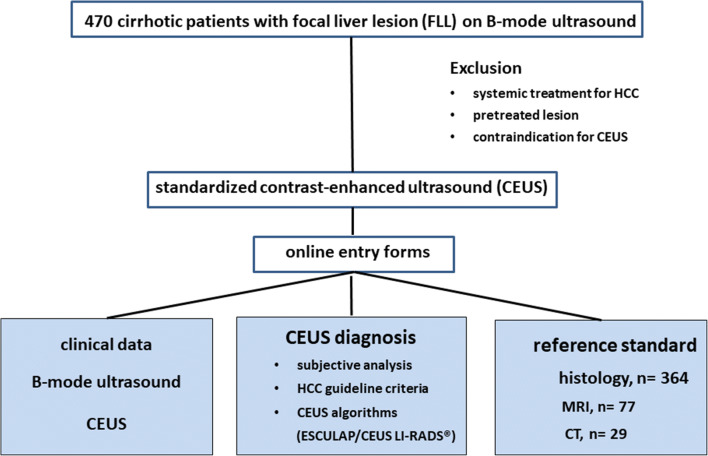
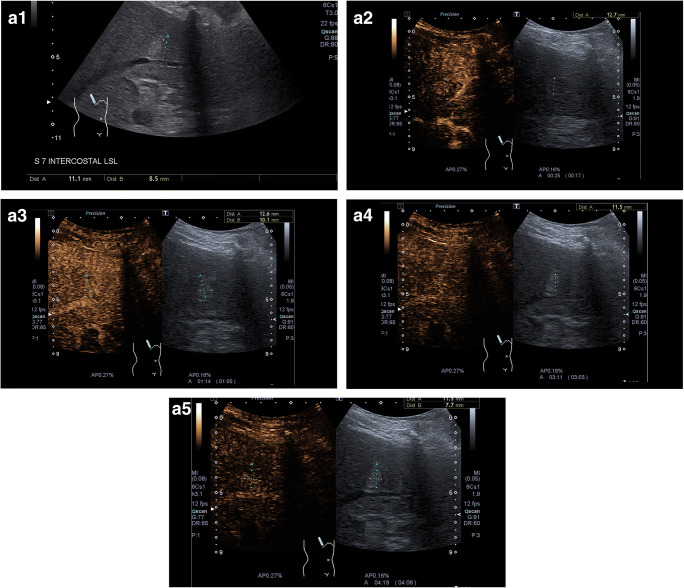
Cirrhotic patients with liver lesions on B-mode ultrasound were recruited prospectively from 04/2018 to 04/2019, and clinical and imaging data were collected. The CEUS standard included an additional examination point after 4-6 min in case of no washout after 3 min. The diagnostic accuracies of CEUS following the guidelines ("hyper-hypo" pattern), based on the examiner's subjective interpretation ("CEUS subjective"), and based on the CEUS algorithms ESCULAP and CEUS LI-RADS® were compared.
In total, 470 cirrhotic patients were recruited in 43 centers. The final diagnosis was HCC in 378 cases (80.4%) according to the reference standard (histology 77.4%, MRI 16.4%, CT 6.2%). The "hyper-hypo" pattern yielded 74.3% sensitivity and 63% specificity. "CEUS subjective" showed a higher diagnostic accuracy (sensitivity, 91.5%; specificity, 67.4%; positive predictive value, 92%; negative predictive value, 66%). Sensitivity was higher for ESCULAP (95%) and "CEUS subjective" (91.5%) versus CEUS LI-RADS® (65.2%; p < 0.001). Specificity was highest for CEUS LI-RADS® (78.6%; p < 0.001).
CEUS has an excellent diagnostic accuracy for the non-invasive diagnosis of HCC in cirrhosis. CEUS algorithms may be a helpful refinement of the "hyper-hypo" pattern defined by current HCC guidelines.
• Contrast-enhanced ultrasound (CEUS) has a high diagnostic accuracy for the non-invasive diagnosis of hepatocellular carcinoma (HCC) in cirrhosis. • The CEUS algorithm ESCULAP (Erlanger Synopsis for Contrast-enhanced Ultrasound for Liver lesion Assessment in Patients at risk) showed the highest sensitivity, whereas the CEUS LI-RADS® (Contrast-Enhanced UltraSound Liver Imaging Reporting and Data System) algorithm yielded the highest specificity. • A standardized CEUS examination procedure with an additional examination point in the late phase, after 4-6 min in lesions with no washout after 3 min, is vital.
在肝硬化患者中,如果存在动脉期高增强后低增强的特征性模式,则可以通过对比增强超声(CEUS)对肝细胞癌(HCC)进行非侵入性诊断。最近的研究表明,基于这种“高-低”模式的诊断需要进一步细化。本研究在一个前瞻性多中心真实环境中,比较了根据当前指南定义和新开发的 CEUS 算法(CEUS LI-RADS®、ESCAPUL)进行标准化 CEUS 对 HCC 的诊断准确性。
从 2018 年 4 月至 2019 年 4 月,前瞻性招募了 B 型超声显示肝脏病变的肝硬化患者,并收集了临床和影像学数据。CEUS 标准包括在 3 分钟后无洗脱的情况下,在 4-6 分钟后增加一个额外的检查点。比较了基于指南的 CEUS 诊断准确性(“高-低”模式)、基于检查者主观解释的 CEUS 诊断准确性(“CEUS 主观”)和基于 ESCAPUL 和 CEUS LI-RADS®的 CEUS 算法的诊断准确性。
共有 470 例肝硬化患者在 43 个中心被招募。根据参考标准(组织学 77.4%、MRI 16.4%、CT 6.2%),最终诊断为 HCC 的有 378 例(80.4%)。“高-低”模式的敏感性为 74.3%,特异性为 63%。“CEUS 主观”显示出更高的诊断准确性(敏感性为 91.5%,特异性为 67.4%,阳性预测值为 92%,阴性预测值为 66%)。ESCULAP(95%)和“CEUS 主观”(91.5%)的敏感性均高于 CEUS LI-RADS®(65.2%;p<0.001)。CEUS LI-RADS®的特异性最高(78.6%;p<0.001)。
CEUS 对肝硬化患者 HCC 的非侵入性诊断具有出色的诊断准确性。CEUS 算法可能是对当前 HCC 指南定义的“高-低”模式的有益细化。
对比增强超声(CEUS)对肝硬化患者肝细胞癌(HCC)的非侵入性诊断具有较高的准确性。
ESCAPUL(Erlanger 总结对比增强超声在风险患者肝脏病变评估中的应用)算法的敏感性最高,而 CEUS LI-RADS®(对比增强超声肝脏成像报告和数据系统)算法的特异性最高。
标准化的 CEUS 检查程序至关重要,在 3 分钟后无洗脱的情况下,在第 4-6 分钟时在病变中增加一个额外的检查点。