Bruter Alexandra V, Korshunova Diana S, Kubekina Marina V, Sergiev Petr V, Kalinina Anastasiia A, Ilchuk Leonid A, Silaeva Yuliya Yu, Korshunov Eugenii N, Soldatov Vladislav O, Deykin Alexey V
Core Facility Centre, Institute of Gene Biology, Russian Academy of Sciences, Vavilova st. 34/5, Moscow, Russian Federation, 119334.
Center for Precision Genome Editing and Genetic Technologies for Biomedicine, Institute of Gene Biology, Russian Academy of Sciences, Vavilova st. 34/5, Moscow, Russian Federation, 119334.
Transgenic Res. 2021 Apr 14;30(3):289-301. doi: 10.1007/s11248-021-00249-8.
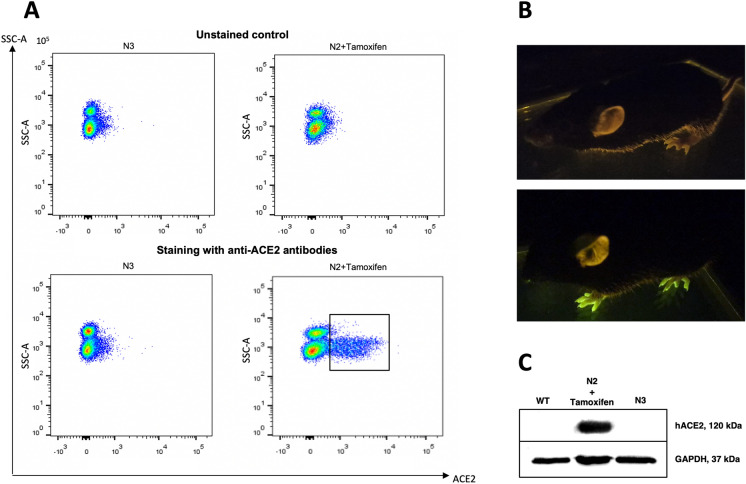
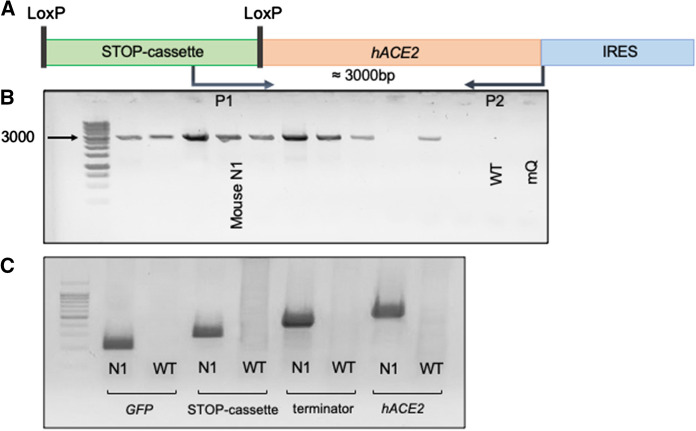
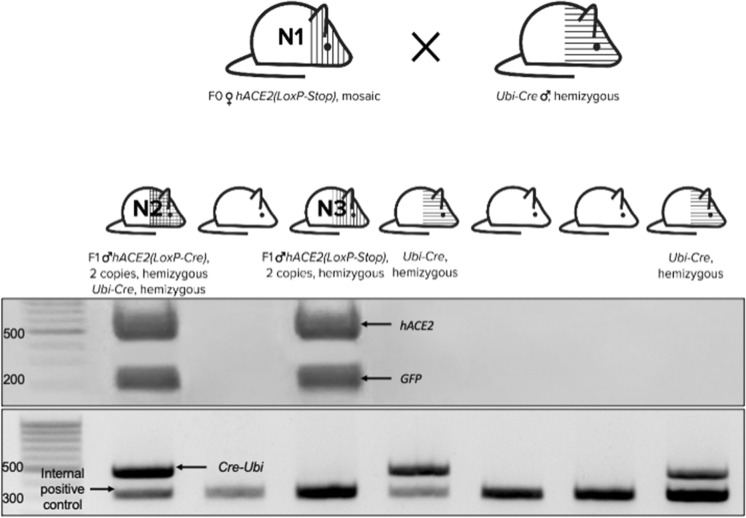
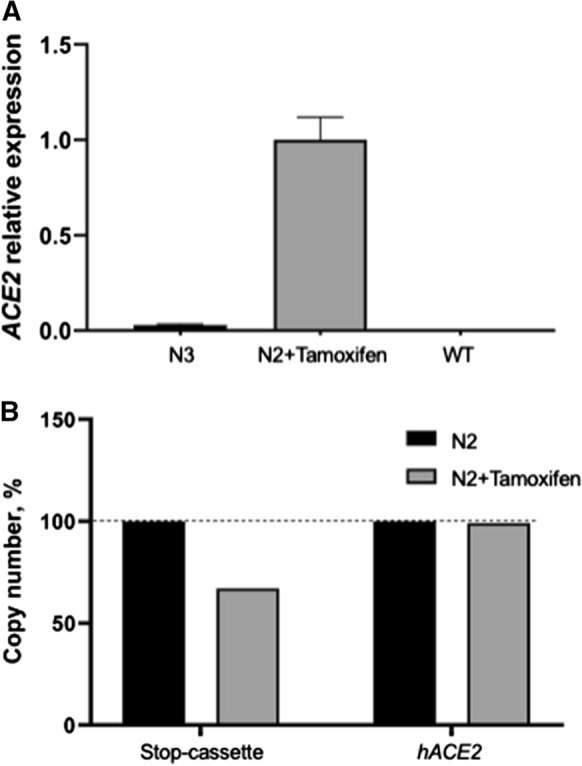
The current coronavirus disease (COVID-19) pandemic remains one of the most serious public health problems. Increasing evidence shows that infection by severe acute respiratory syndrome coronavirus-2 (SARS-CoV-2) causes a very complex and multifaceted disease that requires detailed study. Nevertheless, experimental research on COVID-19 remains challenging due to the lack of appropriate animal models. Herein, we report novel humanized mice with Cre-dependent expression of hACE2, the main entry receptor of SARS-CoV-2. These mice carry hACE2 and GFP transgenes floxed by the STOP cassette, allowing them to be used as breeders for the creation of animals with tissue-specific coexpression of hACE2 and GFP. Moreover, inducible expression of hACE2 makes this line biosafe, whereas coexpression with GFP simplifies the detection of transgene-expressing cells. In our study, we tested our line by crossing with Ubi-Cre mice, characterized by tamoxifen-dependent ubiquitous activation of Cre recombinase. After tamoxifen administration, the copy number of the STOP cassette was decreased, and the offspring expressed hACE2 and GFP, confirming the efficiency of our system. We believe that our model can be a useful tool for studying COVID-19 pathogenesis because the selective expression of hACE2 can shed light on the roles of different tissues in SARS-CoV-2-associated complications. Obviously, it can also be used for preclinical trials of antiviral drugs and new vaccines.
当前的冠状病毒病(COVID-19)大流行仍然是最严重的公共卫生问题之一。越来越多的证据表明,严重急性呼吸综合征冠状病毒2(SARS-CoV-2)感染会引发一种非常复杂且多方面的疾病,需要进行详细研究。然而,由于缺乏合适的动物模型,对COVID-19的实验研究仍然具有挑战性。在此,我们报告了一种新型的人源化小鼠,其hACE2(SARS-CoV-2的主要进入受体)具有Cre依赖性表达。这些小鼠携带由STOP盒介导的hACE2和GFP转基因,使其能够用作繁殖动物,用于创建具有hACE2和GFP组织特异性共表达的动物。此外,hACE2的诱导性表达使该品系具有生物安全性,而与GFP的共表达简化了转基因表达细胞的检测。在我们的研究中,我们通过与Ubi-Cre小鼠杂交来测试我们的品系,Ubi-Cre小鼠的特征是他莫昔芬依赖性的Cre重组酶普遍激活。给予他莫昔芬后,STOP盒的拷贝数减少,后代表达hACE2和GFP,证实了我们系统的有效性。我们相信,我们的模型可以成为研究COVID-19发病机制的有用工具,因为hACE2的选择性表达可以阐明不同组织在SARS-CoV-2相关并发症中的作用。显然,它也可用于抗病毒药物和新疫苗的临床前试验。