Leroux Eric J, Kaufman Elizabeth A, Kontaxis Christian N, Lipman Grant S
Eisenhower Health, Department of Emergency Medicine, Rancho Mirage, California.
Scripps Health, Department of Emergency Medicine, San Diego, California.
West J Emerg Med. 2021 Jan 21;22(2):445-449. doi: 10.5811/westjem.2020.10.48831.
Pain control is an essential component of musculoskeletal injury treatment in the emergency department (ED). We evaluated the most effective type of cryotherapy for analgesia of acute musculoskeletal injury and the impact on opioid utilization.
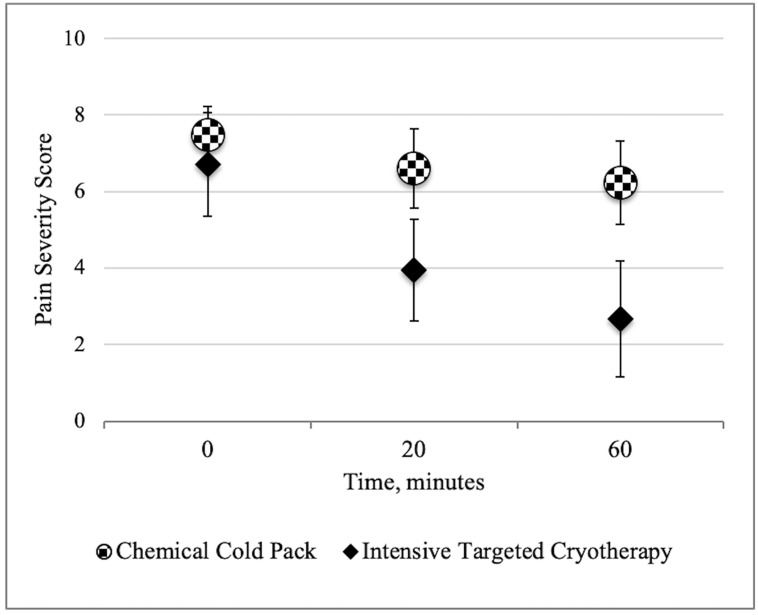
This was a prospective, randomized, single-blind controlled trial of adult ED patients who presented with acute musculoskeletal pain. Patients were randomized to either intensive targeted cryotherapy (crushed wetted ice in a plastic bag) or agitated chemical cold pack applied to the injury site for 20 minutes. All other diagnostic and therapeutic orders were at the discretion of the treating physician. Visual analog pain scores were measured at the time of cryotherapy application, at 20 minutes (time of cryotherapy removal), and at 60 minutes (40 minutes after removal).
We enrolled 38 patients, 17 randomized to intensive targeted cryotherapy and 21 to chemical cold packs, with well-matched demographics. The intensive targeted cryotherapy group achieved significantly greater pain relief at 20 minutes (2.1 [95% confidence interval (CI), 1.3 - 2.9] vs 0.9 [95% CI, 0.3 - 1.5], P < 0.05) and at 60 minutes (2.7 [95% CI, 1.6 - 3.7] vs 1.2 [95% CI, 0.6 - 1.7], P < 0.05), number need to trial (NNT) = 3.2. Opioid administration in the ED was significantly lower in the intensive targeted cryotherapy group (1 [6%] vs 7 [33%], P < 0.05), NNT = 3.6. Those who received a discharge opiate prescription had significantly higher 60-minute pain scores (7.3 ± 2.2 vs 4.1 ± 2.7, P < 0.05).
Intensive targeted cryotherapy provided more effective analgesia than chemical cold packs for acute musculoskeletal injuries in the ED and may contribute to lower opioid usage.
疼痛控制是急诊科(ED)肌肉骨骼损伤治疗的重要组成部分。我们评估了用于急性肌肉骨骼损伤镇痛的最有效冷冻疗法类型以及对阿片类药物使用的影响。
这是一项针对出现急性肌肉骨骼疼痛的成年急诊科患者的前瞻性、随机、单盲对照试验。患者被随机分为强化靶向冷冻疗法组(塑料袋中碾碎的湿冰)或应用于损伤部位20分钟的搅拌化学冷敷袋组。所有其他诊断和治疗医嘱由主治医生自行决定。在应用冷冻疗法时、20分钟(去除冷冻疗法时)和60分钟(去除后40分钟)测量视觉模拟疼痛评分。
我们纳入了38例患者,17例随机分配至强化靶向冷冻疗法组,21例分配至化学冷敷袋组,两组人口统计学特征匹配良好。强化靶向冷冻疗法组在20分钟时(2.1[95%置信区间(CI),1.3 - 2.9]对0.9[95%CI,0.3 - 1.5],P<0.05)和60分钟时(2.7[95%CI,1.6 - 3.7]对1.2[95%CI,0.6 - 1.7],P<0.05)疼痛缓解明显更大,需治疗人数(NNT)=3.2。强化靶向冷冻疗法组在急诊科的阿片类药物使用显著更低(1例[6%]对7例[33%],P<0.05),NNT = 3.6。那些收到出院阿片类药物处方的患者60分钟时的疼痛评分显著更高(7.3±2.2对4.1±2.7,P<0.05)。
对于急诊科的急性肌肉骨骼损伤,强化靶向冷冻疗法比化学冷敷袋提供了更有效的镇痛效果,并且可能有助于降低阿片类药物的使用。