W.J. Peterson is assistant professor, Department of Emergency Medicine, University of Michigan Medical School, Ann Arbor, Michigan; ORCID: https://orcid.org/0000-0003-3950-3054 .
B.W. Munzer is assistant professor, Department of Emergency Medicine, University of Michigan Medical School, Ann Arbor, Michigan.
Acad Med. 2021 Oct 1;96(10):1414-1418. doi: 10.1097/ACM.0000000000004120.
The most effective way to train clinicians to safely don and doff personal protective equipment (PPE) and perform aerosol-generating procedures (AGPs), such as intubations, is unknown when clinician educators are unavailable, as they have been during the COVID-19 pandemic. Proper PPE and airway management techniques are critical to prevent the transmission of respiratory illnesses such as COVID-19.
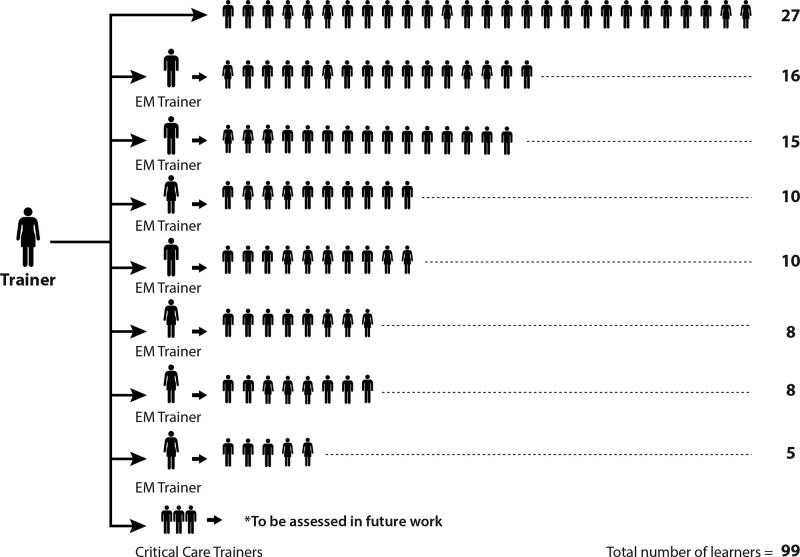
In March 2020, the authors implemented a structured train-the-trainers curriculum to teach PPE techniques and a modified airway management algorithm for suspected COVID-19 patients. A single emergency medicine physician trainer taught 17 subsequent emergency medicine and critical care physician trainers the proper PPE and airway management techniques. The initial trainer and 7 of the subsequent trainers then instructed 99 other emergency medicine resident and attending physicians using in situ simulation. Trainers and learners completed retrospective pre-post surveys to assess their comfort teaching the material and performing the techniques, respectively.
The surveys demonstrated a significant increase in the trainers' comfort in teaching simulation-based education, from 4.00 to 4.53 on a 5-point Likert scale (P < .005), and in teaching the airway management techniques through simulation, from 2.47 to 4.47 (P < .001). There was no difference in the change in comfort level between those learners who were taught by the initial trainer and those who were taught by the subsequent trainers. These results suggest that the subsequent trainers were as effective in teaching the simulation material as the initial trainer.
Work is ongoing to investigate clinician- and patient-specific outcomes, including PPE adherence, appropriate AGP performance, complication rate, and learners' skill retention. Future work will focus on implementing similar train-the-trainers strategies for other health professions, specialties, and high-risk or rare procedures.
当临床医生教育者无法提供帮助时,例如在 COVID-19 大流行期间,培训临床医生安全穿戴和脱下个人防护设备 (PPE) 并进行产生气溶胶的程序 (AGP)(例如插管)的最有效方法尚不清楚。正确的 PPE 和气道管理技术对于预防 COVID-19 等呼吸道疾病的传播至关重要。
2020 年 3 月,作者实施了一项结构化的培训培训师课程,以教授 PPE 技术和针对疑似 COVID-19 患者的改良气道管理算法。一名急诊医学医师培训师教授了 17 名后续的急诊医学和重症监护医师正确的 PPE 和气道管理技术。最初的培训师和 7 名后续的培训师随后使用现场模拟指导了 99 名其他急诊医学住院医师和主治医生。培训师和学习者分别完成了回顾性的前后调查,以评估他们教授材料和执行技术的舒适度。
调查显示,培训师在教授模拟基础教育方面的舒适度显着提高,从 5 分制的 4.00 提高到 4.53(P<.005),通过模拟教授气道管理技术的舒适度从 2.47 提高到 4.47(P<.001)。最初的培训师和后续培训师教授的学习者的舒适度水平变化没有差异。这表明后续培训师在教授模拟材料方面与最初的培训师一样有效。
正在开展工作以调查与患者和临床医生特定相关的结果,包括 PPE 佩戴、适当的 AGP 性能、并发症发生率以及学习者的技能保留情况。未来的工作将侧重于为其他健康专业、专业和高风险或罕见程序实施类似的培训培训师策略。