Bisanzio Donal, Montresor Antonio, French Michael, Reithinger Richard, Rodari Paola, Bisoffi Zeno, Buonfrate Dora
RTI International, Washington DC, United States of America.
Epidemiology and Public Health Division, School of Medicine, University of Nottingham, Nottingham, United Kingdom.
PLoS Negl Trop Dis. 2021 Apr 15;15(4):e0009314. doi: 10.1371/journal.pntd.0009314. eCollection 2021 Apr.
Strongyloides stercoralis is a soil-transmitted helminth (STH) that affects approximately 600 million people worldwide. Interventions targeting S. stercoralis have not been implemented yet. Specific treatment (ivermectin) could be included in already ongoing preventive chemotherapy (PC) campaigns targeting other STHs. The aim of this study was to estimate the quantity of ivermectin needed for an integrated STH/S. stercoralis control program.
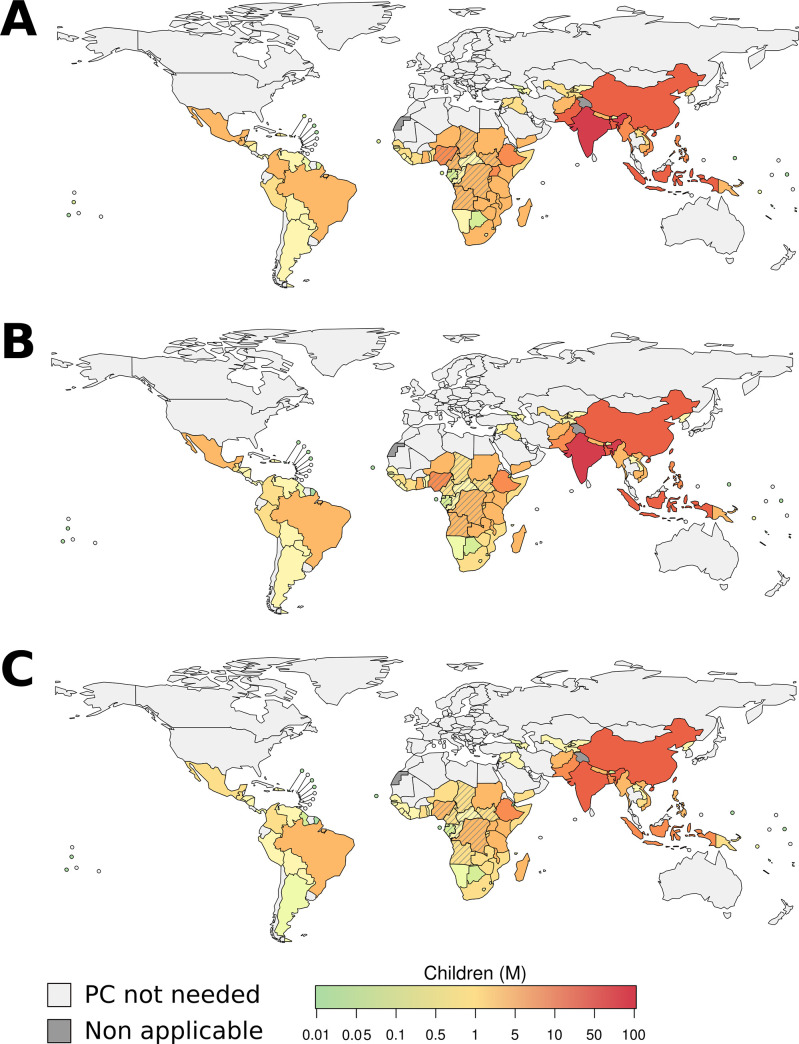
METHODODOLOGY/PRINCIPAL FINDINGS: Our study estimates the number of school- age children (SAC) (the main focus of STH deworming campaigns) in need of PC with ivermectin. The normal approximation of the binomial distribution was adopted to calculate the hypothetical prevalence distribution in each endemic country. Considering prevalence thresholds for PC equal to 10%, 15%, and 20%, we estimated the number of SAC in need of treatment. We adjusted the estimates accounting for ivermectin distributed in lymphatic filariasis and onchocerciasis elimination programs and excluded from our calculation areas where Loa loa is endemic. The global number of SAC that should be targeted in PC campaigns was estimated at 283.9 M (95% CI: 163.4-368.8), 207.2 M (95% CI: 160.9-380.7), and 160.7 M (95% CI: 86.6-225.7) when the threshold for intervention was set to 10%, 15%, and 20%, respectively. India, China, Indonesia, Bangladesh, and Nigeria accounted for about 50% of the global SAC would have to be covered by PC intervention.
CONCLUSIONS/SIGNIFICANCE: Our analysis may support endemic countries to evaluate the ivermectin quantity needed for integrating strongyloidiasis in the existing STH programs. These estimates might also show to generic drug manufacturers the size of the potential market for ivermectin and encourage its production.
粪类圆线虫是一种土壤传播的蠕虫,全球约有6亿人受其影响。针对粪类圆线虫的干预措施尚未实施。针对其他土壤传播蠕虫的现行预防性化疗(PC)项目中可纳入特定治疗药物(伊维菌素)。本研究旨在估算综合控制土壤传播蠕虫/粪类圆线虫项目所需的伊维菌素数量。
方法/主要发现:我们的研究估算了需要接受伊维菌素预防性化疗的学龄儿童(土壤传播蠕虫驱虫项目的主要对象)数量。采用二项分布的正态近似法计算每个流行国家的假设患病率分布。考虑到预防性化疗的患病率阈值分别为10%、15%和20%,我们估算了需要治疗的学龄儿童数量。我们对估算值进行了调整,以考虑在淋巴丝虫病和盘尾丝虫病消除项目中分发的伊维菌素,并在计算中排除了罗阿丝虫病流行地区。当干预阈值分别设定为10%、15%和20%时,全球预防性化疗项目应针对的学龄儿童数量估计为2.839亿(95%置信区间:1.634 - 3.688亿)、2.072亿(95%置信区间:1.609 - 3.807亿)和1.607亿(95%置信区间:8660万 - 2.257亿)。印度、中国、印度尼西亚、孟加拉国和尼日利亚占全球需要预防性化疗干预的学龄儿童的约50%。
结论/意义:我们的分析可能有助于流行国家评估在现有土壤传播蠕虫项目中纳入类圆线虫病所需的伊维菌素数量。这些估计值也可能向仿制药制造商表明伊维菌素的潜在市场规模,并鼓励其生产。