Gualandi Raffaella, Masella Cristina, Piredda Michela, Ercoli Matteo, Tartaglini Daniela
Campus Bio-Medico di Roma University, Rome, Italy.
Politecnico di Milano, Milan, Italy.
BMC Health Serv Res. 2021 Apr 15;21(1):347. doi: 10.1186/s12913-021-06341-3.
Patient-reported data-satisfaction, preferences, outcomes and experience-are increasingly studied to provide excellent patient-centred care. In particular, healthcare professionals need to understand whether and how patient experience data can more pertinently inform the design of service delivery from a patient-centred perspective when compared with other indicators. This study aims to explore whether timely patient-reported data could capture relevant issues to improve the hospital patient journey.
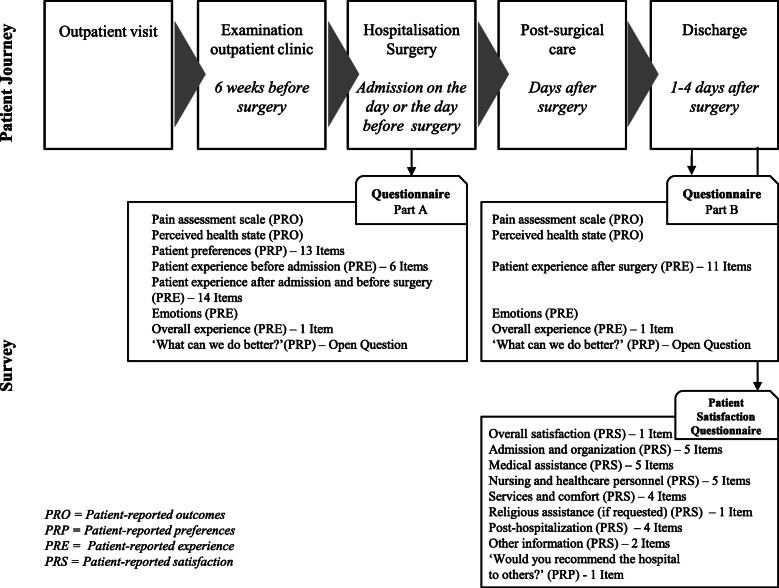
Between January and February 2019, a longitudinal survey was conducted in the orthopaedics department of a 250-bed Italian university hospital with patients admitted for surgery; the aim was to analyse the patient journey from the first outpatient visit to discharge. The same patients completed a paper-and-pencil questionnaire, which was created to collect timely preference, experience and main outcomes data, and the hospital patient satisfaction questionnaire. The first was completed at the time of admission to the hospital and at the end of hospitalisation, and the second questionnaire was completed at the end of hospitalisation.
A total of 254 patients completed the three questionnaires. The results show the specific value of patient-reported data. Greater or less negative satisfaction may not reveal pathology-related needs, but patient experience data can detect important areas of improvement along the hospital journey. As clinical conditions and the context of care change rapidly within a single hospital stay for surgery, collecting data at two different moments of the patient journey enables researchers to capture areas of potential improvement in the patient journey that are linked to the context, clinical conditions and emotions experienced by the patient.
By contributing to the literature on how patient-reported data could be collected and used in hospital quality improvement, this study opens the debate about the use of real-time focused data. Further studies should explore how to use patient-reported data effectively (including what the patient reports are working well) and how to improve hospital processes by profiling patients' needs and defining the appropriate methodologies to capture the experiences of vulnerable patients. These topics may offer new frontiers of research to achieve a patient-centred healthcare system.
患者报告的数据——满意度、偏好、结果和体验——正越来越多地被用于研究,以提供优质的以患者为中心的护理。特别是,医疗保健专业人员需要了解与其他指标相比,患者体验数据是否以及如何能从以患者为中心的角度更切实地为服务提供的设计提供信息。本研究旨在探讨及时的患者报告数据是否能捕捉到相关问题,以改善医院患者就医流程。
2019年1月至2月期间,在一家拥有250张床位的意大利大学医院的骨科对接受手术的患者进行了一项纵向调查;目的是分析从首次门诊就诊到出院的患者就医流程。相同的患者完成了一份纸质问卷,该问卷旨在收集及时的偏好、体验和主要结果数据,以及医院患者满意度问卷。第一份问卷在入院时和住院结束时完成,第二份问卷在住院结束时完成。
共有254名患者完成了这三份问卷。结果显示了患者报告数据的特定价值。较高或较低的负面满意度可能无法揭示与病理相关的需求,但患者体验数据可以检测出医院就医流程中重要的改进领域。由于在单次手术住院期间临床状况和护理环境变化迅速,在患者就医流程的两个不同时刻收集数据使研究人员能够捕捉到与患者所处环境、临床状况和所经历的情绪相关的患者就医流程中潜在的改进领域。
通过为关于如何收集患者报告数据并将其用于医院质量改进的文献做出贡献,本研究开启了关于使用实时重点数据的讨论。进一步的研究应探索如何有效利用患者报告数据(包括哪些患者报告效果良好),以及如何通过分析患者需求和确定捕捉弱势患者体验的适当方法来改进医院流程。这些主题可能为实现以患者为中心的医疗保健系统提供新的研究前沿。