Hu Cheng, Wang Tao, Zhuang Xiaoyu, Sun Qiaoli, Wang Xiaochun, Lin Hui, Feng Mingli, Zhang Jiaqi, Cao Qin, Jiang Yuanye
Experiment Center for Science and Technology, Shanghai University of Traditional Chinese Medicine, Shanghai, 201203, China.
Department of Gastroenterology, Putuo Hospital, Shanghai University of Traditional Chinese Medicine, 164 Lanxi Road, Shanghai, 200062, China.
J Transl Med. 2021 Apr 15;19(1):152. doi: 10.1186/s12967-021-02820-7.
Nonalcoholic fatty liver disease (NAFLD) is a common metabolic disease that affects 20-30% of individuals worldwide. Liver puncture remains the gold standard for the diagnosis of liver diseases despite limitations regarding invasive nature and sample variability. It is of great clinical significance to find noninvasive biomarkers to detect and predict NAFLD.
The aims of this study were to identify potential serum markers in individuals with early-stage NAFLD and to advance the mechanistic understanding of this disease using a high-throughput mass spectrometry-based untargeted metabolomics approach.
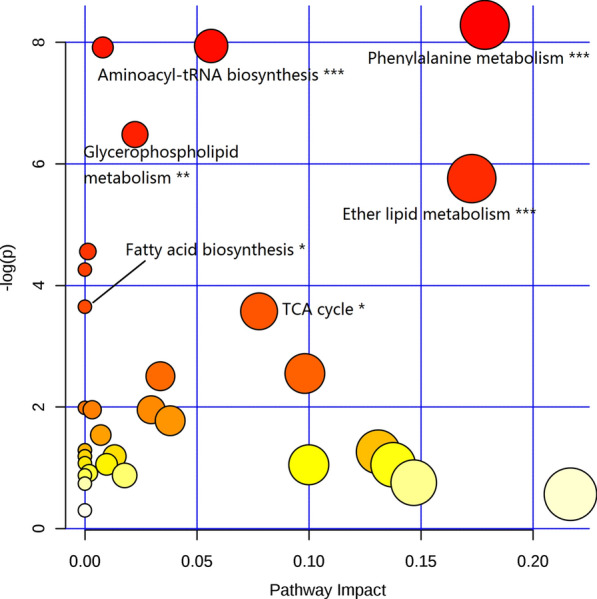
One hundred and twelve patients with early-stage NAFLD aged 18-55 were recruited according to the guidelines. The control group included 112 healthy participants. The demographic, anthropometric, clinical and laboratory data of all participants were systematically collected. Serum samples were obtained after an overnight fast. The comprehensive serum metabolomic analysis was performed by ultra-performance liquid chromatography-Orbitrap mass spectrometry. The resultant data was processed by Compound Discover and SIMCA-P software to validate the potential biomarkers. Significantly altered metabolites were evaluated by variable importance in projection value (VIP > 1) and ANOVA (p < 0.01). Pathway analysis was performed using MetaboAnalyst 4.0.
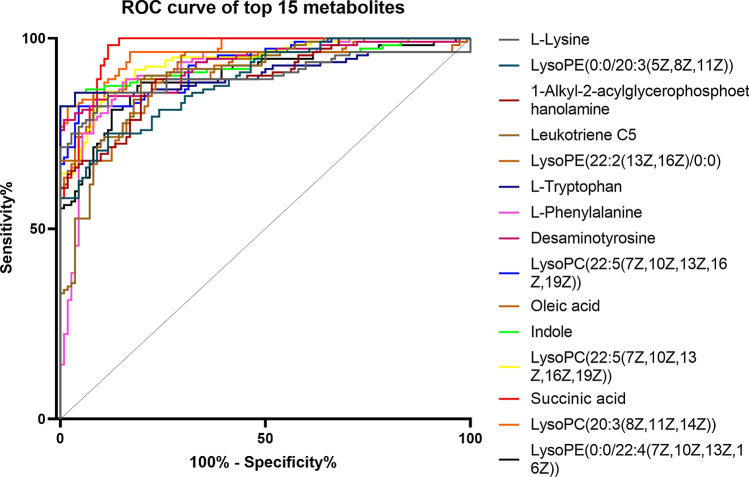
The liver function test of early NAFLD patients showed no statistical differences to control group (p > 0.05). However, obvious differences in blood lipids were observed between subjects with NAFLD and controls (p < 0.001). In total, 55 metabolites showed significant changes in experimental group were identified. The area under curve (AUC) values deduced by receiver operating curve (ROC) analysis indicated that these newly identified biomarkers have high predictability and reliability. Of these, 15 metabolites with AUC greater than 0.9 were of great diagnostic value in early NAFLD patients.
In this study, a total of 15 serum metabolites were found to strongly associate with early NAFLD. These biomarkers may have great clinical significance in the early diagnosis of NAFLD, as well as to follow response to therapeutic interventions.
非酒精性脂肪性肝病(NAFLD)是一种常见的代谢性疾病,全球20%-30%的人受其影响。尽管肝穿刺在侵入性和样本变异性方面存在局限性,但仍是肝病诊断的金标准。寻找非侵入性生物标志物来检测和预测NAFLD具有重要的临床意义。
本研究旨在通过基于高通量质谱的非靶向代谢组学方法,识别早期NAFLD患者潜在的血清标志物,并深入了解该疾病的发病机制。
根据指南招募了112例年龄在18-55岁的早期NAFLD患者。对照组包括112名健康参与者。系统收集所有参与者的人口统计学、人体测量学、临床和实验室数据。过夜禁食后采集血清样本。采用超高效液相色谱-轨道阱质谱进行全面的血清代谢组学分析。所得数据用Compound Discover和SIMCA-P软件处理,以验证潜在的生物标志物。通过投影变量重要性(VIP>1)和方差分析(p<0.01)评估显著改变的代谢物。使用MetaboAnalyst 4.0进行通路分析。
早期NAFLD患者的肝功能检查与对照组无统计学差异(p>0.05)。然而,NAFLD患者与对照组之间血脂存在明显差异(p<0.001)。总共鉴定出55种在实验组中显示出显著变化的代谢物。通过受试者工作曲线(ROC)分析得出的曲线下面积(AUC)值表明,这些新鉴定的生物标志物具有较高的预测性和可靠性。其中,15种AUC大于0.9的代谢物对早期NAFLD患者具有重要的诊断价值。
本研究共发现15种血清代谢物与早期NAFLD密切相关。这些生物标志物在NAFLD的早期诊断以及监测治疗干预反应方面可能具有重要的临床意义。