
髌股关节置换术与全膝关节置换术的围手术期资源利用及有效性:一项荟萃分析
The Perioperative Resource Use and Effectiveness of Patellofemoral Arthroplasty Versus Total Knee Arthroplasty: A Meta-Analysis.
作者信息
Wu Ziying, Wang Ning, Zhang Jian, Lu Cong, Rong Wenni, Ding Xiang, Lei Guanghua
机构信息
Department of Orthopaedics, Xiangya Hospital Central South University, Changsha, China.
Key Laboratory of Aging-Related Bone and Joint Diseases Prevention and Treatment, Ministry of Education, Central South University, Changsha, China.
出版信息
Orthop Surg. 2025 Jul;17(7):1965-1975. doi: 10.1111/os.70063. Epub 2025 May 15.
OBJECTIVE
Patellofemoral osteoarthritis (PFOA) is a common condition that significantly affects quality of life. With advancements in modern patellofemoral arthroplasty (PFA) prostheses, a growing number of surgeons are opting for PFA to treat isolated PFOA. This meta-analysis aimed to compare the perioperative resource use and therapeutic outcomes of PFA versus total knee arthroplasty (TKA) in patients with isolated PFOA.
METHODS
A literature search was conducted in PubMed, EMBASE, the Cochrane Library, and the Web of Science until November 2024. The included studies provided direct comparisons of perioperative resource use (surgical time, blood loss, and length of stay) and postoperative outcomes (patient-reported outcome measures [PROMs], quality of life, and patient satisfaction) between modern PFA and TKA in patients with isolated PFOA. The Cochrane risk of bias assessment tool was applied to randomized controlled trials, and the modified Newcastle-Ottawa Scale was used for observational studies to evaluate methodological quality and risk of bias. Data was extracted from eligible studies and combined to calculate the mean difference (MD) or pooled relative risk with a 95% confidence interval (CI).
RESULTS
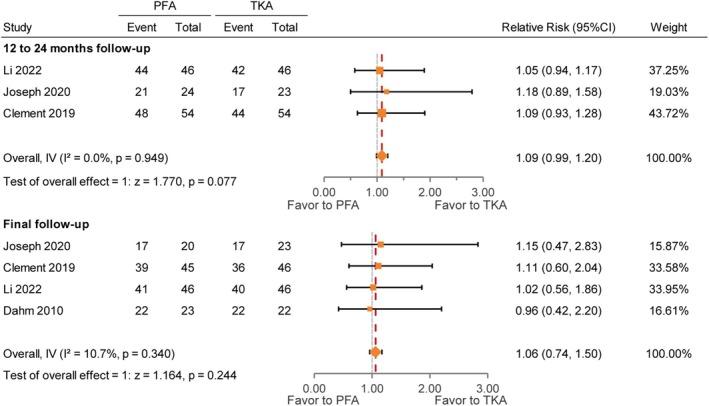
We included eight eligible studies with a mean follow-up duration of 2-10 years. Compared with TKA, modern PFA demonstrated significantly shorter surgical times (MD = -13.67 min; 95% CI: -20.47 to -6.86) and reduced perioperative blood loss. However, no significant difference was observed in hospital length of stay. Regarding PROMs, PFA showed superior functional outcomes on the Oxford Knee Score (OKS) within 2 years postoperatively (MD = -2.02; 95% CI: -3.77 to -0.26). No significant differences were found between PFA and TKA at 12-month follow-up for the Western Ontario and McMaster Universities Osteoarthritis Index (WOMAC) function score (MD = -5.68; 95% CI: -21.54 to 10.18) or total WOMAC score (MD = -6.65; 95% CI: -30.00 to 16.70). Similarly, at 24-month follow-up, no differences were observed in the University of California, Los Angeles activity score (MD = -0.02; 95% CI: -1.79 to 1.75) or final OKS (MD = -1.09; 95% CI: -6.31 to 4.14). Quality of life and patient satisfaction remained comparable between the two procedures throughout the first 2 years and final follow-up.
CONCLUSIONS
PFA demonstrates comparable efficacy to TKA in isolated PFOA, with superior early functional recovery within the first 2 years post-surgery, shorter surgical duration, and reduced blood loss. These findings suggest PFA may be a resource-efficient alternative for eligible patients.
目的
髌股关节炎(PFOA)是一种常见病症,会显著影响生活质量。随着现代髌股关节置换术(PFA)假体技术的进步,越来越多的外科医生选择采用PFA来治疗孤立性PFOA。本荟萃分析旨在比较孤立性PFOA患者接受PFA与全膝关节置换术(TKA)的围手术期资源使用情况和治疗效果。
方法
截至2024年11月,在PubMed、EMBASE、Cochrane图书馆和科学网进行了文献检索。纳入的研究提供了现代PFA与TKA在孤立性PFOA患者围手术期资源使用情况(手术时间、失血量和住院时间)和术后结果(患者报告结局指标[PROMs]、生活质量和患者满意度)方面的直接比较。Cochrane偏倚风险评估工具应用于随机对照试验,改良的纽卡斯尔-渥太华量表用于观察性研究,以评估方法学质量和偏倚风险。从符合条件的研究中提取数据并进行合并,计算平均差(MD)或合并相对风险及95%置信区间(CI)。
结果
我们纳入了八项符合条件的研究,平均随访时间为2至10年。与TKA相比,现代PFA的手术时间显著缩短(MD = -13.67分钟;95% CI:-20.47至-6.86),围手术期失血量减少。然而,住院时间未观察到显著差异。关于PROMs,PFA在术后2年内的牛津膝关节评分(OKS)上显示出更好的功能结果(MD = -2.02;95% CI:-3.77至-0.26)。在12个月随访时,PFA与TKA在西安大略和麦克马斯特大学骨关节炎指数(WOMAC)功能评分(MD = -5.68;95% CI:-21.54至10.18)或WOMAC总分(MD = -6.65;95% CI:-30.00至16.70)方面未发现显著差异。同样,在24个月随访时,加利福尼亚大学洛杉矶分校活动评分(MD = -0.02;95% CI:-1.79至1.75)或最终OKS(MD = -1.09;95% CI:-6.31至4.14)也未观察到差异。在术后前2年和最终随访期间,两种手术的生活质量和患者满意度仍然相当。
结论
在孤立性PFOA中,PFA与TKA疗效相当,术后前2年功能恢复更快,手术时间更短,失血量减少。这些发现表明,对于符合条件的患者,PFA可能是一种资源高效的替代方案。


 Zotero 插件