Nawaz Rasanat Fatima, Reen Gurpreet, Bloodworth Natasha, Maughan Daniel, Vincent Charles
Department of Experimental Psychology, University of Oxford, UK; Patient Safety Collaborative, Oxford Academic Health Science Network, UK; and Department of Psychiatry, University of Cambridge, UK.
Department of Experimental Psychology, University of Oxford, UK; and Oxford Healthcare Improvement Centre, Oxford Health NHS Foundation Trust, UK.
BJPsych Open. 2021 Apr 16;7(3):e80. doi: 10.1192/bjo.2021.41.
Incidents of self-harm are common on psychiatric wards. There are a wide variety of therapeutic, social and environmental interventions that have shown some promise in reducing self-harm in in-patient settings, but there is no consensus on the most appropriate means of reducing and managing self-harm during in-patient admissions.
To review interventions used to reduce self-harm and suicide attempts on adolescent and adult psychiatric in-patient wards.
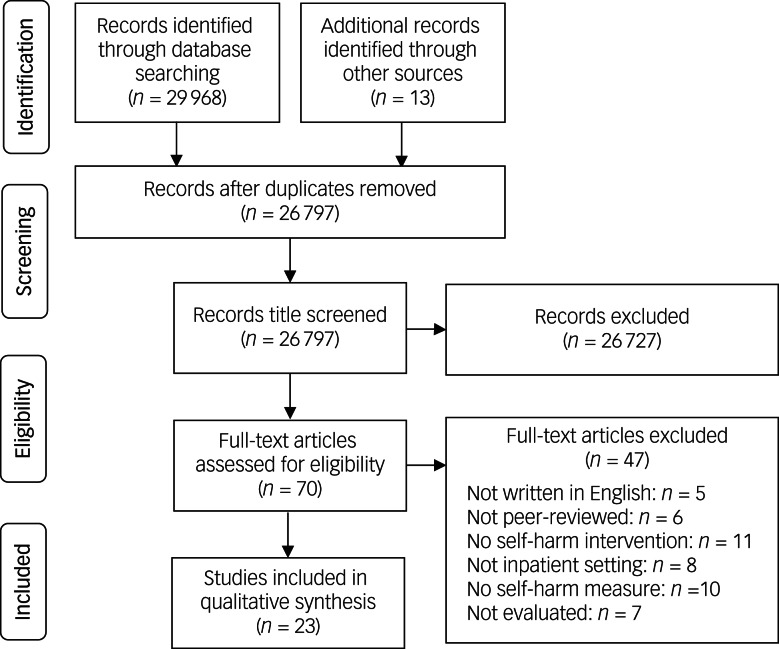
A systematic literature search was conducted between 14 March 2019 and 25 January 2021 using PsycINFO and Medline (PROSPERO ID: CRD42019129046). A total of 23 papers were identified for full review.
Interventions fell into two categories, therapeutic interventions given to individual patients and organisational interventions aimed at improving patient-staff communication and the overall ward milieu. Dialectical behaviour therapy was the most frequently implemented and effective therapeutic intervention, with seven of eight studies showing some benefit. Three of the six ward-based interventions reduced self-harm. Two studies that used a combined therapeutic and ward-based approach significantly reduced self-harm on the wards. The quality of the studies was highly variable, and some interventions were poorly described. There was no indication of harmful impact of any of the approaches reported in this review.
A number of approaches show some promise in reducing self-harm, but the evidence is not strong enough to recommend any particular approach. Current evidence remains weak overall but provides a foundation for a more robust programme of research aimed at providing a more substantial evidence base for this neglected problem on wards.
在精神科病房,自我伤害事件很常见。有各种各样的治疗、社会和环境干预措施在减少住院患者的自我伤害方面显示出了一定前景,但对于住院期间减少和管理自我伤害的最合适方法尚无共识。
回顾用于减少青少年和成人精神科住院病房自我伤害和自杀未遂的干预措施。
于2019年3月14日至2021年1月25日期间使用PsycINFO和Medline进行系统的文献检索(PROSPERO注册号:CRD42019129046)。共确定了23篇论文进行全面审查。
干预措施分为两类,即针对个体患者的治疗性干预措施和旨在改善医患沟通及整体病房环境的组织性干预措施。辩证行为疗法是最常实施且有效的治疗性干预措施,八项研究中有七项显示出一定益处。六项基于病房的干预措施中有三项减少了自我伤害。两项采用治疗与病房相结合方法的研究显著减少了病房内的自我伤害。研究质量差异很大,一些干预措施描述欠佳。本综述中报告的任何方法均未显示出有害影响。
一些方法在减少自我伤害方面显示出一定前景,但证据不足以推荐任何特定方法。目前总体证据仍然薄弱,但为更有力的研究计划奠定了基础,旨在为病房中这一被忽视的问题提供更坚实的证据基础。