Gonzales Mitzi M, Short Meghan I, Satizabal Claudia L, O' Bryant Sid, Tracy Russel P, Zare Habil, Seshadri Sudha
Glenn Biggs Institute for Alzheimer's & Neurodegenerative Diseases University of Texas Health Science Center San Antonio Texas USA.
Department of Neurology UT Health San Antonio San Antonio Texas USA.
Alzheimers Dement (N Y). 2021 Apr 9;7(1):e12164. doi: 10.1002/trc2.12164. eCollection 2021.
The study evaluated if blood markers reflecting diverse biological pathways differentiate clinical diagnostic groups among Hispanic and non-Hispanic White adults.
Within Hispanic (n = 1193) and non-Hispanic White (n = 650) participants, serum total tau (t-tau), neurofilament light (NfL), ubiquitin carboxyl-terminal hydrolase LI, glial fibrillary acidic protein (GFAP), soluble cluster of differentiation-14, and chitinase-3-like protein 1 (YKL-40) were quantified. Mixed-effects partial proportional odds ordinal logistic regression and linear mixed-effects models were used to evaluate the association of biomarkers with diagnostic group and cognition, adjusting for age, sex, ethnicity, apolipoprotein E ε4, education, and site.
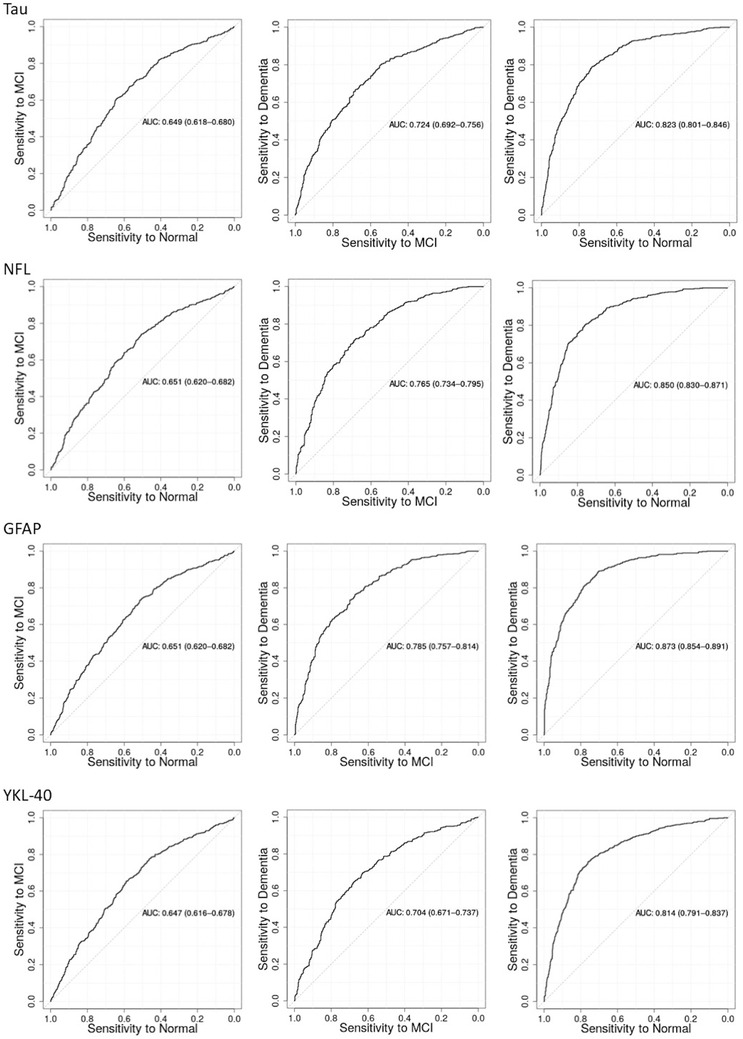
T-tau, NfL, GFAP, and YKL-40 discriminated between diagnostic groups (receiver operating curve: 0.647-0.873). Higher t-tau (odds ratio [OR] = 1.671, 95% confidence interval [CI] = 1.457-1.917, < .001), NfL (OR = 2.150, 95% CI = 1.819-2.542, < .001), GFAP (OR = 2.283, 95% CI = 1.915-2.722, < .001), and YKL-40 (OR = 1.288, 95% CI = 1.125-1.475, < .001) were associated with increased likelihood of dementia relative to cognitively unimpaired and mild cognitive impairment groups. Higher NfL was associated with poorer global cognition (β = -0.455, standard error [SE] = 0.083, < .001), semantic fluency (β = -0.410, SE = 0.133, = .002), attention/processing speed (β = 2.880, SE = 0.801, < .001), and executive function (β = 5.965, SE = 2.037, = .003). Higher GFAP was associated with poorer global cognition (β = -0.345, SE = 0.092, = .001), learning (β = -1.426, SE = 0.359, < .001), and memory (β = -0.890, SE = 0.266, < .001). Higher YKL-40 (β = -0.537, SE = 0.186, = .004) was associated with lower memory scores. Interactions with ethnicity were observed for learning (NfL, GFAP, YKL-40), memory (NfL, GFAP), and semantic fluency (NfL; interaction terms < .008), which were generally no longer significant in a demographically matched subset of Hispanic and non-Hispanic White participants.
Blood biomarkers of neuronal/axonal and glial injury differentiated between clinical diagnostic groups in a bi-ethnic cohort of Hispanic and non-Hispanic Whites. Our results add to the growing literature indicating that blood biomarkers may be viable tools for detecting neurodegenerative conditions and highlight the importance of validation in diverse cohorts.
本研究评估了反映不同生物途径的血液标志物是否能区分西班牙裔和非西班牙裔白人成年人的临床诊断组。
在西班牙裔(n = 1193)和非西班牙裔白人(n = 650)参与者中,对血清总tau蛋白(t-tau)、神经丝轻链(NfL)、泛素羧基末端水解酶LI、胶质纤维酸性蛋白(GFAP)、可溶性分化簇14和几丁质酶3样蛋白1(YKL-40)进行了定量分析。使用混合效应部分比例优势序贯逻辑回归和线性混合效应模型来评估生物标志物与诊断组及认知之间的关联,并对年龄、性别、种族、载脂蛋白E ε4、教育程度和研究地点进行了校正。
t-tau、NfL、GFAP和YKL-40能够区分不同诊断组(受试者工作特征曲线:曲线下面积为0.647 - 0.873)。与认知未受损和轻度认知障碍组相比,较高的t-tau(优势比[OR] = 1.671,95%置信区间[CI] = 1.457 - 1.917,P <.001)、NfL(OR = 2.150,95% CI = 1.819 - 2.542,P <.001)、GFAP(OR = 2.283,95% CI = 1.915 - 2.722,P <.001)和YKL-40(OR = 1.288,95% CI = 1.125 - 1.475,P <.001)与痴呆症发生可能性增加相关。较高的NfL与较差的整体认知(β = -0.455,标准误[SE] = 0.083,P <.001)、语义流畅性(β = -0.410,SE = 0.133,P =.00②)、注意力/处理速度(β = 2.880,SE = 0.801,P <.001)和执行功能(β = 5.965,SE = 2.037,P =.00③)相关。较高的GFAP与较差 的整体认知(β = -0.345,SE = 0.092,P =.00①)、学习能力(β = -1.426,SE = 0.359,P <.001)和记忆力(β = -0.890,SE = 0.266,P <.001)相关。较高的YKL-40(β = -0.537,SE = 0.18⑥,P =.00④)与较低的记忆得分相关。在学习能力(NfL、GFAP、YKL-40)、记忆力(NfL、GFAP)和语义流畅性(NfL;交互项P <.00⑧)方面观察到与种族的交互作用,在西班牙裔和非西班牙裔白人参与者的人口统计学匹配子集中,这些交互作用通常不再显著。
在西班牙裔和非西班牙裔白人的双种族队列中,神经元/轴突和胶质细胞损伤的血液生物标志物能够区分临床诊断组。我们的结果进一步丰富了现有文献,表明血液生物标志物可能是检测神经退行性疾病的可行工具,并强调了在不同队列中进行验证的重要性。