School of Health Sciences, Institute of Mental Health, University of Nottingham, Nottingham, United Kingdom.
NEON Lived Experience Advisory Panel, Nottingham, United Kingdom.
PLoS One. 2021 Apr 16;16(4):e0250367. doi: 10.1371/journal.pone.0250367. eCollection 2021.
Institutional injustice refers to structures that create disparities in resources, opportunities and representation. Marginalised people experience institutional injustice, inequalities and discrimination through intersecting personal characteristics and social circumstances. This study aimed to investigate sources of institutional injustice and their effects on marginalised people with experience of mental health problems.
Semi-structured interviews were conducted with 77 individuals from marginalised groups with experience of mental health problems, including psychosis, Black, Asian and minority ethnic (BAME) populations, complex needs and lived experience as a work requirement. These were analysed inductively enabling sensitising concepts to emerge.
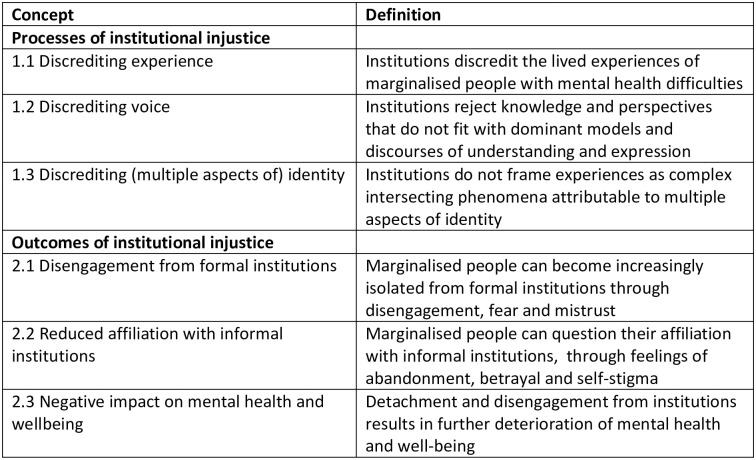
Three processes of institutional injustice were identified: not being believed because of social status and personal backgrounds; not being heard where narratives did not align with dominant discourses, and not being acknowledged where aspects of identity were disregarded. Harmful outcomes included disengagement from formal institutions through fear and mistrust, tensions and reduced affiliation with informal institutions when trying to consolidate new ways of being, and damaging impacts on mental health and wellbeing through multiple oppression.
Institutional injustice perpetuates health inequalities and marginalised status. Master status, arising from dominant discourses and heuristic bias, overshadow the narratives and experiences of marginalised people. Cultural competency has the potential to improve heuristic availability through social understandings of narrative and experience, whilst coproduction and narrative development through approaches such as communities of practice might offer meaningful avenues for authentic expression.
制度不公正指的是造成资源、机会和代表性差异的结构。边缘化人群通过个人特征和社会环境的交叉,经历制度不公正、不平等和歧视。本研究旨在调查制度不公正的来源及其对有心理健康问题经历的边缘化人群的影响。
对 77 名来自边缘化群体且有心理健康问题经历的个体(包括精神病、黑人和少数族裔人群、复杂需求和工作要求的生活经验)进行了半结构式访谈。采用归纳法进行分析,使敏感概念得以出现。
确定了三种制度不公正的过程:由于社会地位和个人背景而不被信任;叙述与主导话语不一致时不被倾听;身份的某些方面被忽视时不被承认。有害的结果包括由于恐惧和不信任而脱离正式机构;当试图建立新的生存方式时,与非正式机构之间的紧张关系和隶属关系减少;通过多种压迫对心理健康和幸福感产生破坏性影响。
制度不公正使健康不平等和边缘化地位永久化。主要地位源于主导话语和启发式偏见,掩盖了边缘化人群的叙述和经历。文化能力有可能通过对叙述和经验的社会理解来提高启发式的可用性,而通过实践社区等方法进行共同创作和叙述发展则可能为真实表达提供有意义的途径。