Research Group Mechanisms of Oncolytic Immunotherapy, Clinical Cooperation Unit Virotherapy, German Cancer Research Center (DKFZ), National Center for Tumor Diseases (NCT), University Hospital Heidelberg, Heidelberg, Germany.
Department of Medical Oncology, University Hospital Heidelberg, Heidelberg, Germany.
J Hematol Oncol. 2021 Apr 16;14(1):63. doi: 10.1186/s13045-021-01075-5.
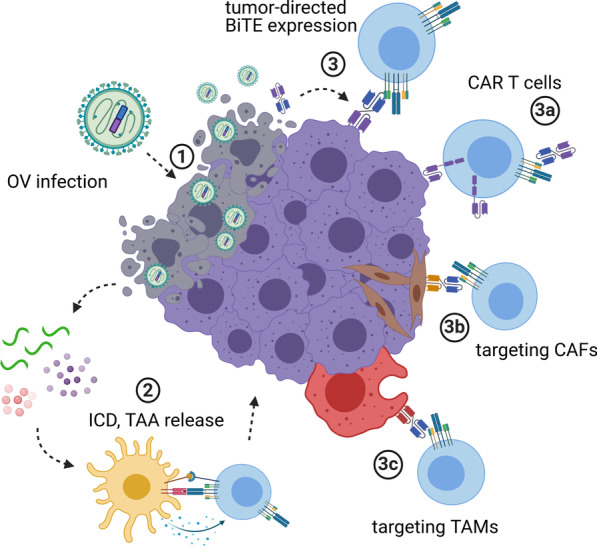
Bispecific T cell engagers (BiTEs) are an innovative class of immunotherapeutics that redirect T cells to tumor surface antigens. While efficacious against certain hematological malignancies, limited bioavailability and severe toxicities have so far hampered broader clinical application, especially against solid tumors. Another emerging cancer immunotherapy are oncolytic viruses (OVs) which selectively infect and replicate in malignant cells, thereby mediating tumor vaccination effects. These oncotropic viruses can serve as vectors for tumor-targeted immunomodulation and synergize with other immunotherapies. In this article, we discuss the use of OVs to overcome challenges in BiTE therapy. We review the current state of the field, covering published preclinical studies as well as ongoing clinical investigations. We systematically introduce OV-BiTE vector design and characteristics as well as evidence for immune-stimulating and anti-tumor effects. Moreover, we address additional combination regimens, including CAR T cells and immune checkpoint inhibitors, and further strategies to modulate the tumor microenvironment using OV-BiTEs. The inherent complexity of these novel therapeutics highlights the importance of translational research including correlative studies in early-phase clinical trials. More broadly, OV-BiTEs can serve as a blueprint for diverse OV-based cancer immunotherapies.
双特异性 T 细胞衔接器(BiTEs)是一类创新性的免疫疗法,可将 T 细胞重新定向到肿瘤表面抗原。虽然对某些血液恶性肿瘤有效,但有限的生物利用度和严重的毒性迄今为止阻碍了更广泛的临床应用,尤其是针对实体瘤。另一种新兴的癌症免疫疗法是溶瘤病毒(OVs),它选择性地感染和复制恶性细胞,从而介导肿瘤疫苗效应。这些致癌病毒可用作肿瘤靶向免疫调节的载体,并与其他免疫疗法协同作用。在本文中,我们讨论了使用 OVs 来克服 BiTE 治疗中的挑战。我们回顾了该领域的现状,涵盖了已发表的临床前研究和正在进行的临床研究。我们系统地介绍了 OV-BiTE 载体的设计和特性,以及免疫刺激和抗肿瘤作用的证据。此外,我们还讨论了其他联合治疗方案,包括 CAR T 细胞和免疫检查点抑制剂,以及使用 OV-BiTE 进一步调节肿瘤微环境的策略。这些新型治疗药物的固有复杂性突出了转化研究的重要性,包括早期临床试验中的相关研究。更广泛地说,OV-BiTEs 可以作为基于 OV 的多种癌症免疫疗法的蓝图。