Hahn-Goldberg Shoshana, Huynh Tai, Chaput Audrey, Krahn Murray, Rac Valeria, Tomlinson George, Matelski John, Abrams Howard, Bell Chaim, Madho Craig, Ferguson Christine, Turcotte Ann, Free Connie, Hogan Sheila, Nicholas Bonnie, Oldershaw Betty, Okrainec Karen
OpenLab, University Health Network, Toronto, Canada.
Caregiver Advisor, University Health Network, Toronto, Canada.
BMC Health Serv Res. 2021 Apr 17;21(1):361. doi: 10.1186/s12913-021-06374-8.
Traditional discharge processes lack a patient-centred focus. This project studied the implementation and effectiveness of an individualized discharge tool across Ontario hospitals. The Patient Oriented Discharge Summary (PODS) is an individualized discharge tool with guidelines that was co-designed with patients and families to enable a patient-centred process.
Twenty one acute-care and rehabilitation hospitals in Ontario, Canada engaged in a community of practice and worked over a period of 18 months to implement PODS. An effectiveness-implementation hybrid design using a triangulation approach was used with hospital-collected data, patient and provider surveys, and interviews of project teams. Key outcomes included: penetration and fidelity of the intervention, change in patient-centred processes, patient and provider satisfaction and experience, and healthcare utilization. Statistical methods included linear mixed effects models and generalized estimating equations.
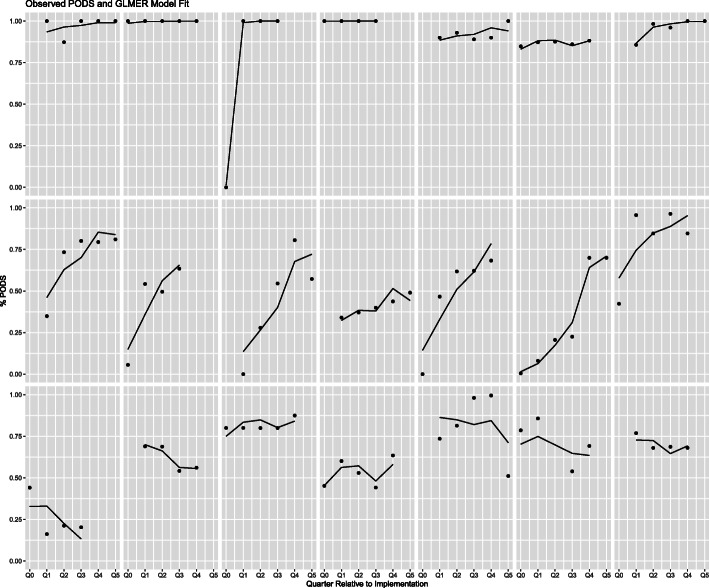
Of 65,221 discharges across hospitals, 41,884 patients (64%) received a PODS. There was variation in reach and implementation pattern between sites, though none of the between site covariates was significantly associated with implementation success. Both high participation in the community of practice and high fidelity were associated with higher penetration. PODS improved family involvement during discharge teaching (7% increase, p = 0.026), use of teach-back (11% increase, p < 0.001) and discussion of help needed (6% increase, p = 0.041). Although unscheduled healthcare utilization decreased with PODS implementation, it was not statistically significant.
This project highlighted the system-wide adaptability and ease of implementing PODS across multiple patient groups and hospital settings. PODS demonstrated an improvement in patient-centred discharge processes linked to quality standards and health outcomes. A community of practice and high quality content may be needed for successful implementation.
传统的出院流程缺乏以患者为中心的关注。本项目研究了一种个性化出院工具在安大略省各医院的实施情况及效果。以患者为导向的出院小结(PODS)是一种个性化出院工具,其指南是与患者及家属共同设计的,以实现以患者为中心的流程。
加拿大安大略省的21家急症护理和康复医院参与了一个实践社区,并在18个月的时间里致力于实施PODS。采用了一种有效性-实施混合设计,运用三角测量法,收集医院数据、患者和医护人员的调查结果以及对项目团队的访谈。主要结果包括:干预措施的渗透率和保真度、以患者为中心的流程变化、患者和医护人员的满意度及体验,以及医疗保健利用率。统计方法包括线性混合效应模型和广义估计方程。
在各医院的65221例出院病例中,41884名患者(64%)收到了PODS。各医院在覆盖范围和实施模式上存在差异,不过各医院之间的协变量均与实施成功无显著关联。实践社区的高参与度和高保真度都与更高的渗透率相关。PODS改善了出院指导期间家属的参与度(增加了7%,p = 0.026)、反馈教学的使用(增加了11%,p < 0.001)以及所需帮助的讨论(增加了6%,p = 0.041)。虽然随着PODS的实施,非计划医疗保健利用率有所下降,但差异无统计学意义。
本项目突出了PODS在全系统的适应性以及在多个患者群体和医院环境中实施的便利性。PODS显示出与质量标准和健康结果相关的以患者为中心的出院流程有所改善。成功实施可能需要一个实践社区和高质量的内容。