Neonatology and Neonatal Intensive Care Unit, Ecclesiastical General Hospital F. Miulli, Acquaviva delle Fonti, Italy.
Department of Woman and Child Health and Public Health, Child Health Area, Fondazione Policlinico Universitario A. Gemelli, IRCCS, Università Cattolica del Sacro Cuore, Rome, Italy.
Int Breastfeed J. 2021 Apr 17;16(1):36. doi: 10.1186/s13006-021-00382-4.
The COVID-19 pandemic has posed several challenges to the provision of newborn nutrition and care interventions including maternal support, breastfeeding and family participatory care. Italy was the first country to be exposed to SARS-CoV-2 in Europe. One of the measures adopted by the Italian government during COVID-19 pandemic was the total lockdown of the cities with complete confinement at home. We aimed to examine the impact of the lockdown caused by COVID-19 pandemic on exclusive breastfeeding in non-infected mothers.
We prospectively enrolled 204 mother-baby dyads during lockdown (9 March to 8 May 2020) that we compared to previously studied 306 mother-baby dyads admitted during the year 2018. To reduce the possible effect of confounding factors on exclusive breastfeeding, a 1:1 matching was performed by using an automatized procedure of stratification that paired 173 mother-baby dyads. Feeding modality was collected at discharge, 30 and 90 days of newborn's life. Exclusive breastfeeding was considered when the infant received only breast milk and no other liquids or solids were given with the exception of vitamins, minerals or medicines.
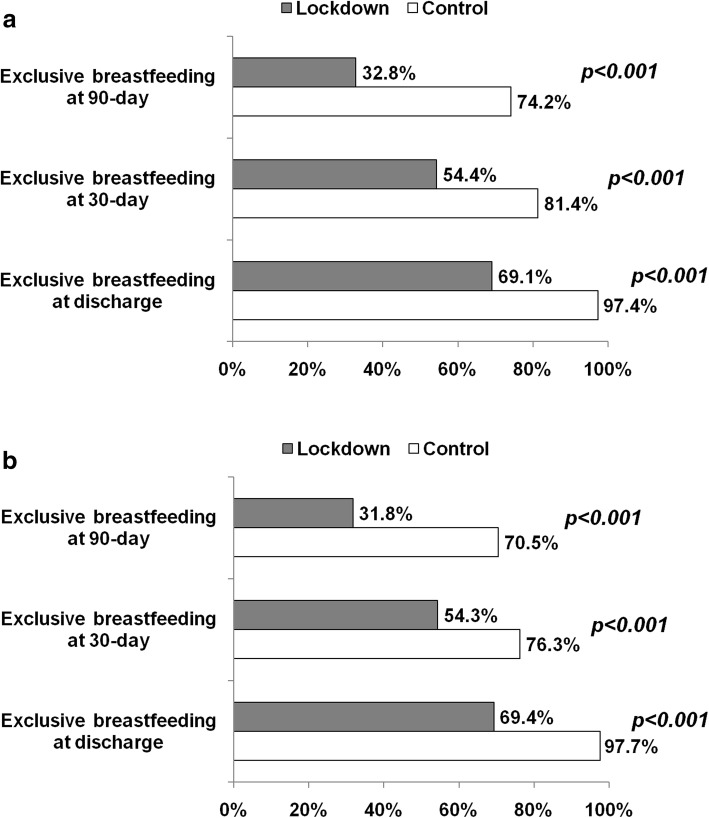
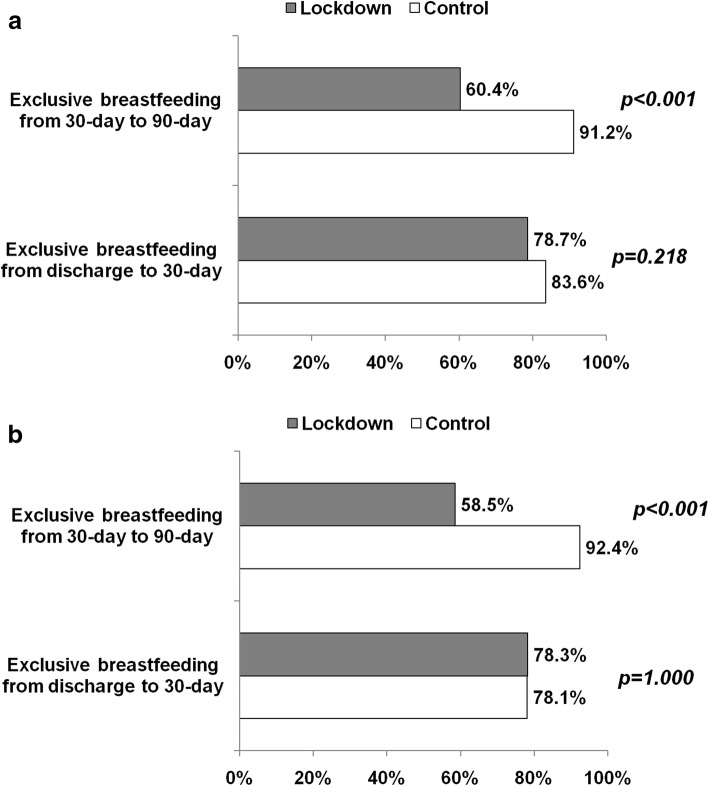
At discharge 69.4% of infants were exclusively breastfed during lockdown versus 97.7% of control group, 54.3% at 30 days vs 76.3 and 31.8% vs 70.5% at 90 days (p < 0.001). The proportion of breastfeeding remaining exclusive from discharge to 30-day was similar between groups (about 80%), but it was lower in lockdown group than in control cohort (58.5% vs 92.4%, p < 0.001) from 30- to 90-days.
Lockdown and home confinement led to a decrease of exclusively breastfeeding in the studied population. Considering the timing to shift from exclusive to non-exclusive breastfeeding, differences between study groups were concentrated during hospital stay and from 30- to 90 days of a newborn's life, confirming that the hospital stay period is crucial in continuing exclusive breastfeeding at least for the first 30 days, but no longer relevant at 90 days of life.
COVID-19 大流行给新生儿营养和护理干预措施的提供带来了诸多挑战,包括产妇支持、母乳喂养和家庭参与式护理。意大利是欧洲第一个遭遇 SARS-CoV-2 的国家。意大利政府在 COVID-19 大流行期间采取的措施之一是对城市实施全面封锁,居民完全居家隔离。我们旨在研究 COVID-19 大流行引起的封锁对未感染产妇的纯母乳喂养的影响。
我们前瞻性纳入了 204 例母婴二人组,纳入时间为封锁期间(2020 年 3 月 9 日至 5 月 8 日),并将其与之前在 2018 年研究的 306 例母婴二人组进行了比较。为了减少混杂因素对纯母乳喂养的可能影响,我们通过使用自动分层程序进行了 1:1 匹配,配对了 173 例母婴二人组。在新生儿出生后第 30 天和第 90 天收集喂养方式。纯母乳喂养是指婴儿仅接受母乳,除了维生素、矿物质或药物外,不给予其他液体或固体。
在出院时,69.4%的婴儿在封锁期间进行纯母乳喂养,而对照组为 97.7%,30 天时为 54.3%,90 天时为 76.3%和 31.8%,70.5%(p<0.001)。从出院到 30 天,两组之间保持纯母乳喂养的比例相似(约 80%),但封锁组从 30 天到 90 天的比例低于对照组(58.5%比 92.4%,p<0.001)。
封锁和居家隔离导致研究人群中的纯母乳喂养率下降。考虑到从纯母乳喂养向非纯母乳喂养转变的时间,研究组之间的差异主要集中在住院期间以及新生儿出生后 30-90 天,这证实了住院期间对于至少在前 30 天继续纯母乳喂养至关重要,但在 90 天以后则不再相关。