Department of Immunology, Faculty of Medicine, Tabriz University of Medical Sciences, Tabriz, Iran; Department of Immunology, School of Medicine, Zanjan University of Medical Sciences, Zanjan, Iran.
Department of Immunology, Health Faculty, Tehran University of Medical Sciences, Tehran, Iran.
Life Sci. 2021 Jul 15;277:119503. doi: 10.1016/j.lfs.2021.119503. Epub 2021 Apr 15.
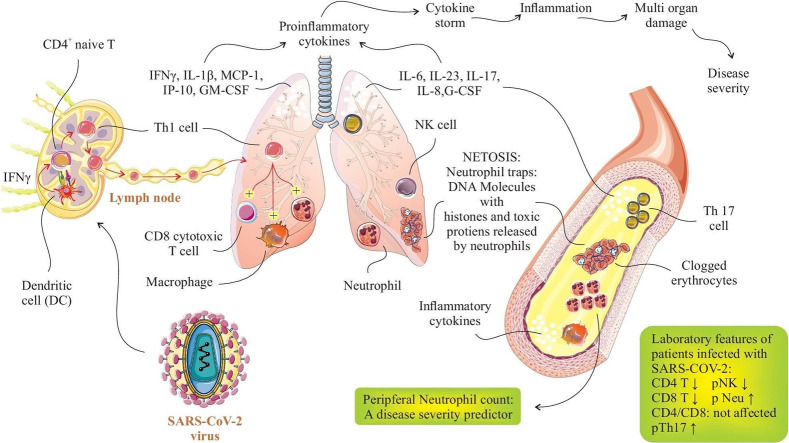
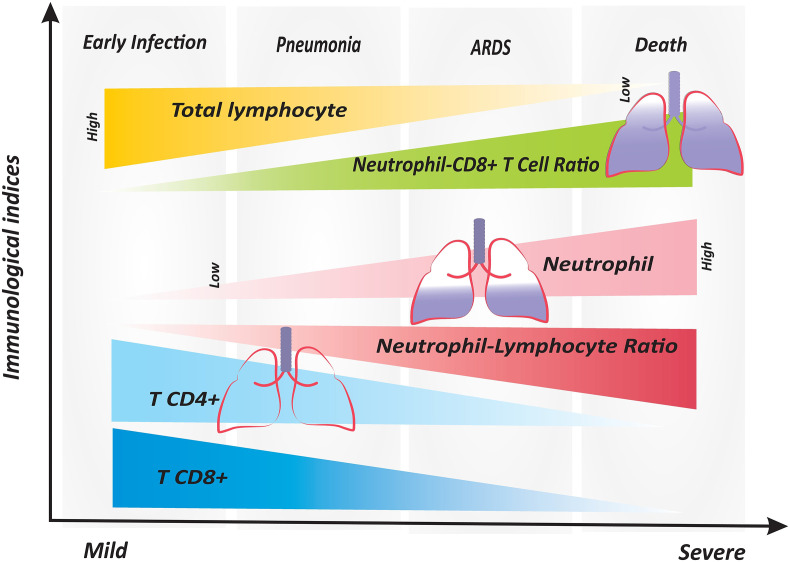
Severe coronavirus disease 2019 (COVID-19) caused by the Severe Acute Respiratory Syndrome coronavirus 2 (SARS-CoV-2) is characterized by an unpredictable disease course, with variable presentations of different organ systems. The clinical manifestations of COVID-19 are highly variable ranging from mild presentations to severe, life-threatening symptoms and the wide individual variability may be due to the broad heterogeneity in the underlying pathologies. There is no doubt that early management may have a major influence on the outcome. This led the scientists to search for ways to monitor disease progression or to predict outcomes in COVID-19. Although it is not yet possible to predict who will progress to the severe forms or in what time, numerous prospective and longitudinal studies represent the evidence for determining the potential immunological risk factors of COVID-19 critical disease and death. The kinetics and breadth of immune responses during COVID-19 appear to follow a trend which is consistent to the predominant pathological alterations. Recent publications have used these biomarkers to help identify patients who will develop the severe acute COVID-19. Of particular interest is the relationship between the kinetics of peripheral leukocytes and clinical progress of the disease in COVID-19. Although research is ongoing in this area, we present details about the current status of the evaluation. Understanding of the COVID-19 related alterations of the innate and adaptive immune responses may help to promote the vaccine development and immunological interventions.
严重急性呼吸综合征冠状病毒 2 (SARS-CoV-2)引起的严重 2019 冠状病毒病 (COVID-19)以不可预测的疾病过程为特征,不同的器官系统表现不同。COVID-19 的临床表现高度可变,从轻症到严重、危及生命的症状都有,而广泛的个体差异可能是由于潜在病理的广泛异质性。毫无疑问,早期管理可能对预后有重大影响。这促使科学家们寻找监测疾病进展或预测 COVID-19 结局的方法。尽管目前还不可能预测谁会发展成严重形式或在什么时间内发展成严重形式,但许多前瞻性和纵向研究为确定 COVID-19 重症疾病和死亡的潜在免疫危险因素提供了证据。COVID-19 期间免疫反应的动力学和广度似乎遵循一种趋势,与主要的病理改变一致。最近的出版物使用这些生物标志物来帮助识别将发展为严重急性 COVID-19 的患者。特别值得关注的是外周白细胞动力学与 COVID-19 疾病临床进展之间的关系。尽管该领域的研究正在进行中,但我们详细介绍了评估的现状。了解 COVID-19 相关的先天和适应性免疫反应的改变可能有助于促进疫苗开发和免疫干预。